El Monte
 Log in
Log in
Log in

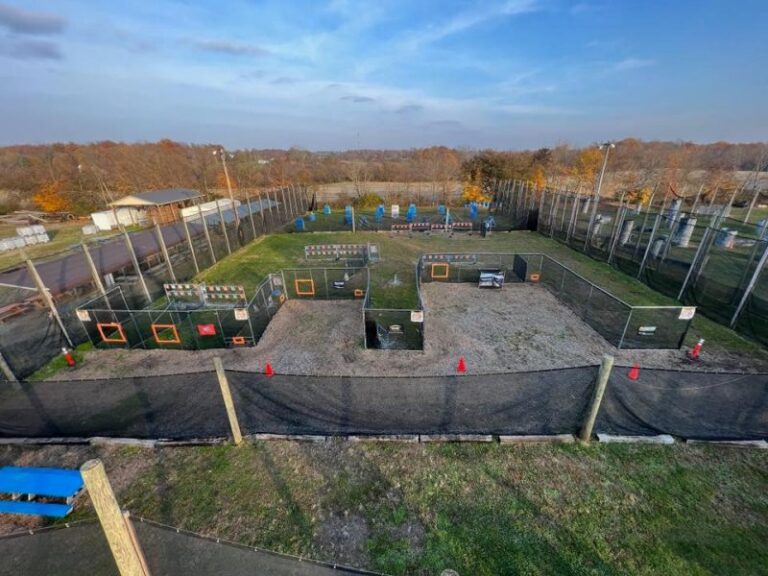
LVL UP Sports Paintball Park sits in Grove City, about 15 miles south of downtown Columbus and Ohio State University, spread across a 36-acre property on Harrisburg Pike.
The park offers ten distinct playing fields, from two-story castles and army trucks to six acres of woods and a tournament-style speedball course. Guests can join public games every Saturday and Sunday without a reservation, or book a private group seven days a week with a dedicated staff host. Traditional paintball, low-impact paintball for younger players, airsoft by reservation, and after-dark Glowball under a UV arena round out the options.
Private party packages cover birthdays, bachelor parties, church outings, and corporate team building, with flat rates that include rental gear, access to all maps, and paintballs. A large covered pavilion with picnic tables is free for parties, guests can bring their own food or have it delivered, and a fully stocked pro-shop carries gear and upgrades. The staff are consistently praised for their safety focus and welcoming approach to first-timers.
 Outdoors
SplatterPark sits in Mount Gilead, Ohio, in Morrow County roughly an hour north of downtown Columbus, on a 40+ acre rural site the brand has called home since 2000.
The park offers 13 themed outdoor paintball and airsoft battle zones, with fields built around cargo crates, a castle, a crashed plane, hillsides, creeks, and trees. Game modes include Capture the Flag, Elimination, Domination, King of the Hill, and survival scenarios, plus the legendary Big Game event. Open play runs on weekends with no reservations, and all skill levels are welcome with full equipment rentals, professional referees, and safety briefings included.
Private groups of ten or more can book the entire facility for birthdays, corporate team building, bachelor and bachelorette parties, church and youth groups, and family outings, with a dedicated referee, private shelter, and covered pavilion. A concession stand, discounts for groups, and the option to bring your own food round out the experience. Players aged ten and up are welcome, and the friendly staff keeps safety and fun at the center of every visit.
OutdoorsPaintball has evolved from a simple test of survival among friends into a global phenomenon that blends high-octane athletics, tactical precision, and team-based cooperation. Whether it is played in the dense brush of an outdoor forest or the high-speed, inflatable setups of an indoor arena, paintball offers a unique escape from the digital age. By examining the mechanics, rules, and benefits of this sport, one can better understand why millions of people suit up every year to engage in this colorful combat.
At its core, a paintball is a spherical capsule made of a thin, gelatinous shell—similar to a vitamin or bath oil bead—filled with a water-soluble, non-toxic, and biodegradable dye. Engineered to break upon impact, the projectile is fired from a marker (commonly referred to as a paintball gun) using compressed air or carbon dioxide.
These projectiles are designed with reliability and safety in mind. The fill inside is typically made from food-grade ingredients like polyethylene glycol, which ensures that it washes out of clothing easily and poses no environmental threat to the flora and fauna of outdoor playing fields. When a marker is fired, it accelerates the paintball to speeds ranging from 250 to 300 feet per second. Despite the velocity, the physics of the gelatin shell ensures that the energy is dissipated upon impact, making the sport manageable for participants provided they wear the correct protective equipment.
Safety is the absolute priority in paintball. Every regulation in the sport is designed to ensure that the experience remains fun rather than dangerous. The most universal rule is the mandatory use of ASTM-approved masks. These masks must remain on at all times while the participant is on the field, regardless of whether the game is currently in motion. Removing a mask during play is a severe infraction that typically results in immediate disqualification.
Beyond safety, the “honor system” forms the backbone of the game. A player is considered “out” if a paintball makes contact with them or their marker and leaves a mark of at least the size of a quarter. If a player is hit but the ball does not break, they may technically stay in the game; however, players are expected to be honest about their status. Once marked, the player must raise their marker, call out “I’m out,” and exit the playing area promptly until the next round begins. Field referees, often called judges or marshals, are present to enforce these rules and mediate disputes, ensuring a fair and sportsmanlike environment.
The versatility of paintball scenarios is one of the sport’s greatest draws. Unlike traditional sports that require a standardized court, paintball can be adapted to fit almost any narrative or terrain.
“Capture the Flag” remains the quintessential scenario, requiring teams to infiltrate the opponent’s territory, retrieve a flag, and return it to their base without being marked. For those seeking more complexity, “Mission-Based” games are popular. These often involve specific objectives like defending a structure (the “Fort” scenario), escorting a VIP to a designated extraction point, or “Search and Destroy,” where a small group must locate a hidden object while being hunted by a larger force. Many fields also offer “Scenario Games” that span an entire day, featuring hundreds of players organized into factions with specific command structures, turning the field into a grand tactical theater.
Paintball transcends the simple act of “tagging” opponents. It is an exceptional tool for physical conditioning, as a full game requires sprinting, crawling, and maneuvering in a way that provides a comprehensive full-body workout. Beyond the physical, it is a masterclass in psychological resilience. Players must learn to maintain focus under pressure, communicate effectively with teammates in high-stress environments, and think several steps ahead to outmaneuver their opponents.
Furthermore, paintball is widely utilized for team-building exercises. In a corporate or organizational setting, it forces groups to break down communication barriers. Hierarchies often dissolve on the field; a junior employee who possesses natural leadership skills or tactical intuition can effectively guide a team toward victory, helping to foster mutual respect and improved synergy back at the office.
The demographic of paintball is remarkably diverse. Historically, the sport leaned heavily toward younger males, but the modern era has seen a massive shift. Today, it is common to see fathers and daughters, professional athletes, retirees, and corporate executives competing on the same fields. Because the sport emphasizes tactical thinking and positioning over raw physical strength, individuals of varying fitness levels can participate successfully. There are also distinct competitive leagues, such as the NXL (National Xball League), which attract elite athletes who treat paintball with the same rigor and dedication as professional soccer or basketball players.
Industry experts frequently point to the evolution of the gear as the primary reason for the sport’s longevity. Innovations in pneumatic technology, high-speed loaders, and lightweight composite materials have made the equipment more reliable and ergonomic than the heavy, temperamental markers of the 1990s.
From a scientific and sociological perspective, experts categorize paintball as a “high-arousal activity.” Researchers have noted that the release of adrenaline and dopamine during a match creates a unique state of “flow”—a psychological state where a person is fully immersed in a feeling of energized focus. This makes paintball a highly effective stress reliever. Because the activity requires total concentration, it provides a much-needed mental break from the complexities of daily life, allowing participants to experience a form of “tactical meditation” where their entire awareness is concentrated on their immediate surroundings.
The playing experience changes significantly based on the environment. Outdoor fields are generally larger and utilize natural obstacles like trees, hills, and trenches, or constructed wooden bridges and bunkers. These venues provide an immersive “wilderness” experience and are ideal for long-distance marksmanship and stealth tactics.
Conversely, indoor fields—often referred to as “Speedball” or “Airball” arenas—are typically located in large warehouses or purpose-built facilities. These arenas feature a flat, artificial turf surface populated with inflatable synthetic bunkers arranged in symmetrical patterns. Indoor play is faster, more intense, and easier for spectators to watch, making it the preferred format for tournament-style competitive play. Regardless of whether one chooses the rugged realism of an outdoor forest or the fast-paced, high-visibility environment of an indoor arena, the core tenets of the sport remain the same: precision, teamwork, and the pursuit of the win. Both settings offer comprehensive rental packages, making it an accessible hobby for newcomers who do not yet own their own markers or safety gear.


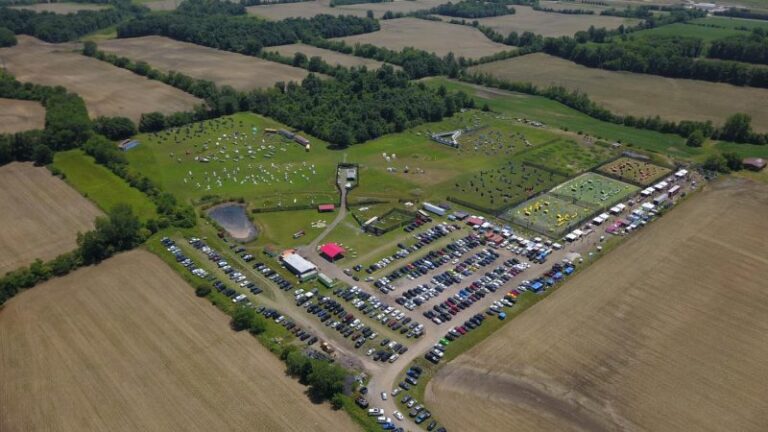
 5390 Harrisburg Pike, Grove City, OH 43123