
 El Monte
 Log in
Log in
Log in

Sandbox VR Dublin sits in the Bridge Park district of Dublin, Ohio, near the Dublin Link Bridge and across the street from the North Market food hall.
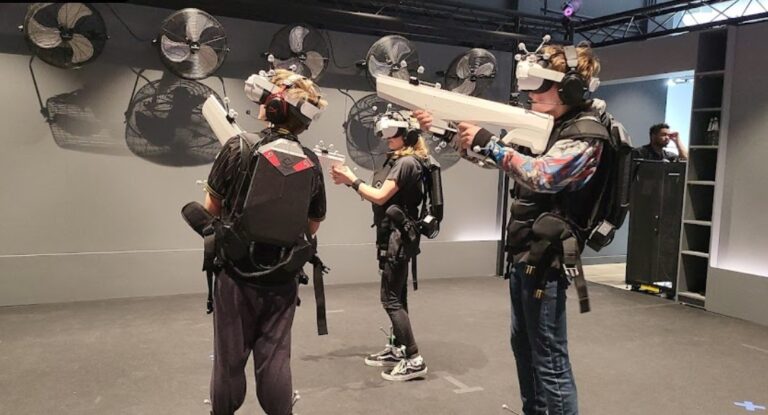
It’s a room-scale, full-body virtual reality venue where groups of friends, families, and coworkers step into immersive worlds like zombie survival, dinosaur safaris, Squid Game competitions, and Stranger Things adventures. Haptic vests, motion-capture tracking, and physical props make every session feel real, and no gaming experience is required. Sessions run roughly 30 to 45 minutes, with weekday, weekend, and matinee ticket options.
Beyond the games, the 6,400-square-foot venue hosts birthday parties, corporate events, and team-building outings through packages like the Gold Package, Ultimate Play Bundle, and the Age of Dinosaurs Birthday Adventure. Private celebration space, catering options, and a friendly, attentive staff round out the experience, making it a go-to spot for memorable group outings in Dublin.
 Indoors
Urban Air Trampoline and Adventure Park sits in Reynoldsburg, Ohio, on East Livingston Avenue, serving families from Reynoldsburg and nearby Pickerington, Groveport, Gahanna, Pataskala, and Canal Winchester. It’s a year-round indoor adventure park where one ticket covers all-day play across APEX trampolines, a Sky Rider zipline, Ropes Course, Warrior Course, climbing walls, Leap of Faith, Stairway to Heaven, dodgeball, Slam Dunk Zone, Battle Beam, and a Tubes playground for younger kids.
The park also runs birthday party packages in Ultimate and Deluxe tiers, a Small Squad option, and private rooms with hosts, plus an Adventure 4 All family bundle, monthly memberships, and a summer pass. Staff handle party setup and cleanup, and the cafe offers pizza, popcorn, cotton candy, coffee, and other add-ons for refueling between activities.
IndoorsFor decades, the concept of virtual reality was confined to the living room: a person strapped into a headset, tethered by cords, standing awkwardly in a small square of carpet while trying not to bump into the coffee table. The evolution of “Free-Roam VR” has shattered these limitations, turning the concept of gaming into a physical, architectural, and social experience. By stripping away the walls of the user’s room and replacing them with large, dedicated warehouse-style spaces, free-roam VR (often called “Location-Based VR”) has transformed fiction into a tangible reality.
A free-roam VR arena is an expansive, open-floor facility designed to allow multiple players to walk, run, and interact within a virtual environment without the restriction of trailing cables or physical obstacles. Unlike home-based systems, these arenas utilize cutting-edge technology—usually involving large-scale optical motion tracking, high-performance wearable PCs (often called “backpacks”), and precise spatial mapping—to sync the player’s physical movements with the virtual world perfectly.
When a player steps into a free-roam arena, the physical room is often fitted with haptic technology, fans, and sometimes even localized heating or cooling elements to enhance immersion. The defining characteristic of these arenas is “unlocked presence.” Because the player is untethered and navigating a space that mirrors the virtual layout, the brain’s vestibular system is less likely to experience the nausea often associated with stationary VR. It is the closest humanity has come to the “Holodeck” experience popularized by science fiction, where the environment is not something you watch, but a place you inhabit.
The strength of free-roam VR lies in the diversity of its scenarios. Because the physical floor is a blank canvas, the virtual software can transport players to any imaginable location.
One popular category is the “Tactical Shooter,” where players don mock weaponry and navigate military-style mazes, collaborating to secure objectives. These scenarios leverage the physical agility of the participants; players find themselves crouching behind virtual crates, leaning around corners that exist physically in the arena, and communicating via headsets with teammates who are standing mere feet away.
Another burgeoning category is the “Immersive Narrative Adventure.” These scenarios lean into storytelling and puzzles rather than combat. Imagine a group of friends exploring an ancient, cursed temple or a derelict spaceship. In these settings, the arena becomes a puzzle box. Players must work together to move physical props that correspond to virtual objects, bridging the gap between the tactile world and the digital one. Finally, there is the “Horror/Escape” genre. By stripping away the visual cues of the physical room and replacing them with terrifying, high-fidelity environments, these scenarios push the limits of psychological immersion, creating a visceral reaction that home entertainment simply cannot replicate.
The demographic for free-roam VR has widened significantly since its inception. While originally targeted at “hardcore” gamers and tech enthusiasts, these arenas have become a staple of general entertainment for all ages.
VR for kids has become a major draw. Children, who are often more naturally inclined to suspend disbelief, find these arenas particularly thrilling. Modern arenas are designed with safety in mind, using padded walls and strictly monitored sessions to ensure that even the most energetic young players remain safe. For children, free-roam VR is essentially a real-life video game. Instead of pressing buttons on a controller, they are using their entire bodies to climb, dodge, and explore. Educational versions of these scenarios are also gaining traction, allowing schools to take groups on “field trips” to the surface of Mars or inside the human circulatory system, turning passive learning into an active, memorable event.
The social nature of free-roam VR has made it a premier destination for milestone events. Moving beyond the traditional dinner-and-a-movie format, groups are increasingly looking for “shared experiences” that create lasting memories.
For a birthday party, free-roam VR provides an adrenaline-fueled centerpiece. It solves the perennial issue of trying to find an activity that interests people with varying levels of gaming experience. Because the mechanics are intuitive—you move by walking, you look by turning your head—even non-gamers can participate comfortably.
Graduation parties utilize these spaces as a final celebratory “adventure” before friends head off in different directions. The intensity of working together to win a game or escape a scenario builds a sense of camaraderie that is unique to the VR medium.
In the corporate sector, free-roam VR is being leveraged as a powerful team-building tool. Unlike traditional corporate retreats that rely on “trust falls” or seminars, VR forces teams to communicate under pressure. When a CEO and an intern are both tasked with protecting a virtual base from an incoming wave of enemies, the corporate hierarchy fades. The shared stress, excitement, and eventual triumph foster a horizontal rapport that is difficult to manufacture in an office environment.
The academic and industrial consensus on free-roam VR is overwhelmingly optimistic, albeit cautious regarding long-term implementation. Scientists studying human-computer interaction (HCI) view these arenas as the most effective method for studying “Presence”—the psychological state where an individual feels they are truly “in” a digital space. The feedback loop created by moving one’s own body to traverse a virtual mile is being studied for its potential in physical therapy, military training, and phobia treatment.
Industry experts describe free-roam VR as a pivotal step toward the “Spatial Internet.” They argue that as the cost of hardware decreases and the quality of high-fidelity sensors improves, these arenas will move from specialized entertainment hubs to essential local infrastructure. The primary challenge remains “scale.” Currently, these arenas require significant real estate and high-tier equipment maintenance. However, experts note that as wireless technology advances, the physical footprint required to generate a high-quality experience is shrinking.
Furthermore, psychologists have begun to explore the “Transfer of Learning” capabilities of these arenas. Because trainees are physically conditioned to respond to stimuli within the arena, the skills learned—whether they be emergency response protocols for first responders or de-escalation techniques for security personnel—are retained much more effectively than those learned through reading or flat-screen simulations.
In summary, free-roam VR is no longer a futuristic curiosity. It has matured into a robust, versatile, and highly engaging medium that bridges the gap between technology and human physicality. Whether it is a child exploring a digital forest for the first time or a corporate team learning to communicate under fire, the free-roam arena offers a glimpse into a future where the borders of our reality are limited only by the software we choose to run.


 6737 Longshore St #130, Dublin, OH 43017, United States
