
 El Monte
 Log in
Log in
Log in

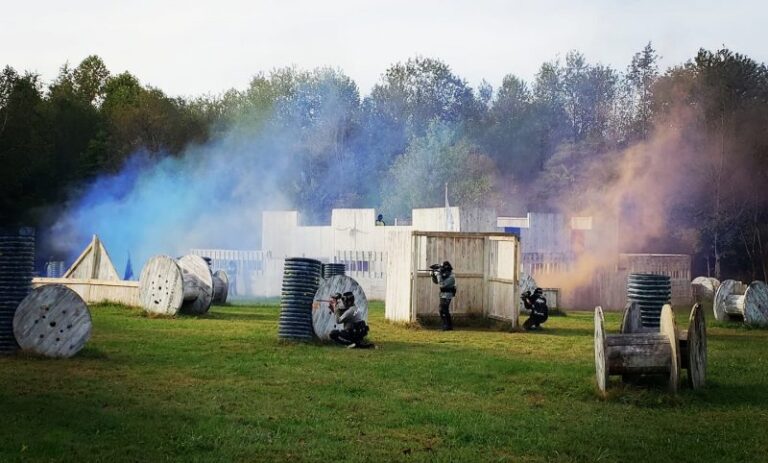
Paintball Barn is located in Attica, Indiana, about 20 miles northeast of Lafayette, on a 10-acre outdoor property with seven distinct battlefields.
The venue offers a wide range of paintball experiences, from speedball on the Airball Field to tactical play in a two-story castle, a fort, a farm machinery graveyard, and wooded terrain. Regular tournament series (3-Man and 5-Man), big games like Red vs. Blue and Battle of the Alamo, and monthly competitions keep the calendar full. Walk-on open play is available on weekends, and private group reservations can be made any day of the week with a dedicated referee.
Paintball Barn is well-suited for birthdays, bachelor parties, corporate team building, family reunions, and fundraisers. Group rates start at 10 players, and the entire facility can be bought out for private events. A pro shop sells gear, rental equipment is available, and annual memberships offer perks like free rentals and field fees. The staff is known for being friendly and welcoming, creating a community atmosphere that appeals to both first-timers and experienced players.
 Outdoors
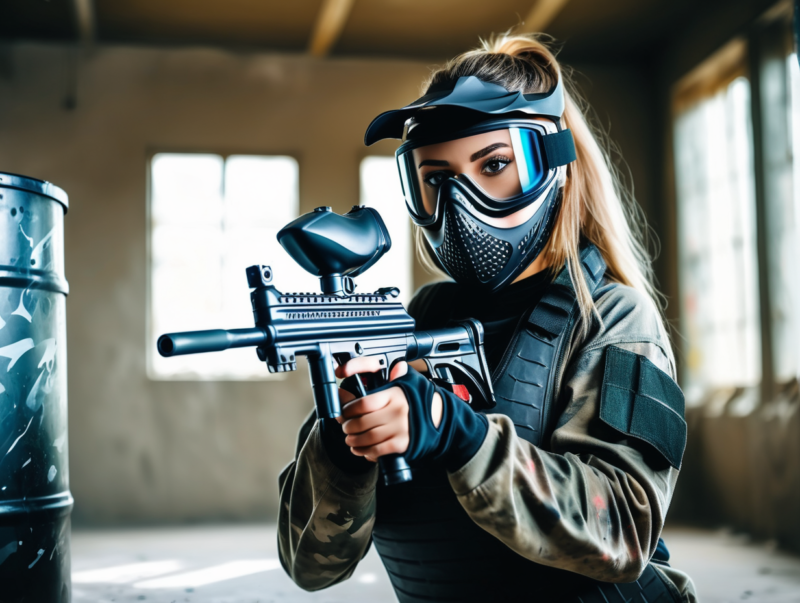
Paintball is a fast‑paced, team‑oriented sport in which participants fire small capsules—known as paintballs—filled with a non‑toxic, water‑based dye from a pneumatic or CO₂‑powered marker. The markers resemble conventional firearms but are deliberately designed to be safe and to fire at velocities typically limited to 280–300 feet per second. When a paintball strikes a player’s clothing or gear, it bursts, leaving a bright, easily visible mark that signals an elimination.
The game can be played in a wide variety of settings, from densely wooded forests to purpose‑built indoor arenas. While the core mechanics are simple—shoot, avoid getting hit, and eliminate opponents—the sport’s richness stems from its strategic depth, the diversity of playing fields, and the community that has grown around it over the past four decades.
Although specific venues may tweak regulations to suit local safety standards, the following rules form the foundation of most organized paintball matches:
Safety Gear Is Mandatory
Every participant must wear an ASTM‑approved face mask or goggles that protect the eyes and face. A full‑coverage chest protector, gloves, and long‑sleeved clothing are strongly recommended and often required in competitive play.
Marker Velocity Limits
Most fields enforce a maximum muzzle velocity of 280–300 fps (feet per second) for standard paintballs. Velocity is checked with a chronograph before play begins, and markers must be adjusted if they exceed the limit.
Elimination Protocol
A player is considered out when a paintball leaves a visible mark on their body, clothing, or equipment. Some “no‑hit” formats allow a player to continue after a hit if the marker does not leave a solid stain, but the majority of games follow the “hit‑and‑out” rule.
Boundary and Safety Zones
Playing areas are clearly marked with boundaries, and there are always designated safety zones—often called “safe zones” or “re‑load areas”—where a player may not be shot. Leaving the field of play without permission results in disqualification.
Sportsmanship and Conduct
Unsportsmanlike behavior, such as shouting at opponents, intentional cheating, or failing to respect the referee’s decisions, can lead to removal from the match. Sportsmanship is a cornerstone of the paintball culture.
Equipment Checks
Before each session, referees or field staff inspect markers, air tanks, and protective gear to ensure compliance with safety standards. Faulty or modified equipment is prohibited.
By adhering to these guidelines, players can enjoy a vigorous yet controlled environment that minimizes risk while preserving the competitive spirit of the game.
Paintball’s versatility allows for a multitude of scenarios that cater to varying skill levels and narrative preferences. Below are some of the most popular formats:
Two teams occupy opposite halves of the field, each defending a flag while attempting to capture the opponent’s. The first team to bring the enemy flag back to its own base wins. This scenario emphasizes teamwork, communication, and tactical movement.
All players compete simultaneously, and the objective is simple: be the last person standing. This format tests individual reflexes, shooting accuracy, and the ability to read opponents’ strategies in real time.
Scenario games go beyond basic objectives, immersing participants in elaborate storylines such as “zombie apocalypse,” “military rescue missions,” or “post‑apocalyptic wastelands.” Props, role‑playing elements, and multi‑stage missions transform the field into a living theater, often lasting several hours.
Played on a compact, symmetrical field with inflatable bunkers, speedball is the fastest form of competitive paintball. Matches are short, intense, and heavily focused on rapid decision‑making and precision shooting.
Many law‑enforcement and military units use paintball as a low‑cost alternative to live‑fire exercises. Scenarios replicate urban environments, hostage situations, or close‑quarter battle, offering realistic stress inoculation without lethal risk.
Each scenario offers a distinct blend of strategy, physical demand, and creative storytelling, ensuring that paintball can appeal to a broad spectrum of enthusiasts.
Beyond the obvious thrill of competition, paintball delivers a suite of benefits that extend into personal development, physical health, and even professional contexts.
Running, sprinting, crawling, and quick directional changes are inherent to most matches. This constant movement improves cardiovascular endurance, muscular strength, and agility. Because the intensity fluctuates—alternating between high‑energy bursts and brief pauses—paintball provides an effective interval workout.
Players must constantly assess terrain, opponent positioning, and ammunition levels. Decision‑making under pressure, spatial awareness, and rapid problem‑solving are exercised in real time, sharpening mental acuity and fostering better situational awareness.
Successful teams rely on clear, concise communication and coordinated tactics. Players learn to delegate roles, share information, and support one another—skills that translate directly into workplace collaboration and leadership.
The adrenaline rush and focus required in a match help participants release built‑up tension. The physical exertion combined with the “playful” nature of the sport creates a natural outlet for stress, often leaving players feeling refreshed and mentally reset after a session.
Because paintball pits competitors against each other in a controlled environment, it can serve as a metaphorical arena for conflict management training. Participants experiment with de‑escalation techniques and learn to handle competitive pressure without aggression spilling over into real‑world animosity.
Through these dimensions, paintball becomes more than a weekend pastime; it can be a vehicle for holistic growth.
Paintball’s demographic is remarkably diverse, reflecting its broad appeal across age groups, cultures, and professional backgrounds.
This wide participation spectrum demonstrates that paintball is not confined to a niche subculture but rather functions as a universally accessible sport.
The scientific community has taken a growing interest in paintball, particularly regarding its physiological effects, safety standards, and potential as a training platform.
Medical researchers have studied the incidence of paintball‑related injuries, finding that with proper protective equipment, serious injuries are rare. Data indicates that most injuries are superficial bruises or minor eye irritation, underscoring the effectiveness of current safety protocols.
Industrial engineers have examined marker design, focusing on reducing recoil, improving weight distribution, and enhancing trigger responsiveness. These ergonomic improvements not only increase player comfort but also contribute to better shooting accuracy.
Psychologists exploring high‑stress decision making have used paintball as a controlled laboratory for measuring cognitive load. Findings suggest that players develop improved multitasking abilities and heightened situational awareness after repeated exposure to dynamic paintball environments.
Experts in law‑enforcement training have highlighted paintball’s value for scenario‑based exercises. Because paintball allows for realistic movement, cover utilization, and engagement tactics without lethal consequences, it is considered a cost‑effective supplement to live‑fire drills.
Overall, the consensus among scientists and industry professionals is that paintball, when practiced responsibly, offers measurable benefits for physical health, cognitive development, and tactical training.
Paintball venues are broadly categorized into outdoor fields and indoor arenas, each offering distinct experiences.
Outdoor venues capitalize on natural terrain—forests, hills, streams, and abandoned structures—to create expansive, immersive battlefields. Players encounter varied elevation changes, dense foliage, and open clearings, demanding adaptive tactics. Many outdoor sites also host multi‑day scenario events, where participants camp on‑site and engage in evolving storylines over several hours or days.
Advantages of outdoor play include:
Indoor paintball arenas, often referred to as “speedball fields,” are engineered for fast, high‑intensity matches. Inflatable bunkers, modular obstacles, and perfectly symmetric layouts ensure fairness and repeatability. Because the environment is climate‑controlled, indoor venues can operate year‑round, regardless of weather conditions.
Key benefits of indoor play are:
When choosing a venue, players should consider the desired experience—whether they seek the rugged immersion of a forested battlefield or the rapid, competitive edge of a speedball arena. Many fields also offer rental equipment, coaching sessions, and themed events, making it simple for newcomers to dive in without extensive personal gear.
In sum, paintball stands as a dynamic sport that blends physical exertion, strategic thinking, and social interaction. Its well‑defined rules ensure safety, while a vast array of scenarios keeps gameplay fresh and engaging. From fitness enthusiasts and corporate teams to military professionals and casual families, paintball attracts a heterogeneous community eager for challenge and camaraderie. Backed by scientific validation and a thriving industry, the sport continues to evolve, offering both outdoor wilderness adventures and high‑octane indoor battles. Whether one seeks personal development, stress relief, or simply the joy of a well‑aimed shot, paintball delivers a compelling experience that resonates across generations.


 5800 N 820 E, Attica, IN 47918