
 El Monte
 Log in
Log in
Log in

Putters Wild Entertainment Indoor Center is located in Anchorage, AK
Putters Wild is a family-friendly entertainment center located in Anchorage, AK. It features a mini-golf course with 18 holes, an arcade room, batting cages, and go-karts. The mini-golf course is crafted with challenging obstacles that entertain players of all expertise levels. Inside the arcade room, there are various games, including pool, air hockey, and several arcade favorites. The batting cages come in different speed levels to accommodate novice to advanced players, and the go-kart track has winding turns and elevated straightaways. Putters Wild is a perfect destination for groups to have fun-filled quality time with family and friends.
 Indoors
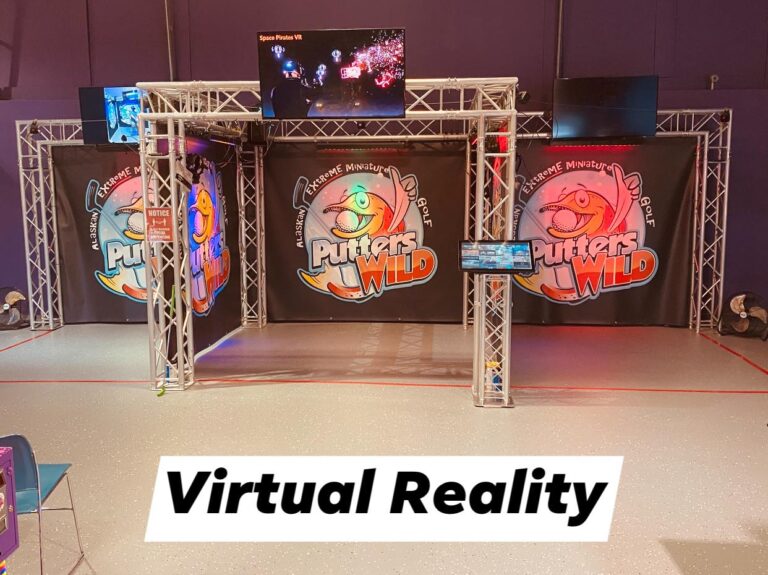
In recent years, virtual reality (VR) has evolved from a niche technology into a mainstream form of interactive entertainment. Among the most immersive and dynamic advancements in this space is the free-roam VR arena—a cutting-edge environment where users don specialized headsets and sensors to physically walk, crouch, jump, and interact in expansive digital worlds. Unlike traditional VR setups that require users to remain seated or within small tracked spaces, free-roam VR arenas open the door to full-body presence in virtual environments, transforming the way people experience games, team-building activities, and even social events.
in essence, a large, purpose-built physical space that serves as a canvas for virtual worlds. Equipped with high-precision motion tracking systems, sensors embedded in the floor and walls, and wireless VR headsets, these arenas allow participants to move freely within a designated area—often the size of a basketball court or larger—while their real-world movements are mirrored in real time within a computer-generated environment. This synchronization between physical and digital space eliminates the need for controllers or stationary platforms, enabling users to physically reach out to grab objects, duck behind cover in a battle, or collaboratively solve puzzles with teammates by walking around and communicating naturally.
—carefully designed interactive narratives or games that leverage the freedom of movement to create deeply engaging content. These scenarios vary widely in genre and complexity. A popular format is cooperative multiplayer missions, such as defending a virtual base from alien invaders or navigating a post-apocalyptic maze to recover a lost artifact. Others simulate intense action sequences, like escaping a collapsing skyscraper, defusing bombs in a high-stakes heist, or surviving a zombie outbreak in a darkened cityscape. Puzzle-based adventures also thrive in free-roam arenas, where teams must decipher cryptic symbols, manipulate virtual machinery, and work together to unlock exit doors—all while physically exploring the environment.
One of the defining features of free-roam VR scenarios is their collaborative nature. Because players must communicate, strategize, and move in sync—just as they would in real-world team activities—these experiences foster stronger interpersonal dynamics than traditional screen-based games. Whether it’s shouting commands during a firefight or coordinating synchronized actions to activate a portal, the physical coordination required deepens immersion and creates memorable moments. Additionally, many systems incorporate haptic feedback vests or wearable props, like simulated weapons or tools, to enhance sensory realism and further blur the line between the physical and virtual.
—far beyond the stereotypical image of tech-savvy gamers. Families, school groups, corporate teams, and social clubs are increasingly choosing free-roam VR as a destination for shared experiences. Children and teenagers, in particular, are drawn to the excitement and novelty of stepping into fantastical worlds. Many arenas offer age-appropriate scenarios specifically designed for younger players, featuring vibrant visuals, non-violent themes, and intuitive objectives. These kid-friendly experiences prioritize safety, with adjustable difficulty levels and real-time monitoring by trained staff who ensure that younger participants remain engaged without feeling overwhelmed.
Parents often appreciate VR arenas not only as entertainment but as a way to encourage physical activity and social interaction in an era dominated by screen time. Unlike passive gaming, free-roam VR requires actual movement—walking, turning, ducking—making it a surprisingly active experience. Kids develop spatial awareness, teamwork skills, and quick decision-making abilities while having fun. For many families, visiting a VR arena has become a go-to alternative to arcades or movie outings, offering an experience that is both technologically thrilling and socially enriching.
Adults, too, are discovering the appeal of free-roam VR beyond mere recreation. Corporate teams increasingly use these arenas for team-building exercises. In a world where remote work can erode personal connections, companies are turning to immersive VR challenges to foster collaboration, trust, and creative problem-solving in a high-energy environment. Tasks that require coordination under pressure—like synchronizing actions to disarm a virtual trap or navigating a maze with limited visibility—reveal leadership styles, communication habits, and group dynamics in ways that traditional workshops cannot. The shared adrenaline and laughter that follow a successful mission often translate into improved workplace morale and cohesion.
Birthdays, graduations, and milestone events are increasingly being hosted in these futuristic spaces. Imagine a teenager’s birthday party where guests don VR headsets and teleport into a digital jungle to battle robotic dinosaurs, or a graduation celebration where classmates cooperate to solve an ancient temple puzzle before time runs out. These events combine the excitement of cutting-edge gaming with the emotional resonance of shared achievement. Organizers often customize scenarios to include personal themes or inside jokes, making the experience both thrilling and meaningful.
Venue operators typically provide end-to-end support for such events, including expert facilitators who guide participants through safety instructions and gameplay mechanics. Group sizes can range from small parties of 4 to large gatherings of 20 or more, depending on the arena’s capacity. Booking packages often include access to multiple scenarios, private event spaces for food and drinks, and professional photography or recordings of the VR session—allowing participants to relive their most daring moments.
The technology behind these arenas continues to advance, with developers introducing AI-driven characters, dynamic environments that respond to player behavior, and even cross-location multiplayer capabilities that allow teams from different cities to compete or collaborate in the same virtual space. As hardware becomes lighter, more comfortable, and even more responsive, the barrier to entry continues to lower, inviting a broader audience to participate.
Still, accessibility and inclusivity remain key considerations. Venue operators are increasingly trained to accommodate participants with varying physical abilities, ensuring that the experiences can be enjoyed by as many people as possible. Features such as adjustable difficulty, seated or limited-mobility modes, and multilingual support help ensure that free-roam VR remains an inclusive form of modern entertainment.
Looking ahead, free-roam VR arenas are poised to become staples of experiential entertainment. As digital storytelling becomes more sophisticated and the technology more seamless, these spaces offer a glimpse into the future of interactive play—where imagination, technology, and human connection intersect. Whether it’s a child’s laughter echoing through a digital castle, a team celebrating a hard-won victory, or friends reuniting for a graduation adventure, the free-roam VR arena is more than just a game. It’s a new frontier of shared experience—one where the real and the virtual merge to create moments that linger long after the headset comes off.


 1230 E 68th Ave #109, Anchorage, AK 99518, United States