El Monte
 Log in
Log in
Log in

TracksVR Indoor Center is located in Calgary, AB.
TracksVR is a virtual reality arcade located in the heart of Calgary, Alberta. With a wide selection of immersive experiences, including popular games like Beat Saber, Superhot VR, and Arizona Sunshine, TracksVR offers an unparalleled VR gaming experience. Their state-of-the-art equipment and experienced staff ensure that each guest receives top-notch service and maximum enjoyment from their virtual adventures. Whether you’re a seasoned VR gamer or a first-timer, TracksVR is the perfect destination for an unforgettable VR experience.
 Indoors
Zero Latency OnTilt Calgary Indoor Center is located in Calgary, AB.
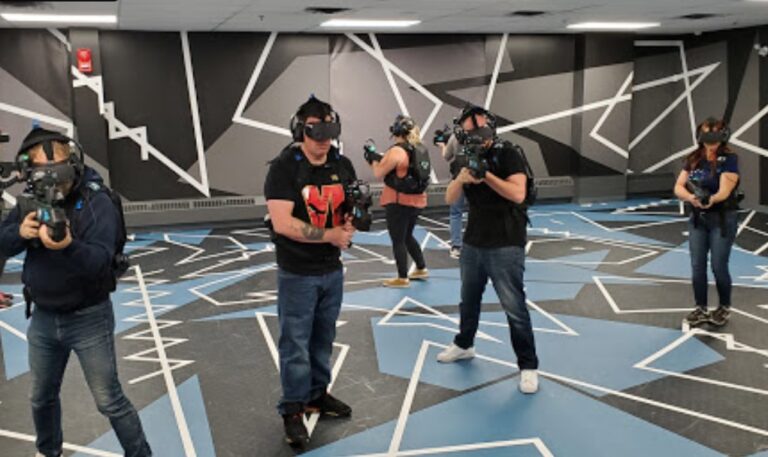
Zero Latency OnTilt Calgary offers a cutting-edge, free-roam virtual reality experience where you and your friends become the heroes in virtual worlds. Beyond the core VR arena, the venue features a spacious 1,500-square-foot arcade and lounge zone. Here you’ll find classic pinball machines, retro and modern arcade games, pool and shuffleboard tables, and a fully licensed lounge with snacks and beverages. Whether you’re taking a break after your mission or hanging out while others play, the lounge area adds a relaxed and social dimension to your visit.
Zero Latency OnTilt Calgary blends state-of-the-art free-roam virtual reality with a comfortable arcade and lounge social space, making it a versatile destination for fun, excitement and events. Whether you’re planning a birthday, corporate outing, friend get-together or celebration of achievement, this venue offers the technology, atmosphere and flexibility to make your occasion memorable.
IndoorsVRCORE – SW Calgary Indoor Center is located in Calgary, AB.
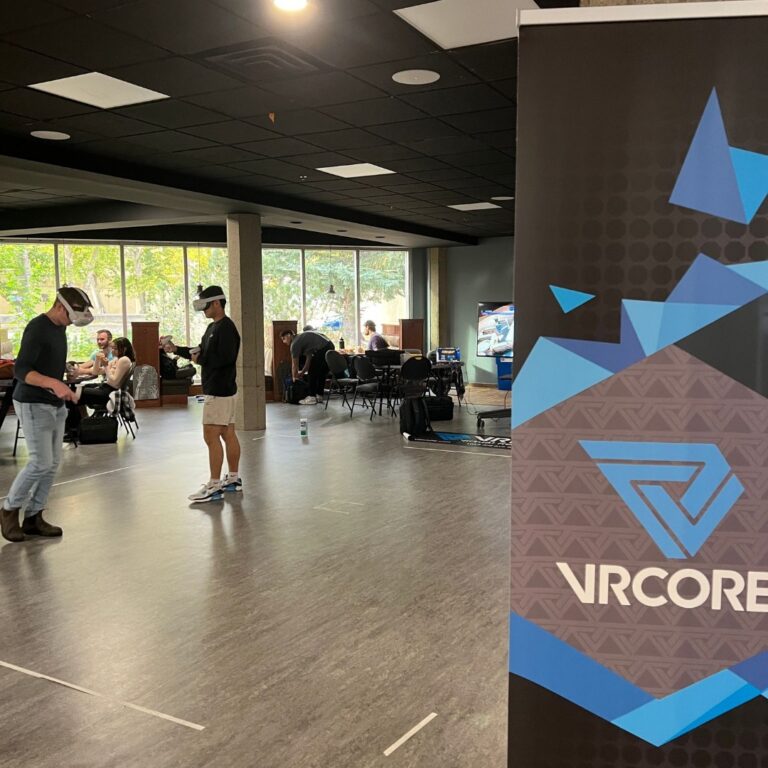
VRCORE is a virtual reality arcade located in Southwest Calgary, Alberta. Customers can experience immersive virtual reality games and activities at this location. It provides a unique and cutting-edge entertainment experience for individuals looking to enjoy the latest in virtual reality technology.
IndoorsVRCORE – NE Calgary Indoor Center is located in Calgary, AB.
VRCORE – an innovative development located in the thriving neighborhood of NE Calgary, AB – offers an immersive living experience that blends modern design, cutting-edge technology, and nature’s beauty. With its state-of-the-art virtual reality showroom, VRCORE allows future residents to virtually tour their preferred unit before making a purchase decision. This unique feature provides a realistic and interactive experience that sets it apart from traditional condo developments. The project’s prime location near major transportation hubs, shopping centers, schools, and parks adds further value to its already impressive offerings. VRCORE is a must-see for anyone seeking a luxurious and technologically advanced living space in Calgary’s northeast region.
Indoors
A free‑roam virtual‑reality arena is a purpose‑built physical space that lets participants move unhindered while wearing a head‑mounted display (HMD). Unlike seated or room‑scale setups that confine users to a few square metres, free‑roam arenas often span dozens of meters, sometimes an entire warehouse or a repurposed gymnasium. The environment is tracked by a network of infrared cameras, lidar sensors, or a combination of ultra‑wide‑angle optical systems that constantly locate each headset and its controllers with sub‑centimetre precision.
The key characteristic that distinguishes free‑roam from other VR formats is kinesthetic freedom. Users can walk, jog, crouch, climb, or even perform full‑body gestures without fear of colliding with furniture or walls that exist only in the virtual world. The arena’s floor is typically covered with a low‑friction, shock‑absorbing material to reduce fatigue and protect against accidental falls. Safety barriers, soft padding on walls, and real‑time proximity alerts are standard, creating a space where immersive experiences feel as natural as moving through a real room.
Because the hardware is anchored to a physical space, developers can design experiences that leverage the real‑world dimensions: sprawling battlefields, intricate mazes, or multi‑level structures that would be impossible to simulate convincingly in a confined area. The result is a level of presence that pushes the boundary between the digital and the tangible, turning gaming, training, and social interaction into physically embodied activities.
The flexibility of a free‑roam arena opens the door to a wide spectrum of scenarios, each exploiting the ability to move freely.
Adventure and Exploration – Players can trek through a recreated ancient ruin, wander an alien planet, or sail a virtual sea while actually stepping across a large, safe floor. The sense of scale is amplified when the horizon in the headset matches the physical distance covered by the user’s legs.
Competitive Sports and E‑Sports – From futuristic dodgeball to fully fledged laser‑tag battles, the arena translates rapid physical movement into in‑game actions. The lack of tethering allows participants to sprint, dive, and perform acrobatic maneuvers, creating a kinetic e‑sports genre that blends athletics with digital scoring.
Co‑Operative Puzzle Rooms – Teams must collaborate to solve spatial riddles that require coordinated movement. Imagine a scenario where a group must lift a virtual platform by physically standing on pressure plates spread across the arena, demanding precise teamwork.
Educational Simulations – Students can walk through a scaled‑down model of the solar system, explore a 3‑D reconstruction of a historical battlefield, or practice hazardous procedures (e.g., chemical spills) in a controlled environment that feels authentic.
Narrative Storytelling – Immersive theater productions place participants directly into the plot. Audiences can walk alongside protagonists, interact with virtual characters, and influence story outcomes through physical actions.
Each scenario capitalises on the core advantage of free‑roam: the ability to map real‑world locomotion onto virtual motion without latency or distortion, delivering an experience where the body and the digital avatar share the same space.
Free‑roam VR is not limited to adult enthusiasts; it has become a popular destination for younger audiences as well. Children are naturally drawn to experiences that let them run, jump, and explore—behaviours that traditional seated VR discourages. Consequently, many arenas design kid‑friendly modules that balance excitement with safety.
Developers craft content with adjustable difficulty levels, bright visual palettes, and age‑suitable themes such as jungle safaris, friendly robot factories, or whimsical fairy‑tale realms. Motion sensitivity is taken into account; experiences are often shorter and include built‑in rest zones to prevent fatigue or motion sickness.
For younger participants, arenas enforce stricter supervision ratios, provide soft‑edge padding, and equip headsets with adjustable straps and lighter lenses. Some centres employ guardian‑watch systems where a parent or trainer can view the child’s location on a live map and intervene if needed.
Beyond pure entertainment, free‑roam VR can reinforce STEM concepts. A “Space Mission” scenario might teach basic orbital mechanics while children physically navigate a spacecraft’s controls. The embodied learning model—where children act out concepts rather than passively observe—has been shown to improve retention and spark curiosity.
Overall, the combination of physical freedom, engaging narratives, and safety protocols makes free‑roam VR a compelling playground for kids, providing an experience that mirrors the unbounded play of the real world while adding a layer of digital wonder.
The versatility of free‑roam arenas has turned them into sought‑after venues for a wide range of celebrations. Organisers value the ability to customise the experience to fit the theme of the event, while participants enjoy an activity that feels novel and inclusive.
For birthdays, arenas often offer themed packages—pirate treasure hunts, superhero training camps, or sci‑fi escape rooms. These packages typically include a host who guides the group through the storyline, ensures safety, and adjusts difficulty on the fly. Because participants can move freely, the party becomes a kinetic adventure rather than a passive gathering, keeping children and teens engaged throughout the event.
Graduates looking for a memorable send‑off can opt for a “Future‑World” experience, where each attendee walks through a series of immersive vignettes representing possible career paths or life milestones. The arena can be configured to accommodate large groups, allowing simultaneous participation in shared challenges that encourage camaraderie and collective achievement.
Companies increasingly book free‑roam VR for employee celebrations, product launches, or team‑building days. The technology supports custom branding—virtual environments can be infused with corporate colours, logos, or product prototypes. Team‑oriented scenarios, such as collaborative construction challenges or competitive strategy games, foster communication, problem‑solving, and trust. Moreover, the physical activity element promotes wellness and breaks the monotony of typical office gatherings.
Across all these use cases, the common thread is the immersive social experience. By placing participants side‑by‑side in a shared physical space, free‑roam VR amplifies the sense of togetherness, making celebrations feel more vibrant and memorable than conventional party formats.
Academic researchers and industry leaders have been closely monitoring the evolution of free‑roam VR, recognising its potential to reshape interaction paradigms across multiple sectors.
Neuroscientists note that the congruence between proprioceptive feedback (the body’s sense of position) and visual cues in free‑roam setups reduces the sensory conflict that often causes motion sickness in seated VR. Studies show that participants experience higher levels of presence and lower physiological stress markers when their physical movements are accurately mirrored in the virtual world.
HCI experts highlight free‑roam as a breakthrough in embodied interaction. The technology allows for natural gestures, full‑body navigation, and even haptic feedback through floor vibration or wearable exoskeletons. This expands the design space for user interfaces, moving beyond hand‑controller paradigms to encompass whole‑body input, which can be particularly beneficial for accessibility applications.
Industry analysts in aerospace, defense, and emergency response cite free‑roam VR as a cost‑effective alternative to physical mock‑ups. The ability to rehearse complex procedures—such as aircraft maintenance, fire‑fighting tactics, or surgical operations—in a space where trainees can walk around equipment improves muscle memory and situational awareness. The technology also enables rapid scenario iteration, allowing trainers to modify variables on the fly.
From a business perspective, market analysts forecast that the free‑roam segment will experience double‑digit growth over the next five years. The drivers include falling hardware costs, advances in markerless tracking, and rising consumer appetite for experiential entertainment. Companies that invest in modular arena designs, scalable software platforms, and cross‑industry partnerships are positioned to capture a larger share of the emerging market.
Overall, the consensus among scientists and experts is that free‑roam VR represents a convergence of physicality and digital immersion that can elevate user experience, improve learning outcomes, and generate new economic opportunities.
Free‑roam virtual‑reality arenas have transcended the notion of “video game” to become immersive ecosystems where the body and the digital world move as one. By offering unfettered physical movement, these spaces enable a spectrum of scenarios—from adventurous gameplay and collaborative puzzles to educational simulations and unforgettable celebrations. Children benefit from safe, engaging, and educational experiences, while adults find novel avenues for social bonding, corporate events, and professional training.
Scientific research underscores the physiological and cognitive advantages of aligning real‑world motion with virtual perception, while industry analysts anticipate robust market growth fueled by technological advances and expanding use cases. As hardware becomes lighter, tracking more precise, and software more adaptable, free‑roam VR will likely continue to blur the line between reality and imagination, inviting anyone willing to step inside to explore worlds that were once confined to the realm of dreams.


 625 Manitou Rd SE, Calgary, AB T2G 4C2, Canada