Log in
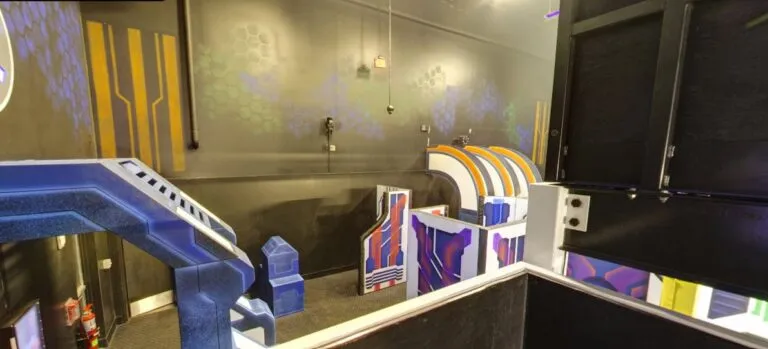
Main Event Indoor Laser Tag arena is located in Knoxville, TN.
Main Event is a huge entertainment hub where you can spend your weekend or throw a birthday party. These laser-tag battles take place in a multi-story arena with fantasy-like decorations, neon lights, and laborious obstacles. Climb up the towers and rain fire on unsuspecting enemies.
There is also a large recreation area with snacks and drinks to chill after the game. There’s also bowling, pool, VR, mini-golf, a story room, and a ropes course – all available at one single place!
IndoorsSpace Race Adventures is located in Pigeon Forge, TN.
Space Race Adventures: An Interstellar Entertainment Destination in Pigeon Forge, TN
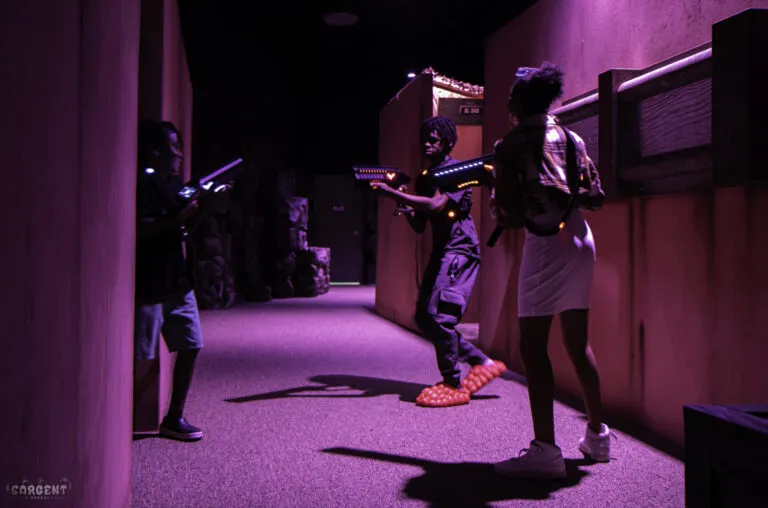
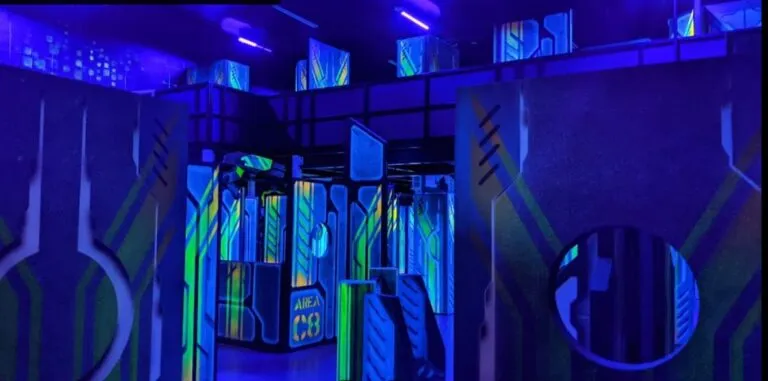
Space Race Adventures in Pigeon Forge, TN, offers an out-of-this-world experience, promising galactic fun and thrilling adventures for all. It stands as a premier destination for space-themed entertainment, inviting guests to embark on an interstellar journey filled with excitement. Prepare to blast off into a universe of adventure as they explore the thrilling attractions available. These include space-themed mini golf, laser tag battles, futuristic go-kart racing, and much more, ensuring a diverse and engaging experience.
IndoorsUrban Air Trampoline and Adventure Indoor Park is located in Knoxville, TN.
The Urban Air Trampoline and Adventure Park is a popular attraction in Knoxville, TN. It offers a range of activities such as trampoline jumping, climbing walls, ropes courses, obstacle courses, and more. The park has a variety of attractions suitable for different ages and levels of experience. Visitors can enjoy freestyle jumping, dodgeball, and slam dunking in the trampoline area, or challenge themselves on the warrior course or the sky rider coaster. Urban Air also offers birthday party packages and group events. The park has a clean and safe environment, and friendly staff are always on hand to assist visitors.
Indoors
Virtual reality has traveled a long, winding road from the clunky, tethered headsets of the 1990s to the sleek, immersive ecosystems of today. Yet, the most significant leap forward isn’t found in home gaming consoles or sedentary setups; it is found in the expansive, physical footprints of free-roam VR arenas. These spaces represent a fundamental shift in how humans interact with digital landscapes, moving the experience from the wrist-flicking limitations of a living room to the boundless possibilities of a vast, tracked physical floor.
A free-roam VR arena is an immersive entertainment facility that combines high-fidelity virtual reality hardware with a large-scale, open-plan physical space. Unlike home VR, which often forces users to stay within a “guardian boundary” of just a few square feet to avoid bumping into furniture, a free-roam arena utilizes advanced motion-tracking technology, such as optical sensors and inertial measurement units, to map a physical warehouse or specialized room into a virtual environment.
In this setting, players are equipped with lightweight VR headsets, haptic vests, and sometimes prop-based controllers. Because the digital world is perfectly calibrated to the physical walls and floor, participants can walk, run, crouch, and dodge in the real world, experiencing the exact same movements in the virtual one. This removes the physiological friction of “teleporting” or using a thumbstick to move, which is the primary cause of motion sickness in many users. By aligning the vestibular system—what the inner ear senses—with visual input, free-roam VR creates a profound sense of “presence,” the psychological state where the brain truly believes it has been transported to another reality.
The beauty of a free-roam arena lies in its versatility. Because the environment is entirely software-driven, the same physical room can transform from a post-apocalyptic cityscape to the deck of a starship, or from a dense, enchanted forest to the silent, weightless expanse of outer space within seconds.
Common scenarios include squad-based tactical shooters, where teams coordinate to hold positions against waves of encroaching enemies. Others lean into the “escape room” genre, where players must solve complex, physics-based puzzles by physically manipulating digital objects. Some arenas even incorporate educational or historical scenarios, allowing players to walk through recreations of ancient civilizations or microscopic views of the human bloodstream. The lack of physical constraints allows developers to build verticality into their games; players might find themselves walking across narrow planks suspended over virtual canyons or exploring multi-level fantasy strongholds, all while remaining securely on the safety of the arena’s flat floor.
While early VR adopters were primarily hardcore tech enthusiasts, the accessible nature of free-roam arenas has widened the demographic significantly. These spaces are social hubs where the barrier to entry is low; if you can walk, you can participate. This has made VR arenas increasingly popular for younger audiences.
For children, free-roam VR acts as a high-tech playground. It encourages movement, spatial awareness, and cooperative problem-solving. Educators and child development specialists have noted that when children engage with VR, it often sparks a deep curiosity about technology and design. However, safety remains paramount. Reputable arenas enforce strict age guidelines and utilize ergonomic equipment tailored to smaller frames. When implemented correctly, it transforms screen time from a passive, isolating activity into an active, social, and physically stimulating event that leaves kids tired, happy, and intellectually engaged.
The “events” sector has become the bread and butter of the free-roam VR industry. As traditional entertainment venues like movie theaters or bowling alleys face stiff competition from streaming services, VR arenas offer something that cannot be replicated at home: collective, shared presence.
For a birthday party, a VR arena offers a high-octane alternative to traditional parties, providing a memorable, adrenaline-fueled experience that bonds friends in a way that board games simply cannot. Graduation parties find value in the novelty of the technology, giving groups a final “shared mission” before heading to college or new careers.
Perhaps the most surprising growth has been in the corporate sector. Companies are increasingly turning to free-roam VR for team-building exercises. Unlike a standard seminar or ice-breaker game, virtual reality forces colleagues to communicate clearly and trust one another’s actions in a high-pressure environment. A team that successfully defends a virtual fortress together develops a unique rapport, breaking down traditional office hierarchies and creating a shared narrative that carries over into the workplace. It is an effective method for fostering collaboration, as the virtual stakes—however imaginary—demand real-world teamwork to succeed.
The consensus among scientists and industry experts is that free-roam VR is currently in its “goldilocks” phase of development. Researchers into human-computer interaction (HCI) are particularly fascinated by the concept of “proprioceptive drift”—the moment when the brain stops relying on the physical body’s location and fully commits to the virtual representation.
Industry experts view free-roam VR as the logical precursor to the “Metaverse” or spatial computing models of the future. They argue that as hardware becomes lighter, more wireless, and computationally capable of rendering photorealistic environments, the distinction between a VR arena and reality will continue to blur. There is also a significant focus on the ergonomic and health benefits of these spaces; by encouraging natural movement, free-roam systems avoid the sedentary pitfalls of traditional gaming, potentially offering a path toward integrating physical exercise with digital play.
Furthermore, experts highlight the potential for “digital twinning.” As these arenas become more sophisticated, they could be used to simulate hazardous work environments for training purposes. Firefighters, emergency medical technicians, and military personnel are already experimenting with scaled-down versions of these technologies to rehearse high-risk scenarios in a zero-risk environment. The technology is no longer just a toy; it is a tool for behavioral conditioning, skill acquisition, and complex spatial training.
As we look toward the horizon, the marriage of high-speed connectivity, advanced haptics, and the physical freedom of the arena suggests that we are at the beginning of a new era in entertainment. The free-roam VR arena is not just a destination for gaming; it is an experimental frontier for how humans will learn, work, and connect in the decades to come. By stripping away the walls of our physical limitations, these arenas have granted us the keys to navigate infinite worlds, proving that the most exciting place to be is wherever our imagination—supported by the right technology—takes us.