El Monte
 Log in
Log in
Log in

Sandbox VR Louisville is located inside the Oxmoor Center at 7900 Shelbyville Road in the East End of Louisville, Kentucky.
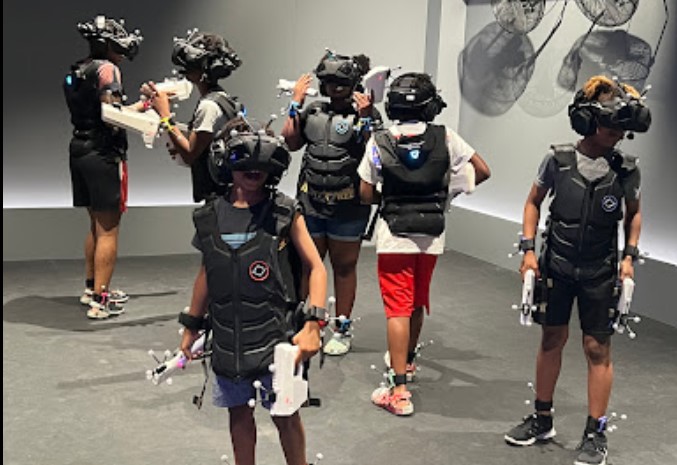
This 5,300-square-foot venue features four state-of-the-art VR rooms where groups of two to six players can step into exclusive, full-body virtual reality experiences built by Sandbox VR’s own AAA development studio. Using real-time motion capture and haptic vests, guests can freely roam through worlds like Squid Game Virtuals, Stranger Things: Catalyst, Deadwood PHOBIA, Age of Dinosaurs, and several others — all designed to be social, cooperative, and accessible to players of any skill level. Mixed reality highlight videos are included with every session at no extra cost.
Beyond standard gameplay, the venue offers dedicated party packages for birthdays and social gatherings (the Gold Package with two experiences, snacks, and beverages for up to six guests) and corporate team-building bundles (the Ultimate Play Bundle for up to 18 guests with catering options). The staff can transform areas into semi-private zones, and VR rooms can double as meeting spaces with AV capabilities. The venue also offers membership plans and an Unlimited Summer Pass for frequent visitors, plus gift cards for those who want to share the experience.
 Indoors
OVRDRIVE is located in Downtown Louisville at 112 West Jefferson Street. This multi-activity venue offers six linked racing simulators running Assetto Corsa, eight digital axe-throwing lanes, a rage room for smashing glass and electronics, and VR gaming options. The space is designed for groups of all sizes, with party packages, group rates, and full facility rentals available for birthdays, corporate events, bachelor parties, and team-building outings.
Guests can refuel at the self-pour tap wall featuring 15 craft beers and cocktails, plus a menu of signature pizzas and wings with catering options starting at $10 per person. The venue is open seven days a week (Mon-Thu 3PM-10PM, Fri-Sat 12PM-12AM, Sun 12PM-8PM) and is available 24/7 by reservation for private events. Founded by the team behind Full Throttle Adrenaline Park, the experienced staff provides safety briefings and coaching for all activities.
IndoorsMalibu Jack’s Louisville is located in the East End of Louisville, Kentucky, off S Hurstbourne Parkway. This 135,000-square-foot indoor park offers nine attractions including laser tag (arena for up to 25 players), electric go-karts, mini-golf, an indoor roller coaster, bumper cars, a 4D motion theater, virtual reality rides, a soft-play zone for kids, 16 bowling lanes, and over 100 arcade games. The park operates on a free-admission model with pay-per-attraction pricing or all-day passes.
Beyond the attractions, the venue features a full-service restaurant and bar, 11 bookable event spaces (including semi-private Party Beach areas, a Private Cabana, and the Winner’s Circle), complimentary Wi-Fi and A/V equipment, and dedicated event coordinators for birthdays, corporate events, field trips, and youth groups. Birthday packages include options like the Bounce Beach Party and Unlimited Beach Bash, while corporate offerings range from the Team Builder experience to full facility buyouts. Game card bonus deals and seasonal unlimited attraction passes provide flexible ways to enjoy the park.
IndoorsFor decades, the concept of virtual reality was synonymous with being tethered to a chair, restricted by cables, or confined to a small square of living room floor. Today, that limitation has been shattered by the emergence of free-roam VR arenas. These expansive, physical spaces allow users to walk, run, and collaborate in digital worlds without the interference of wires or walls. By treating the physical room as a blank canvas, free-roam VR transforms passive observation into active participation, turning the human body into the primary controller of a digital odyssey.
A free-roam VR arena is an industrial-scale facility dedicated to untethered virtual reality experiences. Unlike home systems that rely on room-scale tracking within a limited space, these arenas utilize advanced proprietary tracking technology, such as optical motion capture or high-precision spatial anchors, to map a large physical warehouse or studio space into a virtual environment.
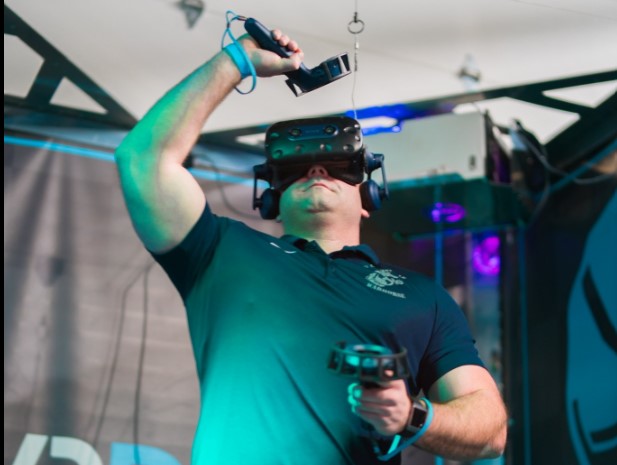
Participants typically wear a lightweight, high-resolution VR headset connected to a powerful, wearable computer—often carried as a backpack—which eliminates the need for cables. With haptic vests that vibrate upon impact and motion-tracking sensors attached to limbs, the system creates a “full-body” presence. When a user steps into the arena, the physical boundaries coincide perfectly with the digital ones. If a player walks forward, they move forward in the game; if they reach out to touch a virtual wall, they feel the physical structure of the arena’s partitions. This synchronization between inner-ear balance and visual input significantly reduces motion sickness and creates a state of “presence”—a psychological phenomenon where the brain accepts the virtual environment as an authentic physical reality.
The true potential of free-roam VR lies in its ability to transport groups to scenarios that would be impossible, deadly, or prohibitively expensive to recreate in real life. These scenarios are designed to leverage the vast space of the arena, moving players through multi-room digital maps that feel like sprawling landscapes.
One of the most popular genres is the “zombie survival” mode, where teams move through derelict laboratories or overrun cities, using physical cover to dodge digital projectiles. Beyond intense action, there are cooperative puzzle-solving scenarios modeled after escape rooms. In these, players might find themselves floating in a zero-gravity space station, needing to physically pass virtual objects between one another to repair a reactor. Others focus on exploration and adventure, placing users in the heart of ancient ruins or alien ecosystems where the scale of the environment is intended to elicit awe. Because the environment is software-defined, the same room can transform from a serene underwater sanctuary in the morning to an intense tactical battlefield by the afternoon, providing endless variety for repeat visitors.
The demographic reach of free-roam VR is expanding rapidly. While the technology was once the domain of hardcore tech enthusiasts, it has become a mainstream attraction for social groups, families, and casual gamers alike. The barrier to entry is minimal; if a person can walk, they can participate.
For children, free-roam VR is arguably the most captivating digital experience currently available. Unlike mobile games or console titles that isolate children behind a screen, these arenas encourage physical activity, spatial awareness, and direct social interaction. Developers have curated specific content for younger audiences that emphasizes discovery and team-based cooperation rather than combat. Parents often favor these venues because they encourage children to be active in the real world while exploring digital realms. Safety protocols, such as soft-padded flooring and physical boundary warnings, ensure that the environment remains secure for younger participants, making it a growing staple in modern recreational activities for children and teens.
The rise of the “experience economy” has positioned free-roam VR arenas as a premium destination for events that require high engagement and shared memories. Traditional party venues often lack the “wow factor” that defines a memorable celebration, but VR arenas offer a unique synthesis of entertainment and socialization.
For a birthday party or graduation, the arena acts as a shared adventure. Unlike a movie, where everyone sits in silence, free-roam VR forces groups to communicate—shouting instructions, laughing at blunders, and celebrating victories together in real-time. It levels the playing field, making it an excellent activity for mixed-age groups.
In the corporate sector, these arenas are gaining traction as high-end team-building exercises. Companies are moving away from traditional “trust falls” and seminars, opting instead for collaborative virtual missions. In a high-stakes, high-pressure virtual scenario, corporate teams must demonstrate clear communication, leadership, and emotional regulation. Observing how a team coordinates during a virtual “crisis” provides unique insights into team dynamics that are rarely visible in a boardroom. Consequently, free-roam VR is rapidly replacing the bowling alley or the escape room as the preferred choice for modern company outings.
The academic and industrial communities view free-roam VR as more than just an amusement; it is seen as the next evolution of human-computer interaction. Scientists who study neurology and cognitive psychology point to the brain’s adaptability in these spaces. Because the brain treats virtual locomotion as real movement, these arenas are being studied for their potential in neuro-rehabilitation, training individuals with motor-skill impairments to navigate physical environments in a controlled, safe setting.
Industry experts, including developers and engineers, view the growth of these venues as the ultimate testbed for the “Metaverse.” They argue that the lessons learned in designing these physical-to-digital spaces—such as optimal latency, user interface design for non-gamers, and social safety—are essential to the development of the next generation of computing. Furthermore, the feedback loop provided by these businesses is invaluable. By observing how thousands of people interact with digital objects, developers can refine the physics, ergonomics, and accessibility of VR technology faster than any lab study could allow.
As the technology matures, the hardware is becoming more intuitive, the graphics more photorealistic, and the arena infrastructures more affordable. From a business perspective, the industry is transitioning from a niche curiosity into a robust sector of the entertainment economy. Experts suggest that as AI integration improves, the “non-player characters” in these arenas will become more reactive and intelligent, essentially turning every session into a uniquely scripted, responsive story. The future of free-roam VR lies not just in better resolution, but in deeper, more meaningful immersion that blurs the line between the physical and the digital until, for the duration of the experience, that line disappears entirely.


 7900 Shelbyville Rd Suite G05, Louisville, KY 40222, United States