El Monte
 Log in
Log in
Log in

RSVR Milwaukee is located in Milwaukee, WI.
RSVR Milwaukee, located in Milwaukee, WI, stands out as a premier virtual reality arcade. The establishment boasts state-of-the-art computers, ultra-high-definition headsets, and a carefully designed atmosphere. This combination positions RSVR as a leading destination for virtual reality gaming within Milwaukee.
RSVR offers a library of over 100 games. Their mission is to immerse visitors in new and thrilling virtual reality adventures. Founded with the intention of providing a dedicated space for both casual gamers and VR enthusiasts, RSVR has evolved into a significant virtual reality gaming and entertainment hub in Milwaukee.
What distinguishes RSVR from other entertainment venues is their strong dedication to customer satisfaction, their carefully curated selection of games and experiences, and the inviting atmosphere they have created. RSVR prioritizes the adventure and enjoyment of their customers.
 Indoors
Urban Air Trampoline and Adventure Indoor Park is located in Appleton, WI.
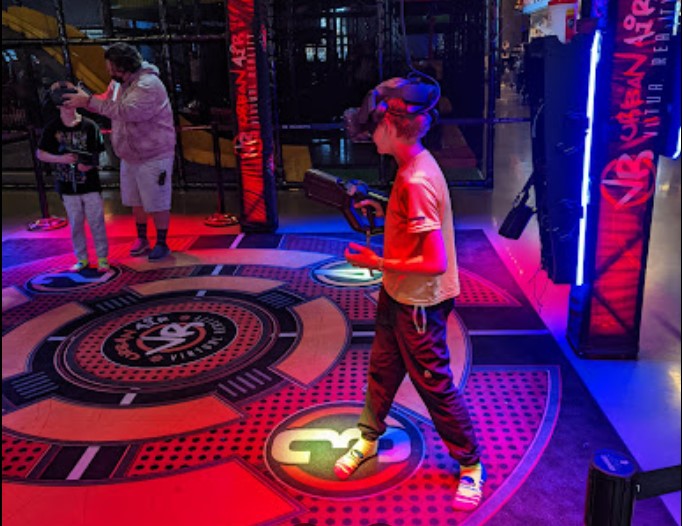
The Urban Air Trampoline and Adventure Park in Altamonte, Appleton, WI offers a thrilling experience for visitors of all ages. With attractions like indoor skydiving, a ropes course, a warrior obstacle course, and a variety of trampolines, there’s never a dull moment. Guests can also enjoy a virtual reality gaming experience, rock climbing, and a ninja course. Birthday parties and group events can be organized, and the park is a popular destination for families and friends looking to have some fun and stay active.
IndoorsFree‑roam virtual‑reality (VR) arenas are physical spaces in which participants can move without the constraints of a corded headset or a confined play area. Unlike seated or tabletop setups that limit motion to a small radius, a free‑roam arena combines a high‑capacity motion‑tracking system with rugged, self‑contained head‑mounted displays (HMDs). The result is an immersive environment where users can walk, duck, sprint, and interact with virtual objects as naturally as they would in the real world.
The technology that makes this possible relies on a blend of optical‑marker tracking, infrared cameras, and increasingly, inside‑out sensors that map the arena in real time. Floor‑mounted safety mats, padded walls, and clearly marked boundaries help prevent collisions while preserving the illusion of limitless space. In many venues, multiple users can share the same virtual world simultaneously, each wearing a wireless headset that streams high‑resolution video from a local server. The overall experience feels less like a game and more like stepping into a parallel universe where the only limits are the imagination of the designers.
The flexibility of a free‑roam arena opens the door to a wide spectrum of scenarios, ranging from adrenaline‑pumping adventures to subtle, narrative‑driven experiences. Below are some of the most popular categories:
Action‑Oriented Adventures – Participants don the role of space marines, treasure hunters, or mythic heroes, navigating sprawling environments that demand quick reflexes and strategic teamwork. Obstacles such as laser barriers, collapsing bridges, and moving platforms keep the heart rate high.
Puzzle and Exploration – In these scenarios, the focus shifts from speed to observation. Players solve environmental riddles, decode symbols hidden in the scenery, and manipulate virtual objects to unlock new areas. The freedom to physically walk around the puzzle space adds a tactile dimension that flat‑screen games cannot replicate.
Educational Simulations – Museums, science centers, and schools use free‑roam VR to recreate historical sites, ecosystems, or scientific phenomena. Learners can walk through a reconstructed ancient city, witness a volcanic eruption up close, or explore a molecular structure at a scale impossible to achieve in the physical world.
Fitness‑Focused Experiences – Some arenas integrate rhythm‑based or cardio‑intensive games that encourage full‑body movement. A “beat‑the‑drum” challenge might require participants to swing virtual weapons in time with music, delivering a workout that feels more like play than exercise.
Social and Creative Spaces – Virtual art galleries, collaborative design studios, and social lounges let groups mingle in a shared VR environment. Users can paint on three‑dimensional canvases, sculpt models with virtual tools, or simply converse while avatars mimic real‑world gestures.
These scenarios are not mutually exclusive; many venues craft hybrid experiences that blend action, education, and social interaction to keep participants engaged for longer periods.
The demographic landscape of free‑roam VR is surprisingly broad. Early adopters were primarily tech enthusiasts and gamers, but the accessible nature of the technology has broadened its appeal considerably.
Young Adults and College Students – This group appreciates the competitive and social aspects of multiplayer experiences. University clubs often schedule regular sessions as a low‑cost alternative to traditional esports arenas.
Families and Children – Parents are drawn to the safety and physical activity built into free‑roam setups. The immersive storytelling options make it an attractive educational supplement for school‑aged kids.
Corporate Teams – Companies use the arenas for team‑building exercises, leadership training, and creative brainstorming. The shared virtual space facilitates collaboration across geographic boundaries while reinforcing trust through shared challenges.
Senior Citizens and Rehabilitation Patients – With carefully designed low‑impact scenarios, free‑roam VR can serve as a low‑risk form of physiotherapy. The novelty factor encourages patients to complete movement routines that might otherwise feel monotonous.
Tourists and Event Attendees – Pop‑up free‑roam installations at conventions, festivals, and tourism centers provide a memorable attraction that differentiates a venue from its competitors.
The versatility of the technology means that almost any age group or interest area can find a suitable experience, making free‑roam VR a truly inclusive entertainment platform.
When it comes to children, safety and content suitability are paramount. Free‑roam VR arenas address these concerns in several ways:
Physical Safety Measures – Soft‑foam flooring, padded walls, and motion‑capture systems that automatically pause the experience if a user approaches a boundary reduce the risk of injury. Many venues also implement a “guardian” mode that allows an adult to monitor a child’s session in real time.
Age‑Appropriate Content – Content providers curate libraries specifically for younger audiences. These experiences avoid graphic violence, feature bright, whimsical aesthetics, and often embed educational objectives such as basic physics, language learning, or environmental stewardship.
Adjustable Sensory Settings – For children who may be more sensitive to motion sickness, arenas can lower field‑of‑view or limit rapid acceleration in the virtual environment. Some headsets also feature adjustable interpupillary distance (IPD) to accommodate smaller head sizes.
Skill‑Building Opportunities – Beyond pure entertainment, free‑roam VR can strengthen spatial reasoning, hand‑eye coordination, and collaborative problem‑solving. A scenario where children must assemble a virtual robot by physically moving to different stations encourages both mental and physical engagement.
Parents increasingly view free‑roam VR as a “digital playground” that combines the appeal of video games with the benefits of physical activity. With proper supervision, the technology can serve as a catalyst for curiosity and learning.
One of the most compelling use‑cases for free‑roam VR is its ability to transform traditional celebrations into unforgettable, immersive events. The modular nature of the arenas allows organizers to tailor experiences to the occasion.
A birthday celebration in a free‑roam arena can be built around a themed adventure—think “Pirate’s Cove,” “Space Academy,” or “Jurassic Expedition.” Guests arrive in a designated color‑coded headset, and the arena’s software groups them into teams that must complete a series of challenges to “unlock” the birthday cake. The physical movement adds an energetic component that keeps children (and adults) engaged, while the customizable environment can incorporate personal touches like the birthday child’s name displayed on virtual banners.
Graduates often seek experiences that mark the transition to a new phase of life. Free‑roam VR can stage a symbolic journey—perhaps climbing a virtual mountain representing personal growth, or navigating a futuristic city that reflects future career paths. Institutions can record participants’ avatars as they reach milestones, creating digital mementos that complement traditional photographs. The technology also provides an inclusive platform for graduates with mobility limitations, ensuring everyone can partake in the celebration.
Corporate events benefit from the blend of fun and purposeful interaction that free‑roam VR offers. Companies can commission custom scenarios that align with brand values or strategic goals. For instance, a sustainability‑focused firm might immerse employees in a virtual rainforest restoration project where each team’s actions directly affect the health of the simulated ecosystem. Post‑event analytics can reveal collaboration patterns, decision‑making speed, and leadership emergence, providing actionable insights for HR departments.
In each of these settings, the key advantage lies in the ability to craft a narrative that resonates with the audience while leveraging the physicality of the arena to foster genuine connection and excitement.
The scientific community has taken a keen interest in free‑roam VR for its potential to advance research across multiple disciplines. A consensus among scholars and industry analysts highlights several core benefits and challenges.
Researchers use free‑roam arenas to study spatial navigation, memory encoding, and sensorimotor integration in environments that mimic real‑world complexity. The ability to track a participant’s position, orientation, and physiological responses in three dimensions provides richer data than stationary setups. Studies have demonstrated that the immersive nature of free‑roam VR can produce stronger hippocampal activation, offering insights into how the brain constructs mental maps.
Physical therapists are exploring free‑roam VR as a low‑impact, motivating alternative to conventional exercises. By embedding therapeutic movements within a game‑like narrative—such as reaching for floating objects or walking through a virtual garden—patients are more likely to adhere to prescribed regimens. Early trials have reported improvements in balance, gait, and upper‑limb function for stroke survivors and individuals with Parkinson’s disease.
Industry experts evaluate the ergonomics of prolonged headset use, emphasizing the importance of weight distribution, heat dissipation, and lens clarity. The transition to wireless, inside‑out tracking reduces the need for external cameras, simplifying arena setup and maintenance. However, experts caution that latency must remain below the perceptual threshold (approximately 20 ms) to avoid motion sickness, especially during fast‑paced activities.
Analysts project that the free‑roam VR market will experience double‑digit growth over the next five years, driven by demand from entertainment venues, educational institutions, and corporate training programs. The technology’s scalability—ranging from small pop‑up rooms to large‑scale arenas covering thousands of square meters—makes it adaptable to various business models. Nonetheless, experts note that the upfront capital investment for tracking infrastructure and high‑spec servers remains a barrier for smaller operators.
Scholars also address the ethical implications of immersive environments. Issues such as data privacy, especially when biometric data is collected, and the psychological impact of highly realistic simulations are under active discussion. Industry bodies are developing guidelines that encourage transparent data handling and user consent, aiming to balance innovation with responsible stewardship.
Collectively, the viewpoints of scientists and industry leaders portray free‑roam VR as a multidisciplinary catalyst—one that expands the horizons of entertainment, education, health, and research while prompting careful consideration of technical, ethical, and economic factors.
Free‑roam VR arenas represent a convergence of cutting‑edge tracking technology, high‑fidelity graphics, and thoughtful physical design. By liberating users from static play spaces, they unlock a realm of experiences that can be thrilling, educational, therapeutic, and socially enriching. From adrenaline‑pumping action quests to gentle, exploratory tours of ancient civilizations, the variety of scenarios ensures there is something for every age group and interest.
The demographic reach of these arenas—from curious children and enthusiastic gamers to corporate teams and senior citizens—demonstrates a universal appeal that transcends traditional market segments. When integrated into special events such as birthdays, graduations, or corporate celebrations, free‑roam VR adds a layer of immersive storytelling that transforms ordinary gatherings into memorable adventures.
Scientific investigations continue to reveal the profound impacts of immersive, movement‑based VR on cognition, rehabilitation, and human‑computer interaction, while industry analysts predict robust market expansion. As technology advances—making headsets lighter, tracking more precise, and content pipelines richer—the potential for free‑roam VR to reshape how people learn, play, and collaborate grows ever more tangible.
In the coming years, the most successful arenas will likely be those that blend technical excellence with thoughtful curation of experiences, prioritize safety and inclusivity, and remain responsive to the evolving insights of researchers and users alike. The stage is set, the arena is waiting, and the next step forward is simply to step inside.


 2210 S Kinnickinnic Ave, Milwaukee, WI 53207, United States