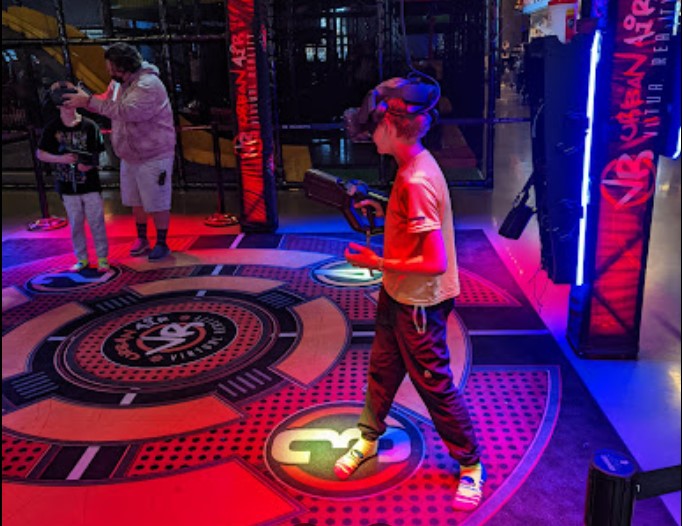
RSVR Milwaukee, located in Milwaukee, WI, stands out as a premier virtual reality arcade. The establishment boasts state-of-the-art computers, ultra-high-definition headsets, and a carefully designed atmosphere. This combination positions RSVR as a leading destination for virtual reality gaming within Milwaukee.
RSVR offers a library of over 100 games. Their mission is to immerse visitors in new and thrilling virtual reality adventures. Founded with the intention of providing a dedicated space for both casual gamers and VR enthusiasts, RSVR has evolved into a significant virtual reality gaming and entertainment hub in Milwaukee.
What distinguishes RSVR from other entertainment venues is their strong dedication to customer satisfaction, their carefully curated selection of games and experiences, and the inviting atmosphere they have created. RSVR prioritizes the adventure and enjoyment of their customers.
Urban Air Trampoline and Adventure Indoor Park is located in Appleton, WI.
The Urban Air Trampoline and Adventure Park in Altamonte, Appleton, WI offers a thrilling experience for visitors of all ages. With attractions like indoor skydiving, a ropes course, a warrior obstacle course, and a variety of trampolines, there’s never a dull moment. Guests can also enjoy a virtual reality gaming experience, rock climbing, and a ninja course. Birthday parties and group events can be organized, and the park is a popular destination for families and friends looking to have some fun and stay active.
The Rise of Free‑Roam VR Arenas: A New Playground for Everyone
Virtual‑reality has moved far beyond the cramped confines of a headset‑only experience. Free‑roam VR arenas—large, sensor‑filled spaces where users can walk, run, jump, and interact with a fully tracked digital world—are redefining entertainment, education, and even corporate culture. In this deep‑dive article we’ll explore what a free‑roam VR arena actually is, the imaginative scenarios that bring these spaces to life, who’s stepping inside (including kids), how the technology is reshaping celebrations from birthdays to boardrooms, and what scientists and industry experts think about this rapidly evolving medium.
What Is a Free‑Roam VR Arena?
At its core, a free‑roam VR arena is a physical room or warehouse equipped with a network of motion‑capture cameras, infrared beacons, or LIDAR sensors that constantly track the position and orientation of every participant’s headset and controllers. Unlike seated or handheld VR setups, the user’s real‑world movements map directly onto a virtual environment, creating an immersive sense of presence that feels almost magical.
Prevents users from bumping into walls or each other
Software Engine
Unity, Unreal, custom multi‑user platforms
Generates the virtual world, physics, and multiplayer logic
The result is a synchronous, multi‑user playground that can host a single explorer or a whole team, all sharing the same virtual narrative while staying physically safe.
Free‑Roam VR Scenarios: From Fantasy Quests to Real‑World Simulations
The flexibility of an open‑space tracker means designers can conjure any environment they can imagine—and then let participants physically inhabit it. Below are some of the most popular and inventive scenario categories you’ll find across today’s arenas.
1. Adventure & Story‑Driven Quests
Mythic Realms – Players become heroes in a CGI‑rich Olympus, wielding light‑swords against mythic beasts.
Space‑Station Escape – A zero‑gravity simulation where you float between modules, solve puzzles, and repair a failing hull.
These experiences focus on narrative arcs, branching choices, and dramatic set‑pieces that reward exploration and teamwork.
2. Competitive eSports & Battle Arenas
Laser‑Tag VR – Classic laser‑tag meets digital effects; each hit registers as a visual blast on the HUD.
MOBA‑Lite – Small‑scale, team‑based “battle arena” games where each player controls a unique hero with distinct abilities.
The real‑world movement adds a physical fitness component, turning an esports match into a cardio workout.
3. Training & Education Simulations
Firefighter Drill – Trainees navigate a burning building, practice hose handling, and learn evacuation routes.
Medical Anatomy Lab – Students walk through a 3‑D human body, dissect organs, and practice surgical procedures with haptic feedback.
Because the body is moving, muscle memory and spatial reasoning improve dramatically compared to flat‑screen simulations.
4. Creative & Artistic Playgrounds
VR Graffiti Wall – Spray‑paint in mid‑air, see your art scale up on a virtual skyscraper.
Music Jam Sessions – Walk around a virtual stage, strike virtual instruments, and watch sound waves visualized in real time.
These venues attract creators who want to paint, sculpt, or compose in a space not bound by physics.
5. Social & Party Games
Mystery Mansion – A whodunit where guests solve clues hidden throughout a haunted house.
Team‑Building Escape Rooms – Corporate groups must cooperate to defuse a virtual bomb before time runs out.
Social scenarios leverage the shared physical presence to heighten laughter, collaboration, and memory formation.
Who Plays on Free‑Roam VR Arenas? A Look at the Demographics
Free‑roam VR is no longer a niche hobby for hardcore gamers. Its accessibility, safety features, and diverse content have opened the doors to a broad spectrum of participants.
1. Hardcore Gamers & VR Enthusiasts
These early adopters seek the ultimate immersion—no more “standing in a chair” while their avatar runs a marathon. They appreciate high‑fidelity graphics, low latency, and competitive leaderboards.
2. Families & Kids
Why Kids Love It
Physical Activity: The experience feels like a high‑tech playground, encouraging running, ducking, and jumping.
Instant Feedback: Visual cues (e.g., glowing footprints) help children understand cause‑and‑effect.
Safety: Soft padding and real‑time boundary alerts keep play areas kid‑proof.
Age‑Appropriate Content
Cartoon‑Style Adventures – Bright, whimsical worlds with low‑intensity challenges.
Educational Mini‑Games – Math puzzles, language quests, and science labs that blend learning with movement.
3. Corporate Teams & HR Professionals
Free‑roam VR is becoming a staple of team‑building retreats, innovation workshops, and leadership training. The technology promotes:
Empathy – Walking in a colleague’s virtual shoes during scenario‑based discussions.
Problem‑Solving – Real‑time puzzles that require physical coordination and communication.
4. Event Planners & Experience Designers
From birthday parties to product launches, event curators are now adding VR arenas to their toolkits for memorable, Instagram‑worthy moments.
5. Researchers & Scientists
Academics use arenas to study human perception, spatial cognition, and motion sickness under controlled yet naturalistic conditions.
Free‑Roam VR for Celebrations: Birthdays, Graduations, Corporate Parties
The novelty factor makes free‑roam VR a magnetic draw for special occasions. Below are practical ideas and logistical tips for turning an ordinary celebration into an unforgettable multi‑dimensional experience.
1. Birthday Parties
Element
Example
Why It Works
Theme
“Superhero Academy” – kids earn powers by completing obstacle courses.
Gives each child a role and a sense of progression.
Customization
Personalized avatars wearing birthday hats and a virtual cake that pops when they reach a milestone.
Reinforces the birthday narrative.
Take‑Home Souvenirs
360‑degree video clips or GIFs of each child’s best moves.
Extends the memory beyond the arena.
2. Graduations
Virtual Commencement Hall: A grand auditorium where graduates walk across a digital stage, hear speeches, and see fireworks that respond to applause.
Alumni Networking Quest: Graduates explore “career rooms,” each representing a different industry, while meeting mentors in VR.
Memory Lane: A timeline tunnel showcasing photos and videos from their school years, flickering as they stroll through.
3. Corporate Parties & Product Launches
Goal
VR Execution
Added Value
Team Bonding
Multi‑team challenges (e.g., “Capture the Data Center”) that require cross‑department collaboration.
Breaks down silos, fosters trust.
Brand Immersion
A custom‑built virtual showroom where attendees can interact with a 3‑D model of a new product.
Allows tactile exploration without physical prototypes.
Data Capture
Real‑time analytics on movement patterns, decision latency, and communication flow.
Generates actionable insights for HR and marketing.
Logistics Checklist for Event Organizers
Capacity Planning: Most arenas cap at 8–12 users per session for optimal tracking. Book staggered slots.
Safety Briefing: Run a quick “real‑world vs. virtual” orientation to prevent collisions.
Attire Guidelines: Flexible shoes (no heels), lightweight clothing, and optional motion‑capture suits for enhanced interaction.
Technical Support: Have a tech‑savvy staff member on‑site to troubleshoot headset battery and sensor alignment.
Post‑Event Content: Capture 4‑K video of the session for a highlight reel; participants love seeing themselves in VR.
Scientists and Industry Experts Weigh In on Free‑Roam VR
The rapid adoption of free‑roam VR has attracted the attention of neuroscientists, ergonomics researchers, and venture capitalists alike. Their perspectives help us understand both the promise and the challenges ahead.
1. Cognitive Benefits
Spatial Navigation & Memory: Dr. Lina Patel (University of Cambridge, Cognitive Neuroscience) notes that “physically moving through a virtual environment activates the hippocampus more robustly than stationary VR, leading to measurable gains in spatial memory tasks.”
Embodied Learning: A 2023 study from the MIT Media Lab found that medical students who practiced suturing in a free‑roam VR simulation showed a 24% faster skill acquisition compared with screen‑based training.
2. Health & Safety Considerations
Motion Sickness Reduction: Because the vestibular system receives congruent signals (the body moves, the visuals move), the incidence of VR‑induced nausea drops from ~30% in seated setups to under 5% in well‑calibrated arenas (Journal of Virtual Medicine, 2022).
Physical Strain: Ergonomist Prof. Miguel Santos warns that “extended sessions (>30 minutes) without proper breaks can lead to lower‑back fatigue; arena designers should implement rest zones and encourage micro‑stretch intervals.”
3. Technological Outlook
Edge Computing & Latency: Industry analyst Priya Rangan of Gartner predicts that by 2028 edge‑rendered VR will cut end‑to‑end latency to <10 ms, making large‑scale free‑roam experiences indistinguishable from reality.
Mixed‑Reality Fusion: Companies like Meta and Magic Leap are piloting hybrid AR/VR arenas where digital overlays augment the physical space (e.g., projecting holographic clues on real walls). Experts see this as the next evolutionary step.
4. Economic Impact
Market Growth: The free‑roam VR market is projected to reach USD 5.2 billion by 2030, driven by entertainment, corporate training, and education sectors.
Job Creation: New roles—“VR Experience Director,” “Spatial Data Analyst,” “Safety Choreographer”—are emerging, expanding the ecosystem beyond traditional game development.
5. Ethical & Social Implications
Digital Inclusion: Dr. Aisha Rahman (UNESCO) stresses the need for affordable access to free‑roam VR in underserved schools, warning that a divide could widen existing educational inequities.
Data Privacy: As arenas collect granular movement data, privacy advocates call for transparent consent frameworks and anonymization protocols.
The Future of Free‑Roam VR: Where Do We Go From Here?
The trajectory of free‑roam VR points toward greater integration with the physical world, richer sensory feedback, and broader societal adoption.
Full‑Body Haptics: Emerging lightweight exoskeletons will let users feel resistance when they “push” a virtual door or “duck” under a projectile.
AI‑Generated Worlds: Procedural generation, powered by large language models, will enable infinite, personalized storylines without manual design.
Hybrid Remote Participation: With ultra‑low latency streaming, a user in New York could join a Tokyo arena and share the same physical space virtually—a true “global playground.”
If the technology continues to mature while staying affordable and safe, free‑roam VR could become the new default venue for experiential learning, social interaction, and celebration—a place where imagination literally moves you.
Quick Takeaways
Topic
Key Insight
Definition
An open‑space, sensor‑rich environment where users physically walk and interact with a fully tracked virtual world.
Scenarios
Adventure quests, competitive eSports, training simulations, creative studios, and party games.
Who Plays?
Gamers, families, kids, corporate teams, event planners, and researchers.
Celebrations
Tailorable birthday adventures, immersive graduations, and data‑driven corporate parties.
Full‑body haptics, AI‑generated worlds, and cross‑continental shared arenas.
Free‑roam VR is more than a novelty—it’s a platform for physical‑digital convergence that invites anyone willing to step inside to explore, learn, and celebrate in ways that were once pure science‑fiction. Whether you’re a parent planning the ultimate birthday surprise, a manager seeking innovative team‑building, or a researcher probing the limits of human perception, the arena is ready. All you need is a willingness to move, and the rest will follow in stunning, immersive detail.

 El Monte
 Log in

 Indoors


 2210 S Kinnickinnic Ave, Milwaukee, WI 53207, United States