
 El Monte
 Log in
Log in
Log in

Infinite Loop VR sits in La Vista, a suburb in the Omaha metro area of Nebraska, at 9825 Giles Road, and is Nebraska’s largest virtual reality arcade.
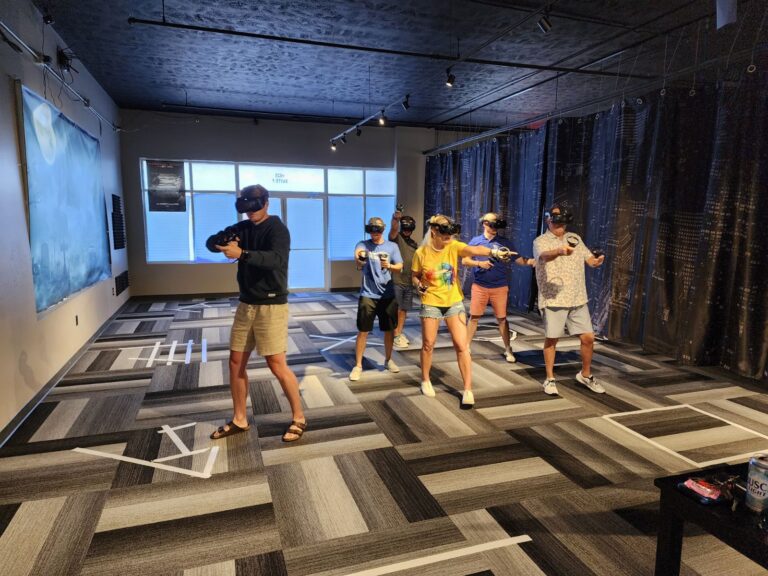
The club offers over 60 games across nine VR stations, a 600-square-foot free-roam arena where 2–5 players physically walk through zombie and robot battles, four racing simulators with 5K headsets and wind effects, Tower Tag laser-tag-style play, and five multiplayer escape experiences. Birthday packages include the VR Station Party Package, the Tower Tag & Racing Package, and a full-facility Private Party Package, with party room time, plates, cups, utensils, and cleanup included.
The club also hosts corporate events, graduation parties, team building, and date nights, with a party room where guests can bring in food and drinks or order from a catering menu. The friendly staff handle setup, intro, and cleanup, and the facility is family-friendly, ADA compliant, and offers free parking on site.
 Indoors
A free‑roam virtual‑reality arena is a purpose‑built physical space where participants can move without the constraints of a tethered headset or a stationary play area. Unlike traditional seated or room‑scale VR setups that require users to stay within a limited footprint, free‑roam arenas are equipped with wireless head‑mounted displays, often paired with sophisticated motion‑capture systems that track every step, turn, and gesture. The environment itself can be a large warehouse, a converted gym, or a custom‑designed modular structure, usually lined with safety padding, clear boundaries, and ambient lighting that enhances immersion while protecting users from collisions.
The technology that powers these arenas typically combines high‑resolution, low‑latency headsets with infrared or optical tracking rigs positioned around the perimeter. Some installations also integrate haptic floor panels, wind‑blowing vents, and scent diffusers, turning the experience into a multisensory adventure. Because participants are free to walk, run, duck, and even climb, the narratives presented in free‑roam VR can be far more dynamic and physically engaging than those designed for stationary play.
In essence, a free‑roam VR arena transforms a room into a stage where the digital world and the physical world intersect seamlessly, allowing users to inhabit virtual spaces as naturally as they move through a real one.
The flexibility of a free‑roam arena opens the door to a wide spectrum of scenarios, each designed to exploit the ability to move unrestrictedly.
Players embark on sprawling treasure hunts that span multiple “rooms” within the arena. Each section can be themed as a jungle, a pirate ship, or an alien planet, with physical props that complement the virtual assets. The sense of actually stepping onto a crumbling bridge or ducking behind a fallen column heightens the thrill and makes puzzle solving feel tactile.
Workout‑oriented experiences such as virtual boxing, rhythm‑based dance, or obstacle‑course runs leverage the arena’s space to deliver full‑body cardio sessions. Real‑time metrics—heart rate, calories burned, and movement efficiency—are displayed on a companion screen, turning exercise into an entertaining competition.
Science museums and schools use free‑roam VR to recreate historical events, biological processes, or astronomical journeys. Imagine a class of students walking through a life‑size model of a dinosaur habitat, hearing the roar of a Tyrannosaurus, or floating in zero‑gravity while assembling a virtual space station.
Multiplayer shooters, tactical heists, or cooperative survival games take advantage of the arena’s size to foster real‑world teamwork. Players must communicate verbally, coordinate movement, and strategize together, mirroring the dynamics of conventional team sports.
Story‑driven experiences such as mystery thrillers or horror adventures use the arena’s layout to create tension. Dark corridors, sudden jumpscares triggered by physical props, and ambient sound design make the narrative feel like a live theater production in which the audience is also the actor.
These scenarios illustrate how free‑roam VR is not just a novelty; it is a versatile platform that can be tailored for entertainment, education, health, and corporate training.
The demographic reach of free‑roam VR is surprisingly broad, but there are distinct patterns in how different age groups engage with the technology.
Kids between the ages of six and fourteen are perhaps the most enthusiastic participants. Their natural curiosity and boundless energy align perfectly with the physical freedom the arena provides. For younger children, experiences are carefully curated to emphasize safety and simplicity—colorful adventure quests, interactive animal encounters, and basic puzzle games dominate the lineup. The tactile nature of free‑roam VR helps develop spatial awareness, hand‑eye coordination, and even basic problem‑solving skills in a context that feels like play rather than instruction.
Teenagers gravitate toward higher‑intensity experiences such as competitive sports simulations, fast‑paced shooters, and rhythm games. Social interaction becomes a core component; friends can team up for a heist mission or challenge each other in a virtual laser‑tag match. Because the arenas are designed for group play, they provide a safe, supervised alternative to outdoor gatherings, especially in urban environments where space may be limited.
Adults use free‑roam arenas for a variety of reasons: stress relief, fitness, corporate team‑building, or simply as a novel leisure activity. The immersive nature of the medium offers a break from screen‑based work, encouraging physical movement and mental reset. In many cases, adults who are new to VR find the free‑roam format less intimidating than a cramped room‑scale setup, as the spacious environment reduces the likelihood of colliding with walls or furniture.
While not the primary market, senior citizens are increasingly participating in specially designed experiences. Low‑impact fitness routines, gentle nature walks, and guided meditation journeys are crafted to accommodate limited mobility while still delivering the immersive benefits of VR.
Overall, the inclusive design of free‑roam arenas means that people of virtually any age can find an experience that resonates with their interests and physical abilities.
Because the arena merges physical activity with digital storytelling, it has become a popular venue for celebrations and corporate events. The adaptability of the space allows organizers to tailor the experience to the occasion, ensuring that participants leave with memorable, shareable moments.
A birthday party in a free‑roam arena is a dynamic playground where the traditional cake‑cutting ritual can be complemented with a custom‑built adventure. Organizers can create a themed quest—pirates searching for treasure, superheroes defending a city, or explorers navigating a jungle—where the birthday child leads the group through challenges designed around their interests. Many venues offer “party packages” that include private time in the arena, a staff member to guide the gameplay, and optional add‑ons such as photo booths that capture participants in their VR gear for lasting souvenirs.
Graduation marks a transition, and a free‑roam VR celebration can symbolize stepping into an unknown future. A “future‑vision” scenario might let graduates walk through a virtual representation of their chosen career paths, explore a simulated campus, or embark on an interstellar voyage that metaphorically represents new horizons. The collaborative nature of many VR games also reinforces the bonds formed during years of study, as friends work together to solve puzzles or compete in friendly challenges.
Companies increasingly turn to free‑roam VR for employee appreciation events, product launches, or team‑building workshops. The arena’s capacity to host large groups makes it ideal for corporate parties where the goal is to blend fun with subtle skill development. For instance, a strategic escape‑room scenario can be used to assess problem‑solving, communication, and leadership qualities in a low‑risk environment. Fitness‑oriented games promote wellness, while narrative experiences can reinforce branding messages—imagine a custom adventure that incorporates a company’s mission statement or product line as part of the storyline.
When planning any celebration in a free‑roam arena, several logistical factors help ensure a smooth experience:
Capacity and Session Length – Most arenas can accommodate 10‑20 participants per session, with each game lasting between 15 and 30 minutes. For larger groups, the event can be broken into overlapping sessions or scheduled “mega‑games” that involve multiple teams competing simultaneously.
Safety Protocols – Staff members conduct a brief safety orientation before participants don the headsets. The arena is equipped with soft padding, emergency stop buttons, and clear exit routes, ensuring that even high‑energy activities remain safe.
Customization Options – Many providers offer the ability to brand the virtual environment with company logos, birthday banners, or graduation caps, making the experience feel personalized.
Post‑Event Content – After the session, participants can receive video highlights or photo collages captured from the VR perspective, providing a digital keepsake that extends the excitement beyond the event itself.
By blending cutting‑edge technology with the social dynamics of celebrations, free‑roam VR arenas create a unique platform where milestones are not just marked but lived in an immersive, unforgettable way.
The rapid evolution of wireless VR hardware, lower latency tracking, and immersive peripherals suggests that free‑roam arenas will become increasingly accessible. As costs drop and modular designs become more common, smaller venues—such as community centers, schools, and even shopping malls—could host their own mini‑arenas. This democratization will likely broaden the user base further, inviting more families, educators, and small businesses to experiment with VR experiences that were once reserved for large entertainment facilities.
Moreover, advances in artificial intelligence and procedural generation promise to make every session uniquely tailored to the participants. Imagine a birthday quest that automatically incorporates the guest of honor’s favorite colors, music, and personal anecdotes, or a corporate challenge that adapts difficulty based on real‑time performance metrics. Such personalization will deepen engagement and make free‑roam VR a compelling tool for both entertainment and purposeful applications.
In the meantime, the current generation of free‑roam VR arenas already offers a compelling blend of physical freedom, narrative depth, and social interaction. Whether a child is exploring a dinosaur world, a graduate is navigating a futuristic career landscape, or a team of colleagues is strategizing a virtual heist, the arena provides a space where imagination can move unhindered.


 9825 Giles Rd suite c & d, La Vista, NE 68128, United States