TOP 10 best of the best Free-roam VR in Norfolk, VA – Battleonix
El Monte
Log in
0

Advanced Search:

City

Rating

Playground


Price:

Main / Catalog / VR / Virginia, US / Norfolk, VA

The best Free-roam VR near me in Norfolk, VA

img
from $10
VR

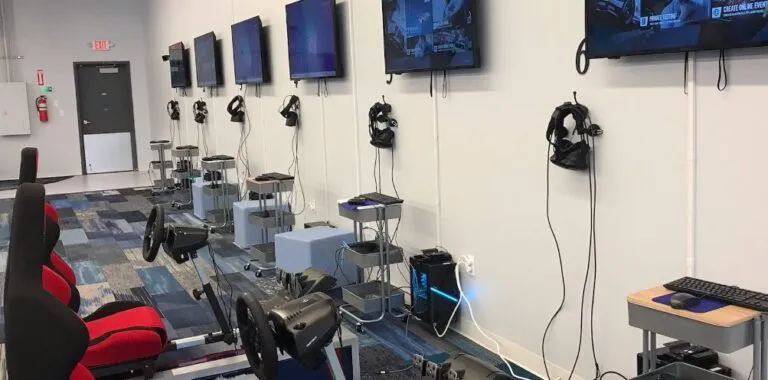
VR64 Arcade / New World VR is located in Norfolk, VA.


VR64 Arcade, also known as New World VR and located in Norfolk, VA, is a virtual reality arcade with additional locations in Williamsburg, Virginia.

They emphasize a focus on family-friendly entertainment suitable for all ages. In addition to gaming, VR64 also provides 360 media creation and educational services.

VR64 highlights its suitability as a party venue. The facility offers a cozy atmosphere with an open floor plan, allowing everyone to participate in the fun. They describe the party area as spacious with ample seating. Parties are private, and guests receive full access to equipment.

Indoors

Best of the best Free-roam VR in Norfolk, VA


What Is a Free‑Roam VR Arena?

A free‑roam virtual‑reality arena is a physical space where participants can move unrestricted while wearing a head‑mounted display (HMD) that tracks their position, orientation, and sometimes even hand gestures. Unlike seated or room‑scale setups that confine the user to a limited play area, free‑roam arenas are often the size of a small gymnasium or warehouse and are equipped with an array of sensors—infrared cameras, lidar scanners, or ultra‑wide‑angle tracking cameras—mounted on the ceiling or walls. The technology creates a seamless bridge between the real world and the digital environment, allowing users to walk, run, duck, and interact with virtual objects as if they were truly present.

Because the arena’s tracking system continuously maps each participant’s location, multiple users can share the same virtual space without colliding in the physical world. Safety nets such as padded walls, cushioned floors, and real‑time collision alerts are standard, ensuring that the excitement of immersion does not compromise physical well‑being. The result is an experience that feels more like stepping into a living video game than merely watching one on a screen.


Free‑Roam VR Scenarios

The flexibility of a free‑roam arena lends itself to an ever‑growing catalogue of scenarios, each designed to exploit the freedom of movement and the depth of sensory feedback.

  • Adventure Quest – Players become explorers in a sprawling fantasy realm, scaling cliffs, navigating labyrinthine ruins, and battling mythical creatures. The large play area enables designers to craft expansive maps where distance truly matters, encouraging teamwork and strategic positioning.

  • Historical Reconstructions – Museums and heritage sites employ free‑roam VR to transport visitors to ancient civilizations. Participants can walk through a reconstructed Roman forum, feel the weight of a Viking longship’s hull, or witness a prehistoric volcano erupt in real time.

  • Simulation Training – Emergency responders, pilots, and industrial workers practice high‑risk procedures in a zero‑consequence environment. The ability to physically move through a virtual fire‑scene or crane‑operation area improves muscle memory and situational awareness.

  • Sports and Fitness – From futuristic racetracks to fully fledged basketball courts, athletes use free‑roam VR for conditioning, skill drills, and competitive play. Real‑world motion translates directly into virtual performance metrics, providing immediate feedback.

  • Creative Sandbox – Artists and designers experiment with 3D sculpting, architectural modeling, or interactive storytelling. By walking around their creations, they gain a perspective that flat screens cannot offer, fostering a more intuitive design process.

Each scenario builds upon the core promise of free‑roam VR: the removal of physical constraints to let imagination dictate the boundaries of play and learning.


Who Plays on Free‑Roam VR Arenas?

The appeal of free‑roam VR transcends age, profession, and cultural background. While early adopters were predominantly tech‑savvy gamers, the user base has broadened dramatically.

  • Gamers and Entertainment Seekers – For avid gamers, free‑roam arenas represent the next evolutionary step beyond console or PC gaming. The sheer physicality of the experience satisfies a desire for visceral, adrenaline‑pumping entertainment.

  • Families and Children – Parents see the arenas as safe, supervised environments where kids can explore digital worlds without the risk of bumping into furniture. The tactile interaction encourages active play, countering concerns about sedentary screen time.

  • Educators and Students – Schools incorporate free‑roam VR into curricula to illustrate complex concepts—like planetary motion or molecular structures—in a manner that is both memorable and engaging.

  • Corporate Teams – Companies use the arenas for team‑building exercises, leadership workshops, and immersive product demonstrations. The shared experience fosters camaraderie and highlights the benefits of collaborative problem‑solving.

  • Researchers and Professionals – Scientists, engineers, and medical practitioners leverage the technology for experimental studies, prototype testing, and procedural rehearsals. The high fidelity of motion tracking provides data that traditional simulations cannot capture.

The diversity of participants underscores the arena’s versatility: it is as much a laboratory for discovery as it is a playground for fun.


VR for Kids

When it comes to children, free‑roam VR offers a unique blend of education, physical activity, and imagination. The immersive nature of the medium naturally captures a child’s curiosity, turning abstract lessons into concrete experiences. A biology module might let a child wander through a bloodstream, watching red blood cells transport oxygen, while a math challenge could transform a maze into a series of problem‑solving checkpoints.

Safety is paramount. Arenas designed for younger audiences feature lower ceilings, softer padding, and simplified controls that rely on natural gestures rather than complex button combinations. Session lengths are carefully managed—typically 15 to 20 minutes—to avoid visual fatigue and motion discomfort. Parental dashboards allow guardians to monitor progress, set content preferences, and schedule breaks.

Beyond curriculum, free‑roam VR satisfies the innate need for kinetic play. Children expend energy by dodging virtual obstacles, leaping over imagined chasms, or collaborating in cooperative quests. This active engagement helps counteract the sedentary habits associated with traditional screen time while still delivering the intellectual stimulation of digital media.


Free‑Roam VR for a Birthday Party, Graduation, Corporate Party

The adaptable nature of free‑roam arenas makes them an increasingly popular venue for special events, turning ordinary celebrations into unforgettable spectacles.

Birthday Parties

A birthday party in a free‑roam arena becomes a quest‑filled adventure. Organizers can customize a storyline around the celebrant’s favorite theme—pirates, space explorers, or superhero academies—and embed puzzles, treasure hunts, and boss battles throughout the space. The collaborative format encourages friends to work together, strengthening social bonds while keeping the energy high.

Graduations

Graduation ceremonies benefit from the arena’s capacity to merge tradition with novelty. Graduates can don their caps and gowns and then step onto a virtual stage that expands into a panoramic landscape—perhaps a sunrise over a city they will soon enter professionally, or a symbolic journey through a forest representing their growth. Family members, even those attending remotely, can view a live 360‑degree broadcast, making the event inclusive and visually striking.

Corporate Parties

For businesses, a free‑roam VR event can serve multiple purposes: celebration, brand reinforcement, and employee engagement. Companies often commission custom scenarios that incorporate corporate values, product lines, or mission statements. A tech firm might design a futuristic city where participants solve challenges that mirror real‑world projects, reinforcing teamwork and innovation. The immersive environment also provides a novel setting for networking, as attendees naturally mingle while navigating shared virtual objectives.

In each case, the arena’s flexibility—its ability to host multiple simultaneous sessions, adapt lighting and sound, and tailor content on the fly—ensures that the event feels personalized while still harnessing the excitement of cutting‑edge technology.


Scientists and Industry Experts View on Free‑Roam VR

The scientific community and industry thought leaders recognize free‑roam VR as more than a novelty; they view it as a transformative platform with broad implications across multiple domains.

Cognitive and Neurological Research

Neuroscientists point out that the embodied interaction afforded by free‑roam VR offers a richer dataset for studying spatial cognition, motor learning, and sensory integration. The precise tracking of head, hand, and body movements enables researchers to correlate neural activity with real‑time behavior, opening pathways for new insights into how the brain constructs and navigates virtual environments.

Human‑Factors Engineering

Ergonomists and safety engineers appreciate the arena’s capacity to simulate hazardous scenarios without exposing participants to actual danger. By recreating high‑risk environments—such as chemical plants, construction sites, or deep‑sea vessels—experts can evaluate human responses, refine interface designs, and develop training protocols that translate directly to improved workplace safety.

Medical Rehabilitation

Physical therapists and clinicians see free‑roam VR as a powerful adjunct to traditional rehabilitation. The ability to gamify repetitive exercises encourages patient adherence, while the system’s analytics track range of motion, balance, and progression with clinical precision. Early studies suggest that immersive, movement‑rich therapy can accelerate recovery for stroke survivors, orthopedic patients, and individuals with chronic mobility impairments.

Entertainment and Content Creation

From a production standpoint, developers highlight how free‑roam arenas democratize high‑quality VR experiences. Instead of requiring each user to possess a costly, fully tracked setup at home, studios can host immersive experiences centrally, allowing creators to push visual fidelity and narrative depth far beyond what consumer‑grade hardware currently supports.

Economic Impact

Analysts observe that the burgeoning free‑roam market contributes to local economies through venue construction, staffing, and ancillary services such as catering and event planning. Moreover, the technology spurs job creation in fields ranging from 3D modeling to network engineering, reinforcing its role as a catalyst for innovative entrepreneurship.

Overall, the consensus among experts is that free‑roam VR stands at the intersection of entertainment, education, and scientific inquiry. Its capacity to blend physical freedom with digital richness positions it as a pivotal tool for learning, training, and leisure in the coming decade.


The Future Landscape of Free‑Roam VR

Looking ahead, several trends are poised to shape the evolution of free‑roam arenas:

  • Scalable Architecture – Modular arena designs will allow venues to expand or contract based on demand, making the technology accessible to smaller cities and community centers.

  • Hybrid Reality Integration – Combining augmented reality (AR) overlays with fully immersive VR will enable participants to interact with real‑world objects that carry contextual digital information, blurring the line between the two modalities.

  • AI‑Driven Personalization – Machine‑learning algorithms will analyze player behavior in real time, dynamically adjusting difficulty, narrative pacing, and environmental cues to maintain optimal engagement.

  • Sustainability Focus – Energy‑efficient tracking systems, recyclable cushioning materials, and renewable‑powered facilities will address environmental concerns as the industry scales.

  • Cross‑Platform Connectivity – Cloud‑based streaming of VR content will let users transition from a home headset to a free‑roam arena without losing progress, fostering a seamless ecosystem of experiences.

As these developments converge, free‑roam VR is set to become a mainstream venue for not only entertainment but also education, professional development, and therapeutic intervention. The arena’s core promise—unrestricted movement within a meticulously crafted virtual world—remains the catalyst that continues to attract a diverse audience and inspire innovation across disciplines.

In sum, free‑roam VR arenas have evolved from experimental labs into vibrant communal spaces where imagination, learning, and celebration intersect. Whether a child embarking on a prehistoric adventure, a corporate team solving a simulated crisis, or a scientist measuring the subtleties of human motion, the arena provides a canvas that is as limitless as the ideas that inhabit it.