VR64 Arcade / New World VR is located in Norfolk, VA.
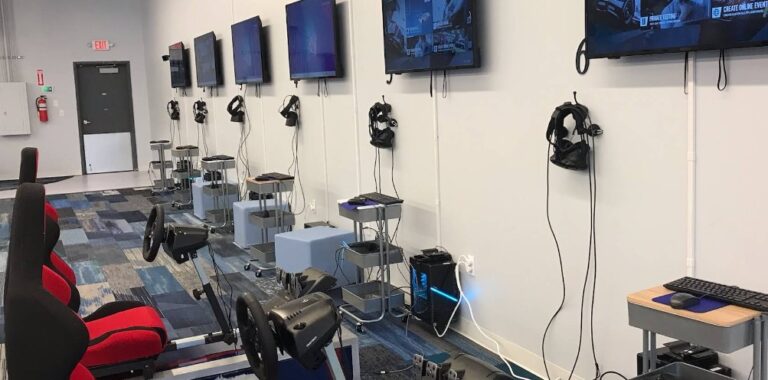
VR64 Arcade, also known as New World VR and located in Norfolk, VA, is a virtual reality arcade with additional locations in Williamsburg, Virginia.
They emphasize a focus on family-friendly entertainment suitable for all ages. In addition to gaming, VR64 also provides 360 media creation and educational services.
VR64 highlights its suitability as a party venue. The facility offers a cozy atmosphere with an open floor plan, allowing everyone to participate in the fun. They describe the party area as spacious with ample seating. Parties are private, and guests receive full access to equipment.
Imagine stepping into a room where the walls disappear, the floor becomes a launchpad, and every direction you turn is a portal to a different world. That’s the essence of a free‑roam virtual reality (VR) arena. Unlike the seated or treadmill‑based setups you might see in a home living‑room, a free‑roam arena gives users unrestricted physical movement inside a bounded space that’s instrumented with motion‑tracking cameras, infrared sensors, and sometimes even haptic floor tiles.
The arena is typically a 3 × 3 m (or larger) room lined with reflective markers or LED beacons that the headset and external trackers use to pinpoint your exact location in real time. A powerful PC or a dedicated edge server streams high‑resolution, low‑latency graphics to the headset, while the tracking system translates every step, duck, or leap into the virtual world. The result is a seamless blend of physical navigation and digital immersion—you’re not just looking at a game; you’re inside it.
Key characteristics of a free‑roam VR arena:
Feature
Why It Matters
Six‑degree‑of‑freedom (6DoF) tracking
Allows natural walking, leaning, crouching, and turning without a tether.
Bounded play space
Keeps users safe while preserving the illusion of limitless horizons.
High‑fidelity graphics
Prevents motion sickness and maintains immersion.
Multi‑user capability
Enables cooperative or competitive experiences for groups.
Modular design
Easy to reconfigure for different scenarios (escape rooms, training sims, parties).
Free‑roam arenas have migrated from research labs and military training centers into commercial entertainment venues, schools, museums, and even pop‑up festivals. The technology is democratizing experiences that once required a full‑scale motion‑capture studio.
Free‑Roam VR Scenarios: From Fantasy Quests to Real‑World Simulations
The freedom to move physically opens a Pandora’s box of creative possibilities. Below are some of the most compelling scenarios developers and venue owners are rolling out today.
1. Adventure & Story‑Driven Games
Mythic Realms – Players become heroes in a Norse‑inspired world, battling giants with a physical sword replica that is tracked and rendered as a glowing axe.
Time‑Slip Detective – Walk through a Victorian London street, investigate clues, and then “jump” to a futuristic version of the same alley to compare evidence.
2. Co‑Op Escape Rooms
Traditional escape rooms rely on puzzles you solve with your hands and mind. Free‑roam VR adds spatial puzzles that require you to physically reposition yourself, climb virtual ladders, or coordinate with teammates across separate islands of the arena.
3. Education & Training
Anatomy Walk‑Through – Medical students walk inside a 3‑D heart, following blood flow in real time, while instructors annotate directly on the holographic organ.
Industrial Safety Simulations – Workers practice navigating a hazardous plant, learning to spot dangers without putting anyone at risk.
4. Sports & Fitness
VR Boxing Ring – Throw punches at holographic opponents; the arena’s floor sensors give feedback on footwork.
Aerial Acrobatics – Use a lightweight harness to simulate soaring through a canyon, engaging core muscles while the system tracks your flight path.
5. Art & Music Installations
Artists are turning the arena into a canvas where brushstrokes are made with hand gestures, and musicians can conduct an orchestra of floating, responsive visualizations that react to their movements.
Each scenario leverages the physicality that free‑roam provides, delivering a depth of presence that seated VR can rarely match.
Who Plays on Free‑Roam VR Arenas?
VR for Kids: A New Playground
Parents often ask, “Is VR safe for my children?” In a controlled, supervised arena, the answer is increasingly “yes.” Here’s why kids love it and why it’s becoming a staple in family‑friendly entertainment centers:
Physical Activity – Kids burn calories while battling dragons or solving puzzles, turning screen time into active play.
Social Interaction – Multiplayer experiences teach teamwork, communication, and conflict resolution in a fun, low‑stakes environment.
Cognitive Development – Spatial navigation tasks improve spatial reasoning and memory. Studies have shown that moderate VR exposure can boost problem‑solving skills in children aged 8–12.
Safety Net – The arena’s soft‑padding walls, real‑time monitoring, and instant “pause” button give parents peace of mind.
Popular kid‑focused experiences include:
Dino Safari – A prehistoric adventure where children ride a Triceratops and learn about fossils.
Space Builders – A cooperative sandbox where kids construct a space station by physically moving modules into place.
Magic School – A Wizarding World where spells are cast via hand gestures, encouraging imagination and reading.
Adults, Corporates, and Enthusiasts
While kids are a major demographic, free‑roam VR also attracts:
Hardcore gamers looking for the next level of immersion.
Corporate teams using VR for teambuilding, leadership training, or product demos.
Researchers and engineers who need a realistic testbed for human‑machine interaction studies.
The diversity of users underscores the technology’s versatility: it isn’t just a novelty—it’s a platform that can be tailored to any age, skill level, or objective.
Free‑Roam VR for Celebrations: Birthdays, Graduations, Corporate Parties
1. Birthday Parties – The Ultimate “Level‑Up” Gift
Instead of the classic cake‑and‑clown routine, a birthday party in a free‑roam arena offers:
Customizable Themes – From a pirate ship battle to a superhero training academy, the experience can match the child’s favorite franchise.
Party Packages – Include a “photo‑capture” zone where the system records short 360° videos of each child’s reactions, later compiled into a keepsake.
Safety‑First Staffing – Certified VR guides monitor each participant, ensuring no one trips over cables or runs into walls.
A typical 2‑hour party package might look like:
Time
Activity
0–15 min
Welcome & safety briefing
15–45 min
Main adventure (team‑based)
45–60 min
Snack break (outside the arena)
60–90 min
Mini‑games (VR race, treasure hunt)
90–120 min
Photo/Video montage & cake ceremony
2. Graduations – Walking Into the Future
Graduates love symbolic milestones, and free‑roam VR turns that symbolism into an interactive rite of passage:
“Future‑Self” Simulations – Graduates navigate a virtual version of their future career, making choices that affect a storyline, reinforcing optimism and goal‑setting.
Commencement Ceremonies – The stage can be projected onto a massive virtual auditorium where all attendees see the graduate’s avatar walk across a digital podium.
Group Memories – The system can stitch together all participants’ first‑person perspectives into a 360° highlight reel that can be shared on social media.
3. Corporate Parties & Team‑Building Events
Businesses are discovering that experiential entertainment boosts morale, creativity, and brand recall. Free‑roam VR fits perfectly into:
Product Launches – Showcase a new car, gadget, or architectural design by letting attendees drive or walk through it in life‑size scale.
Innovation Workshops – Teams collaborate in a virtual sandbox to prototype ideas, then export the 3‑D models for real‑world development.
Competitive Tournaments – From VR laser tag to strategic battles, friendly competition energizes staff while providing measurable data (reaction times, teamwork scores) for post‑event analysis.
ROI considerations: Companies report up to a 30% increase in post‑event engagement metrics (social shares, employee satisfaction surveys) when incorporating VR experiences, according to a 2023 Deloitte study.
Scientists and Industry Experts View on Free‑Roam VR
The Research Perspective
Free‑roam VR sits at the intersection of human factors engineering, neuroscience, and computer graphics. A handful of prominent voices have weighed in:
Dr. Maya Patel, Cognitive Neuroscientist (MIT) – “The embodiment afforded by free‑roam VR triggers proprioceptive feedback loops that are absent in seated setups. This leads to stronger memory encoding and, for certain populations, can aid in rehabilitation after stroke.”
Prof. Lars Johansson, Human‑Robot Interaction (Karolinska Institute) – “When humans can move naturally, the latency budget for safe human‑robot collaboration widens dramatically. Free‑roam arenas become testbeds for next‑generation cobots.”
Industry Insights
Mark Alvarez, CTO of Immersive Labs – “The biggest barrier now is cost scaling. As sensor technology (e.g., LiDAR, depth cameras) becomes cheaper, we expect arena installations to drop from $150k to under $50k per unit within five years.”
Sofia Rossi, VP of Experience Design at PlayVerse – “Designers are learning to write ‘spatial narratives.’ It’s not just about visual assets; it’s about choreographing the user’s physical path through a story.”
Safety, Ethics, and Future Directions
Motion Sickness Mitigation – The consensus is that true locomotion (walking) eliminates most cybersickness, but developers must still manage visual‑vestibular mismatches in fast‑moving scenes.
Data Privacy – Free‑roam arenas collect granular movement data. Experts advocate for edge‑processing to keep raw data on‑site and anonymized before any cloud transmission.
Accessibility – Researchers are prototyping adaptive rigs (e.g., seated wheelchairs with tracked arms) to let users with mobility impairments experience free‑roam VR via surrogate avatars.
Looking Ahead
Hybrid Reality – Combining AR overlays with free‑roam VR could let users see real objects (like a physical table) while still being immersed in a virtual world, opening doors for mixed‑reality retail and education.
AI‑Driven Dynamic Worlds – Real‑time procedural generation driven by player behavior will create arenas that evolve on the fly, ensuring no two sessions are alike.
Standardization – Organizations such as the VR Industry Alliance are drafting open standards for arena dimensions, tracking protocols, and safety certifications, which will accelerate adoption across sectors.
The Free‑Roam Revolution Is Just Beginning
From childhood wonder to corporate innovation, free‑roam VR arenas are redefining what it means to be “present” in a digital world. They blend physical movement, high‑fidelity graphics, and social interaction into a single, powerful experience that resonates across age groups and industries.
As sensor costs fall, developers hone spatial storytelling, and scientific research validates the cognitive and therapeutic benefits, we can expect free‑roam VR to migrate from niche entertainment centers into schools, hospitals, factories, and even home backyards.
So the next time you hear someone talk about “the future of VR,” picture a room where you can walk, jump, and collaborate without ever leaving the space—where the only limit is the imagination of the designers and the curiosity of the players. Welcome to the era of free‑roam, where the virtual world finally gets to keep up with your real‑world moves.

 El Monte
 Log in

 Indoors


 1600 Premium Outlets Blvd, Norfolk, VA 23502, United States