
 El Monte
 Log in
Log in
Log in

Urban Air Trampoline and Adventure Indoor Park is located in Moore, OK.
Urban Air Trampoline and Adventure Park in Moore, OK is a popular destination for families and thrill-seekers alike. With over 10 attractions ranging from trampolines to ropes courses, there’s something for everyone. The park also offers birthday party packages and private events. Visitors rave about the friendly staff and clean facilities. Overall, Urban Air Trampoline and Adventure Park is a fun and exciting place to spend a day bouncing, climbing, and soaring through the air.
 Indoors
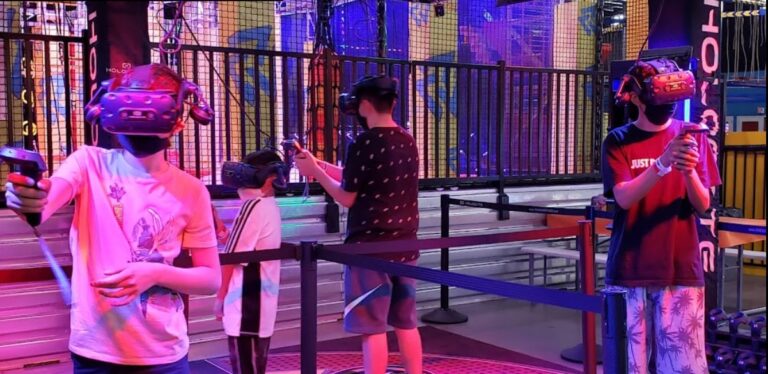
In the rapidly evolving landscape of digital entertainment, few innovations have captured the public imagination quite like the free-roam virtual reality (VR) arena. Unlike traditional home VR setups, which are often confined to a standing square in a living room, free-roam VR removes the tether of wires and the danger of bumping into furniture. It transforms a large physical space into a boundless digital playground, where the player’s body becomes the controller and their movement defines the experience.
At its core, a free-roam VR arena—often referred to as “Location-Based Virtual Reality” or LBVR—is a purpose-built facility designed to allow multiple players to navigate a physical space while wearing high-end VR headsets. These arenas are typically spacious, carpeted, and equipped with sophisticated motion-tracking technology embedded in the walls or ceilings.
The distinction between home VR and a free-roam arena is profound. In a home setting, players are usually restricted by a small “guardian” boundary. In a free-roam arena, the physical space is mapped precisely to the virtual environment. If a player walks ten feet forward in the real world, they walk ten feet forward in the game. This 1:1 movement ratio is the secret ingredient that eliminates the “motion sickness” often associated with joystick-based VR movement. Because the inner ear and the eyes remain in sync, the brain fully accepts the illusion, leading to a state of total immersion that is currently impossible to replicate in a residential setting.
The diversity of scenarios available in these arenas is expanding at a rapid pace. Developers are no longer restricted to simple shooting galleries; instead, they are crafting intricate narratives that require collaborative problem-solving and physical navigation.
One common scenario involves tactical survival games, where teams must navigate labyrinthine corridors, defend fortified positions, and coordinate maneuvers to survive waves of digital adversaries. The physical act of crouching behind a virtual crate or leaning around a corner to “peek” adds a layer of adrenaline that traditional gaming lacks.
Beyond combat, there is a growing trend toward “VR escape rooms.” These experiences emphasize logic, physics-based puzzles, and environmental manipulation. Players might find themselves working together to repair a spacecraft, solve ancient riddles in an Indiana Jones-style temple, or navigate a surrealist landscape that defies gravity. These scenarios are designed to feel like a high-stakes adventure, forcing participants to communicate verbally and physically to advance through the stages of the story.
The demographic for free-roam VR is remarkably broad, though it has seen a surge in popularity among younger generations. For kids and teenagers, these arenas serve as a modern-day playground. In an era where digital screen time is often criticized for being sedentary, free-roam VR flips the script. It is an “active” medium; children are running, dodging, and interacting, which turns gaming into a full-body athletic endeavor.
However, the appeal extends far beyond the youth market. Young adults and tech enthusiasts are frequent visitors, drawn by the novelty of being “inside” a game. For many, it acts as a social activity similar to laser tag or bowling—but with the added benefit of being able to step into a fantasy world that would otherwise be impossible to reach. The barrier to entry is also lower than people fear; because the movement is intuitive (walking and reaching), even older demographics who are unfamiliar with traditional game controllers find themselves comfortable within minutes of entering the arena.
The “event” aspect of free-roam VR has made it a premier destination for milestone celebrations and team-building exercises.
For birthday parties and graduations, these arenas offer an experience that is impossible to emulate at home. It creates a shared memory that feels like a group outing to a movie, but where the participants are the stars of the plot. The excitement of seeing friends and family members interacting with virtual objects is a powerful bonding experience.
Corporate parties and team-building events have also embraced the technology. In a workplace environment, free-roam VR serves as a unique tool for communication training. When a team of colleagues is trapped in a virtual disaster scenario, the hierarchy of the office often evaporates, replaced by the necessity of clear communication and trust. Managers find that these sessions reveal leadership styles and problem-solving capabilities in a way that boardrooms never could. Because the environment is so engaging, the “corporate” feel of the event disappears, leaving behind a genuine sense of camaraderie born from surviving a high-pressure, albeit virtual, situation.
The academic and industrial consensus on free-roam VR is overwhelmingly optimistic, though it comes with a call for continued technological refinement. Scientists studying “presence”—the psychological feeling of being in a location other than one’s physical body—view free-roam VR as the gold standard. Because the user’s proprioception (the sense of self-movement and body position) is aligned with the visual feedback, the cognitive impact is significantly higher than in any other medium. Researchers are currently looking into the therapeutic applications of these arenas, suggesting that they could be used to treat phobias, PTSD, and even as a tool for physical rehabilitation, where movement in the virtual world helps retrain the brain to control limbs in the physical one.
Industry experts, meanwhile, focus on the scalability of the technology. They envision a future where VR arenas are not just specialized venues, but integrated parts of our urban infrastructure, similar to gyms or movie theaters. The consensus is that as hardware becomes lighter, wireless technology improves, and haptic feedback suits become more accessible, the barrier between the real world and the digital world will continue to thin.
While some critics point out that the initial cost of infrastructure remains high, the widespread adoption of location-based entertainment suggests that consumers are willing to pay for premium, high-fidelity experiences that their home equipment simply cannot provide. The experts agree that we are currently in the “early adopter” phase, and as the software library grows, free-roam VR will move from a niche curiosity to a staple of modern entertainment.
In conclusion, the free-roam VR arena represents more than just a passing trend in gaming; it is a fundamental shift in how we consume stories and interact with teammates. By bridging the gap between physical exertion and digital fantasy, these arenas offer a unique venue for growth, social connection, and an unparalleled level of excitement that continues to push the boundaries of what is possible in the human experience.


 2800 S Telephone Rd, Moore, OK 73160, United States