El Monte
 Log in
Log in
Log in

Sandbox VR is located in San Ramon, California, on San Ramon Valley Boulevard, just off Interstate 680.
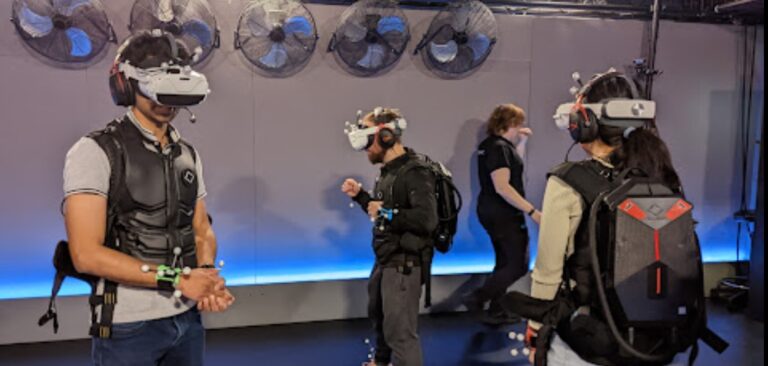
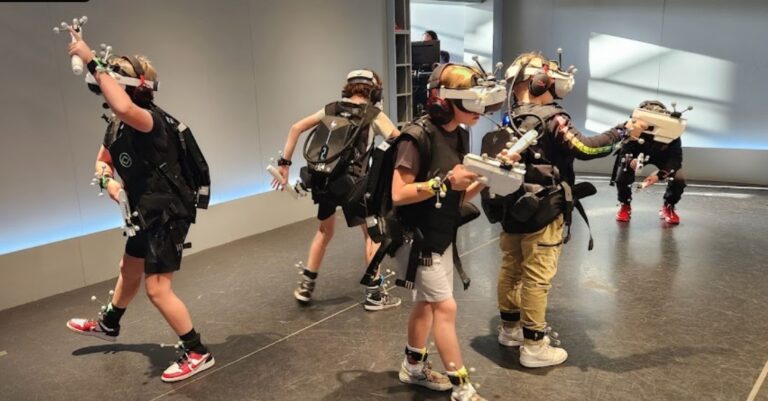
The venue offers a library of exclusive full-body VR experiences developed in-house and in partnership with Netflix, including Deadwood Mansion, Squid Game Virtuals, Stranger Things: Catalyst, and Amber Sky 2088. Groups of two to six players wear motion-capture suits and haptic vests to physically explore virtual worlds together. Each session lasts about an hour including briefing and gameplay, and a free mixed reality highlight video is included with every booking.
Beyond the games themselves, the attentive staff guides guests through every step. The venue is a popular choice for birthday parties, corporate team building, bachelor and bachelorette parties, and family outings. A comfortable lounge area and a party room allow groups to relax and rewatch their gameplay highlights after the mission ends. The San Ramon location serves the broader Tri-Valley area as a go-to destination for unique group entertainment.
 Indoors
Sandbox VR is located inside the Hillsdale Shopping Center in San Mateo, California.
The venue offers a library of exclusive full-body VR experiences developed in-house and in partnership with Netflix, including Deadwood Mansion, Squid Game Virtuals, Stranger Things: Catalyst, and Amber Sky 2088. Groups of two to six players wear motion-capture suits and haptic vests to physically explore virtual worlds together. Each session lasts about an hour including briefing and gameplay, and a free mixed reality highlight video is included with every booking.
Beyond the games themselves, the attentive staff — frequently praised by name in reviews — guides guests through every step. The venue is a popular choice for birthday parties, corporate team building, bachelor and bachelorette parties, and family outings. A comfortable lounge area allows groups to relax and rewatch their gameplay highlights after the mission ends. Being located inside Hillsdale Shopping Center, dining and shopping options are steps away.
IndoorsSandbox VR is located in downtown San Francisco, just off Market Street at Yerba Buena Lane.
The venue offers a library of exclusive full-body VR experiences developed in-house and in partnership with Netflix, including Deadwood Mansion, Squid Game Virtuals, Stranger Things: Catalyst, and Amber Sky 2088. Groups of two to six players wear motion-capture suits and haptic vests to physically explore virtual worlds together. Each session lasts about an hour including briefing and gameplay, and a free mixed reality highlight video is included with every booking.
Beyond the games themselves, Sandbox VR San Francisco features four private holodecks and a dedicated party room, making it a natural fit for birthday celebrations, corporate team building, bachelor and bachelorette parties, and friendly game nights. The attentive staff guides guests through every step, and a comfortable lounge area allows groups to relax and rewatch their gameplay highlights after the mission ends. The venue also hosts private events for larger groups upon request.
IndoorsSandbox VR is located inside the Bay Street Emeryville shopping center in Emeryville, California, just across the bay from San Francisco and easily accessible from Oakland and Berkeley.
The studio offers full-body virtual reality with haptic vests and motion tracking for groups of up to six players. Six immersive experiences are available, including “Deadwood Valley” (zombie survival), “Curse of the Crimson Lily” (pirate adventure), “Squid Game: Virtuals,” “Star Trek: Discovery,” “Smashball,” and “Amber Sky.” Each session runs approximately 30 minutes with a dedicated Game Master handling all technical setup and guidance. The cooperative nature of the games makes it a strong choice for team-building and group outings.
Birthday parties, corporate events, and private buyouts are available, with a Party Room add-on for groups who want dedicated space before or after their session. The studio is located within Bay Street Emeryville, giving visitors access to restaurants, shopping, and an AMC theater for a full night out. A comfortable lounge area is available for waiting or post-game relaxation, and digital recordings of each session can be shared on social media.
Indoors
San Francisco, CA is fast becoming an epicenter for virtual reality (VR) innovation. Virtual reality arenas are popping up across the city, offering a unique and immersive experience for both gamers and non-gamers alike. These arenas are allowing visitors to immerse themselves in an alternate world, giving them an experience they wouldn’t get anywhere else.
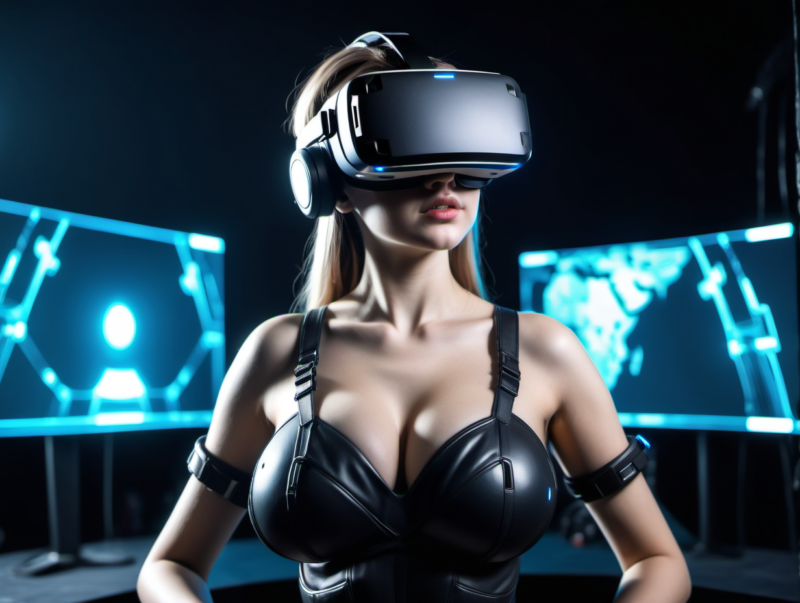
A free‑roam virtual‑reality arena is a purpose‑built space where participants can move unrestricted while wearing a head‑mounted display (HMD). Unlike seated or tethered systems that confine the user to a small play area, free‑roam venues combine wireless VR hardware with real‑world safety measures—such as padded walls, motion‑capture markers, and floor‑level tracking—to let users physically walk, duck, leap, and interact with the environment. The arena’s dimensions typically range from a modest 10 × 10 m room to a full‑scale warehouse that can accommodate dozens of players simultaneously.
The technology stack behind a free‑roam arena blends several components. Inside‑out tracking cameras or external sensor rigs capture the precise position and orientation of each headset and controller, feeding the data to a high‑performance computer that renders the virtual world in real time. Wireless transmission (often via Wi‑Gig or dedicated 5 GHz links) eliminates cables, while battery packs on the headsets provide several hours of operation. The physical layout is deliberately designed to be obstacle‑free; soft padding, safety nets, and clear signage reduce the risk of accidental collisions, allowing participants to focus on immersion rather than caution.
Because the experience is not limited by a stationary play space, developers can design environments that scale with the arena’s size. A single user can explore a sprawling alien planet, a group can battle in a massive multiplayer arena, or a class can walk through a historical reconstruction—each scenario taking advantage of the room‑scale freedom that defines a free‑roam VR arena.
The unrestricted movement offered by free‑roam arenas opens the door to a broad spectrum of scenarios, each leveraging physical locomotion to deepen immersion.
Adventure Exploration – Players embark on quests that span entire virtual continents. The ability to physically stride across a meadow, climb a digital cliff, or crawl through a dark cavern translates into a visceral sense of presence that tabletop maps or seated VR cannot match.
Competitive Sports – From futuristic dodgeball to zero‑gravity fencing, free‑roam venues can host fast‑paced multiplayer matches. The kinetic feedback of sprinting, dodging, or leaping adds a layer of athleticism that blurs the line between video games and real‑world sport.
Educational Simulations – History lessons become living experiences when students walk the streets of ancient Rome, observe a volcanic eruption up close, or interact with a virtual chemistry lab. The physical act of moving through the content helps reinforce memory retention.
Therapeutic and Rehabilitation Activities – Physical therapy programs can incorporate game‑like tasks that encourage patients to move within a safe, controlled environment. The motivational aspect of a gamified VR setting often leads to higher compliance and faster progress.
Story‑Driven Role‑Playing – Narrative experiences benefit from the freedom to physically act out gestures, manipulate props, and explore branching environments. Actors can rehearse scenes in a fully immersive set, while audiences watch from a separate viewing area.
Corporate Training – Simulations for safety drills, equipment handling, or soft‑skill scenarios (such as negotiation or leadership) can be run in a realistic, repeatable format that reduces risk and cost compared to real‑world mockups.
These scenarios illustrate how free‑roam VR transcends traditional gaming boundaries, turning the arena into a versatile platform for entertainment, education, health, and professional development.
Free‑roam VR has attracted a surprisingly diverse audience. While early adopters were predominantly teenage gamers and tech enthusiasts, the demographic now spans children, families, educators, and corporate teams.
Children and families constitute a growing segment. The tactile nature of walking, reaching, and gesturing aligns naturally with how kids explore the world, making the experience intuitively accessible. Parents appreciate the active component—VR that encourages movement rather than sedentary screen time. Many venues curate age‑appropriate content, ranging from whimsical fairy‑tale forests to gentle space‑exploration adventures, ensuring that younger users encounter safe, age‑suitable stimuli.
Educational institutions are also integrating free‑roam VR into curricula. Schools use it to bring abstract concepts to life: biology students dissect virtual organisms, geography classes traverse three‑dimensional maps, and language learners practice conversation in simulated cafés. The collaborative nature of the arena encourages teamwork and peer learning, aspects that are harder to replicate in a solitary headset experience.
Adult gamers and hobbyists continue to drive the market with demand for high‑intensity, multiplayer titles that leverage the physicality of the arena. These users often seek competitive leagues, seasonal events, and high‑score leaderboards that foster a community around the venue.
Corporate groups utilize the space for team‑building exercises, leadership workshops, and product demonstrations. The neutral, immersive environment strips away office distractions, allowing participants to focus on the task at hand while fostering a sense of shared adventure.
Overall, free‑roam VR’s appeal lies in its capacity to translate digital content into a bodily experience, making it relevant for any audience that values active participation.
The adaptability of free‑roam arenas makes them an attractive choice for a variety of celebrations and corporate functions. Organizers can customize the virtual backdrop to match the theme of the event, turning a standard party hall into a galaxy‑orbiting dance floor, a medieval castle banquet, or a futuristic conference center.
For children’s birthdays, venues often offer themed packages—pirate treasure hunts, dinosaur expeditions, or superhero training camps. The immersive world provides a narrative structure that keeps guests engaged for the entire duration of the party. Parents benefit from the supervised environment: staff members monitor safety, handle equipment, and guide participants through each activity, allowing the celebrant to focus on fun rather than logistics.
Graduation ceremonies can be reimagined as a collective virtual journey. Graduates might walk together through a simulated campus, pause at interactive milestones representing academic achievements, and culminate in a spectacular virtual fireworks display. The physical act of walking across a digital stage adds a memorable, kinesthetic layer to an already emotional occasion.
Corporations are increasingly turning to free‑roam VR for product launches, client entertainment, and internal celebrations. A product debut can be staged within a fully rendered virtual showroom, letting attendees interact with digital prototypes as if they were tangible objects. Team‑building exercises—such as cooperative puzzle solving, escape‑room challenges, or virtual obstacle courses—strengthen collaboration skills while providing a novel, conversation‑sparking experience.
The logistics of hosting an event in a free‑roam arena are streamlined by the venue’s staff. They manage equipment sanitization, schedule rotations to accommodate varying group sizes, and provide on‑site technical support. This turnkey approach removes the complexity often associated with organizing high‑tech experiences, making free‑roam VR a viable option for both small gatherings and large corporate functions.
Researchers and industry experts view free‑roam VR as a pivotal development in the evolution of immersive technology. Several key insights have emerged from recent studies and professional analyses.
Enhanced Spatial Presence – Empirical investigations indicate that unrestricted locomotion significantly amplifies the feeling of “being there” compared to seated or limited‑area VR. The congruence between visual flow, vestibular cues, and proprioception reduces cognitive dissonance, leading to deeper immersion and longer tolerated session times.
Physical Activity and Health Benefits – Public health specialists point out that free‑roam VR can serve as a form of moderate exercise. A typical 30‑minute session may involve walking, squatting, and arm movements comparable to a brisk walk or light aerobics class. When paired with gamified objectives, users are motivated to stay active for longer periods than in traditional gym routines.
Data Collection for Human‑Computer Interaction (HCI) – The arena’s sensor network captures high‑resolution motion data from multiple participants simultaneously. This dataset is valuable for HCI researchers studying naturalistic movement patterns, gesture recognition, and collaborative dynamics in shared virtual spaces.
Commercial Viability and Market Growth – Industry analysts project a compound annual growth rate of over 30 % for location‑based free‑roam VR experiences within the next five years. The driving forces include decreasing hardware costs, improvements in wireless bandwidth, and rising consumer demand for social, physical entertainment options.
Safety and Ergonomics – Ergonomists emphasize the importance of designing arenas with clear safety protocols. Studies have shown that well‑padded environments, real‑time collision avoidance systems, and mandatory briefings reduce the incidence of minor injuries to negligible levels. Moreover, ergonomic headset designs that balance weight and field of view are essential to prevent neck strain during extended sessions.
Collectively, these perspectives underscore that free‑roam VR is not merely a novelty but a platform with measurable psychological, physiological, and economic impacts. Its capacity to blend physical movement with digital storytelling positions it as a cornerstone of future immersive applications.
Free‑roam VR arenas have transformed the way people interact with virtual worlds. By removing the physical constraints of traditional VR setups, they enable a breadth of scenarios—from adventurous exploration and competitive sports to educational simulations and therapeutic exercises. The technology appeals to a wide audience: children revel in active play, students gain hands‑on learning experiences, gamers enjoy kinetic competition, and corporations find fresh avenues for training and celebration.
Special events such as birthdays, graduations, and corporate parties benefit from the arena’s adaptability, turning ordinary gatherings into unforgettable immersive journeys. Meanwhile, scientists and industry leaders recognize the platform’s potential for enhancing presence, promoting physical activity, generating valuable interaction data, and driving market growth.
As wireless hardware becomes lighter, tracking systems more precise, and content pipelines richer, free‑roam VR is poised to become an integral part of entertainment, education, and professional ecosystems. The era where walking through a virtual world feels as natural as strolling down a hallway has arrived, and free‑roam arenas stand at the forefront of this immersive revolution.


 6000 Bollinger Canyon Rd #2401, San Ramon, CA 94583, United States