El Monte
 Log in
Log in
Log in

Petaluma Playland is located on the Sonoma County Fairgrounds property in Petaluma, California.
The venue offers five action sports — paintball, airsoft, laser tag, Gelly Ball, and Nerf games — across multiple themed fields including a Ghost Town, an urban arena, a professional turf field, and a wooded area. Private parties for groups of eight or more run two to three hours with dedicated referees and private field access. Walk-on play is available on weekends for individuals who want to drop in without a reservation.
The club also hosts corporate team-building events, birthday parties, and group celebrations. A pro shop sells snacks and drinks, local restaurants deliver to the field, and spectators are welcome in designated viewing areas. Nighttime glow sessions add a unique after-dark experience with cosmic paintball, glow airsoft, and glow Gelly Ball. The facility closes temporarily each June through mid-July due to the annual Sonoma County Fair on the fairgrounds property.
 Indoors
 Outdoors
Fairfield Extreme Sports Paintball and Airsoft is located on Cordelia Road in the Cordelia area of Fairfield, California.
The park offers outdoor paintball and airsoft with game modes including Capture the Flag, Team Death Match, Free for All, and King of the Hill. Players can bring their own equipment or rent markers, masks, air tanks, and airsoft rifles on-site. The field features a mix of natural terrain and tactical obstacles like bunkers and barricades, creating a dynamic environment that rewards teamwork and strategy. The park runs regular weekend open play as well as special scenario events such as Zombie Wars.
Beyond the games themselves, the facility provides a dressing room, restrooms, parking, and a staging area for resting between matches. The venue is well-suited for birthday parties, corporate team-building events, bachelor parties, and group outings. The staff includes experienced referees who ensure safety and fair play while maintaining a friendly, community-oriented atmosphere. Rental packages and group deals are available, and reservations are required to play.
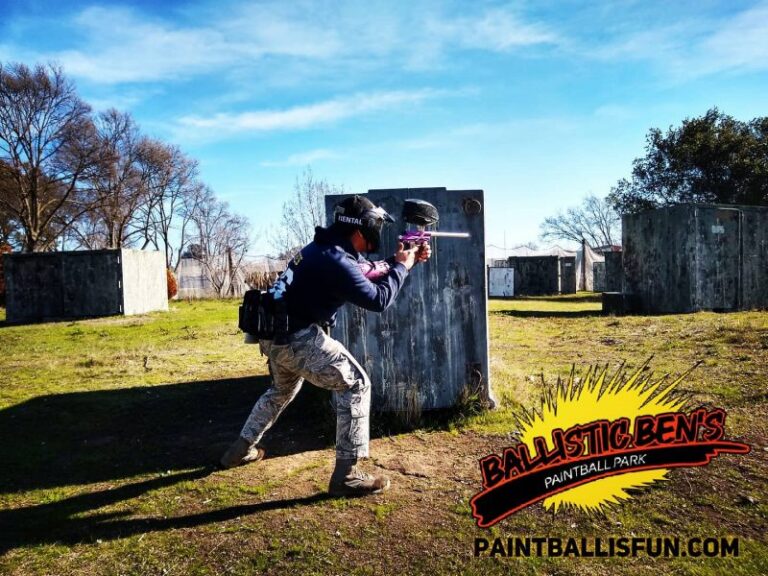
OutdoorsBallistic Ben’s Paintball Park is located on Travis Air Force Base in Fairfield, California, at 125 Armstrong Street. Access requires a valid military ID or prior base clearance. The park spans 20 acres with 11 unique playing fields including jungle, castle, and trench warfare courses, plus Hyperball and Airball setups. They offer Gel Blasters (ages 5+), Low-Impact Paintball, Traditional Paintball, and Airsoft (ages 10+). Game modes include Capture the Flag, King of the Hill, Mario Kart, and Attack and Defend. The park operates by reservation only for private groups 7 days a week, with walk-on play on select Saturdays.
Private group reservations are available for birthday parties, corporate events, and squadron morale days. All equipment is available for rent on-site. The staff is known for being passionate and safety-focused. Military members and dependents receive a discount with valid ID. A charging station is available at no cost, and air, CO2, and batteries can be purchased on-site. The park recommends low-impact paintball for all ages due to its reduced sting, making it family-friendly for first-timers and experienced players alike.
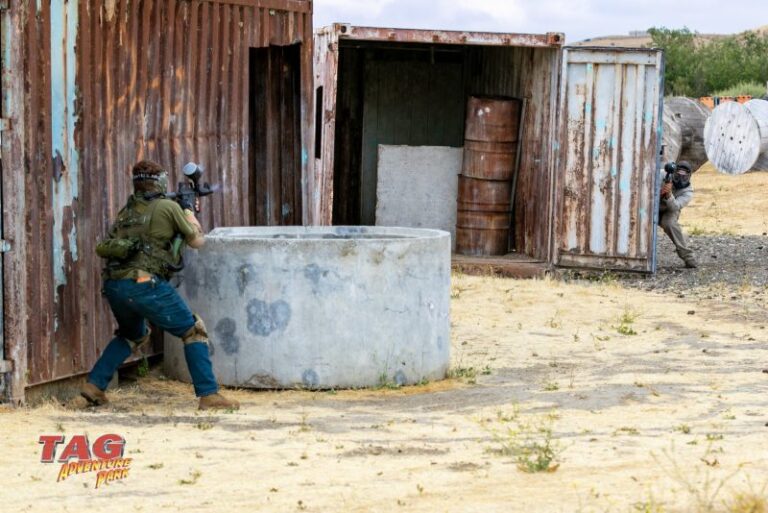
OutdoorsTAG Adventure Park is located in Hollister, California, along San Benito Street — about 30 miles south of San Jose and roughly 45 minutes from Monterey, nestled in the rolling hills of San Benito County.
The park offers paintball at three impact levels (Low, Medium, and High), airsoft, gellyball, archery, Run & Gun time trials, laser tag, and a variety of specialty activities. Over ten courses include speedball, CQB, trenches, a fort, and natural terrain. Walk-on paintball and gellyball are available every weekend, while airsoft runs on select dates. Private events can be booked for birthdays, bachelor parties, corporate team-building, and church or youth groups.
The park features a covered picnic area with misters, elevated watch towers for spectators, and a family-owned staff with over 35 years of experience. Rental gear is available for all activities, and the paintballs are eco-friendly and non-staining. The atmosphere is welcoming to beginners and seasoned players alike, with a strong emphasis on safety and fair play.
OutdoorsGamepod Combat Zone is located in Antioch, California, in the East Bay region of the San Francisco Bay Area.
The 120,000-square-foot indoor facility was originally designed for law enforcement and military training and now opens to the public for airsoft six days a week. Players can drop in for scenario-based 45-minute missions running Wednesday through Sunday, with rental packages available for those without their own gear. The arena features a full-scale urban environment with buildings, a replica aircraft, a jail block, and multiple streets and alleyways. Game modes include team deathmatch, capture the flag, hostage rescue, and bomb defusal, with larger sponsored special events held throughout the year.
Private parties are available for groups of up to 20 players with full facility access, an event manager, and customizable scenarios. Corporate team-building programs are designed by military and law enforcement professionals to develop leadership and communication skills. The on-site Evike Outpost superstore stocks a full range of airsoft equipment and accessories. The facility also serves as a law enforcement training center during weekdays, maintaining professional-grade conditions at all times. Non-participants are welcome to watch from safe areas at no charge.
Indoors
Airsoft is a recreational activity in San Francisco, CA that allows participants to compete in simulated military-style combat using replica firearms. Players are equipped with airsoft guns, which fire BBs or pellets, and then engage in a variety of scenarios, such as capture the flag or team deathmatch.
Airsoft is a fast‑growing sport that blends the thrill of tactical combat with the camaraderie of team play. Participants use replica firearms that fire 1.0‑ to 6.0‑mm plastic BBs powered by electricity, compressed gas, or springs. The weapons are engineered to look, feel, and sound like their real‑world counterparts, but they operate at velocities low enough to be safe when proper protection is worn. In a single match, a handful of players can become a squad advancing through a mock urban landscape, a group of “civilians” attempting a hostage rescue, or a platoon executing a night‑time infiltration. The essence of airsoft is the same as any well‑run simulation: realistic equipment, disciplined teamwork, strategic thinking, and a shared respect for the rules that keep the experience fun and injury‑free.
The realism of airsoft stems from three intertwined elements. First, the gear – from the weight of an AEG rifle to the recoil‑simulating bolt of a gas‑powered pistol – mirrors the handling characteristics of genuine firearms. Second, many fields lay out detailed “mission briefs” that describe objectives, terrain, and potential threats, encouraging players to plan routes, assign roles, and coordinate fire. Finally, the sport’s emphasis on tactics forces participants to think like soldiers, police officers, or special‑operations units: they learn to use cover, communicate silently, and execute flanking maneuvers.
Teamwork is not an optional bonus; it is the core mechanic that separates airsoft from a simple shooting gallery. A successful squad will assign a “point man,” a “sniper,” a “medic,” and a “communications specialist,” each with a distinct purpose. The point man clears the path, the sniper provides overwatch, the medic supplies “first aid” to downed teammates, and the communications specialist maintains radio discipline. This division of labor mirrors real‑world combat teams and teaches players how to trust one another’s expertise while remaining adaptable under fire.
Strategic depth emerges from the variety of game modes and the freedom to customize both equipment and tactics. A match might be a rapid‑fire “capture the flag” where speed wins, a “last man standing” showdown that rewards patience and positioning, or a multi‑hour “MilSim” (military simulation) campaign that weaves a narrative across several days. The choice of mode dictates how a squad allocates resources: a fast‑paced skirmish may favor lightweight gear and high‑capacity magazines, while a MilSim operation might call for heavier armor, extra ammunition caches, and a supply chain of “logistics” players.
| Game Mode | Core Objective | Typical Duration | Tactical Emphasis |
|---|---|---|---|
| Capture the Flag | Seize the opponent’s flag and return it to base | 10–20 minutes | Speed, coordinated assaults, quick‑reaction defense |
| Team Deathmatch | Eliminate the opposing team | 5–15 minutes | Accurate shooting, aggressive push, aggressive positioning |
| Search & Destroy | Plant a “bomb” at a target site while the defenders disarm | 15–30 minutes | Timing, communication, coordinated breaching |
| MilSim Campaign | Complete a series of mission objectives over multiple days | Hours‑to‑days | Long‑term planning, supply management, role specialization |
| Zombie Survival | One side defends against an ever‑growing “infected” force | 20–30 minutes | Defensive fortifications, resource conservation |
While the table above provides a quick glance, the real excitement lies in the improvisation each match demands. A squad that thrives in “Capture the Flag” may need to completely re‑engineer its approach for a “Zombie Survival” scenario, swapping loud AEGs for suppressed pistols and adding extra body armor.
Airsoft’s aftermarket is a sprawling ecosystem of parts, accessories, and upgrades. Players can swap out inner barrels for tighter tolerances that increase accuracy, replace standard hop‑up buckles with adjustable units for superior range control, or install higher‑capacity magazines to reduce reload frequency. Beyond the firearm itself, the “load‑out” includes tactical vests, chest rigs, MOLLE‑compatible pouches, camouflage patterns, and even night‑vision goggles (real or faux). This level of personalisation allows a player to fine‑tune the balance between mobility, protection, and firepower to suit their preferred role and the specific demands of a given game mode.
Customization also fuels a vibrant community of hobbyists who share build guides, DIY tutorials, and trade parts at local meet‑ups. The collaborative spirit extends to field operators who constantly redesign bunkers, construct realistic urban streetscapes, and integrate electronic scoring systems that track hits in real time. The result is a constantly evolving sport that keeps even veteran players engaged.
Airsoft is as much about the people you meet as it is about the matches you play. Clubs and teams form around shared interests – some focus on historical reenactments, others on modern tactical drills, and still others on sci‑fi or fantasy themes. Online forums, Discord channels, and social‑media groups provide a constant stream of advice, event announcements, and gear reviews. The community’s emphasis on mentorship means new players often find seasoned veterans willing to loan equipment, teach proper safety protocols, and explain the nuances of game etiquette. This inclusive environment helps foster a sense of belonging that keeps participants returning week after week.
Every newcomer should build a solid safety foundation before stepping onto the field. The following items constitute the essential “starter kit”:
With these basics, a player can safely engage in most game formats. Additional items such as a tactical vest, a hydration pack, and a reliable radio may be added as the player’s involvement deepens.
These rules are reinforced by field marshals who monitor compliance, resolve disputes, and ensure that the environment remains safe and enjoyable for everyone.
Each platform has its own strengths, and many players own a mix—an AEG rifle for general play, a gas pistol for close‑quarters engagements, and a spring sniper for long‑range precision.
Researchers in ballistics and injury prevention have examined airsoft BBs as a low‑energy projectile, concluding that while the kinetic energy is far below that of real firearms, the risk of ocular injury remains significant without proper eye protection. Studies also note that the plastic composition of BBs reduces the likelihood of severe skin penetration, making the sport relatively safe compared to paintball, which uses larger, heavier pellets.
Industry analysts point out that airsoft’s rapid growth is driven by its blend of affordability, accessibility, and the rising popularity of tactical gaming. The market for airsoft equipment—estimated at over $700 million globally—has spurred innovation in battery technology, polymer plastics, and realistic replica design. Experts caution, however, that regulatory landscapes vary widely; some jurisdictions classify airsoft replicas as firearms, imposing strict licensing, while others treat them as toys. Players are encouraged to stay informed about local laws and to advocate for responsible legislation that protects both safety and hobbyist freedoms.
The demographic tapestry of airsoft is surprisingly diverse. Teenagers and college students often join for the excitement and social aspect, while many adults—ranging from corporate team‑building participants to military veterans—appreciate the strategic depth and physical challenge. Law‑enforcement agencies sometimes use airsoft for training in low‑risk scenarios, and hobbyists with a passion for historical reenactments adapt the sport to simulate World War‑I trench battles or medieval skirmishes. Family‑oriented groups also find value in “kid‑friendly” fields that enforce lower velocity limits and provide lighter weapons.
When selecting a venue, players should verify that the site adheres to recognized safety standards, provides clear communication channels, and respects the honour system that underpins the sport’s culture.
Airsoft stands at the intersection of recreation, tactical training, and community building. Its realistic replicas and immersive scenarios attract those who crave teamwork, strategic depth, and the satisfaction of mastering a complex hobby. By starting with the essential safety gear—eye protection, gloves, sturdy boots, protective pads, helmets, and lower‑face shielding—newcomers can dive into the sport with confidence. Understanding the basic rules, respecting the honour system, and embracing the diversity of game modes ensures that every match remains both thrilling and safe.
Whether wielding an AEG rifle, a gas‑powered pistol, or a spring‑loaded sniper, participants quickly discover that airsoft is more than “shooting plastic beads.” It is a disciplined, ever‑evolving activity that encourages problem‑solving, physical fitness, and camaraderie. Scientists endorse its low‑risk profile when proper protection is used, while industry experts celebrate its booming market and innovative technology. From weekend club meet‑ups to multi‑day MilSim campaigns, airsoft offers a venue for anyone—young or old, novice or veteran—to experience the pulse of tactical teamwork in a controlled, respectful environment. The field awaits; all that’s required is a pair of goggles, a willingness to learn, and a sense of adventure.


 471 Kenilworth Drive Petaluma, CA 94952