El Monte
 Log in
Log in
Log in

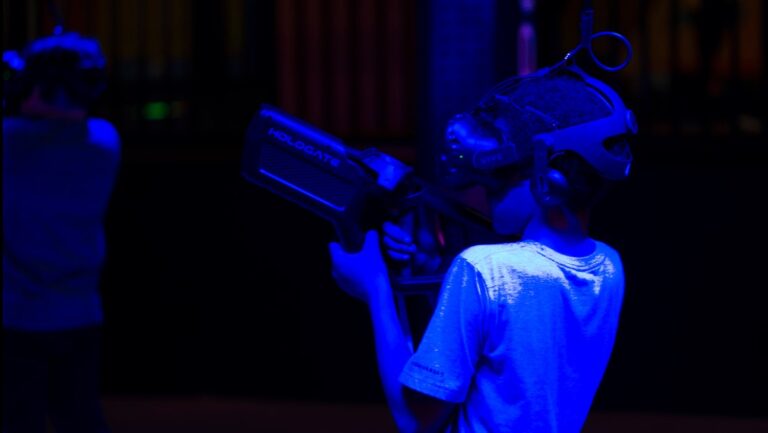
New World Rides is located in the Railroad Square Art District of Tallahassee, Florida. The venue offers two main experiences: a Virtual Reality Arcade with a diverse library of single and multiplayer games, and a Free Roam VR Arena where players use laser blasters in a dynamic, walk-around environment. Their signature attraction is the Roto Loco, a custom-built rotating motion platform that adds physical movement to VR gameplay.
Beyond the core gaming experiences, New World Rides specializes in private events including birthday parties, corporate team-building sessions, and school field trips. The facility includes a lounge and recreation area for guests. The venue is operated by a team of engineers and artists who design and maintain their own equipment, and it is deeply connected to the local Railroad Square arts community, participating in First Friday events and the Railroad Square Bucks discount program.
 Indoors
Urban Air Adventure Park is located at 1644 Governors Square Boulevard in Tallahassee, near the Governor’s Square Mall.
The park offers a wide range of indoor attractions including trampolines, a Sky Rider zip line, ropes course, climbing walls, bumper cars, virtual reality, a warrior course, and a dedicated play area for toddlers. Guests can choose between Ultimate and Deluxe admission passes, with the Ultimate pass granting access to premium attractions like the Leap of Faith and mini go-karts. Birthday parties come in two package tiers with options for table seating, private rooms, or VIP suites, and each party includes a dedicated host, setup, cleanup, and all-day play access.
The Urban Café serves pizza, ICEEs, popcorn, cotton candy, and coffee, with gluten-free pizza available. The park offers memberships for unlimited monthly visits, summer passes for seasonal fun, and camps during school breaks. Parent Passes allow adults to join the fun at a discounted rate, and the Shorty Pass provides affordable access for children under 40 inches. The facility is wheelchair accessible and staff are noted for accommodating children with special needs.
Indoors
Virtual Reality (VR) arenas are a relatively new and exciting addition to the entertainment industry. Tallahassee, Florida is no exception to this trend, as the city has seen a surge in VR arenas in recent years.
VR arenas offer an immersive experience unlike anything else. Participants wear specialized headsets that transport them into a virtual world. Inside the arena, users can interact with their environment or take part in simulated experiences, such as laser tag, paintball, and even drone racing. The possibilities are endless and continue to expand as technology advances.
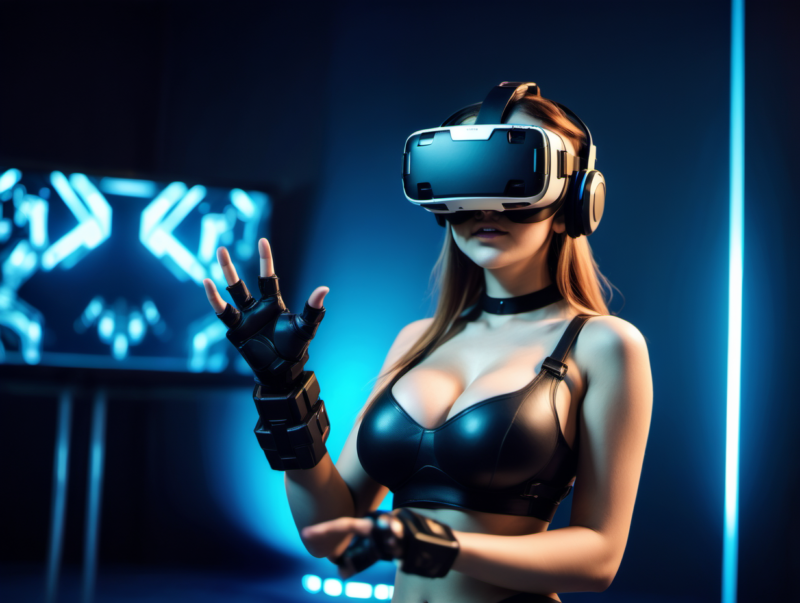
A free‑roam virtual‑reality arena is a physical space that has been transformed into an immersive playground where participants can move unhindered while wearing head‑mounted displays (HMDs). Unlike seated or tethered VR setups, the arena is equipped with a network of motion‑tracking sensors, often mounted on the ceiling, walls, or embedded in the floor, that continuously map each user’s position and orientation in real time. The result is a seamless blend of the real world’s dimensions and the computer‑generated environment, allowing users to walk, duck, jump, and even interact with physical props while their visual experience is rendered entirely within the virtual world.
Because the arena is self‑contained, it eliminates the need for cables or external cameras that could restrict movement. Safety features such as padded walls, padded floors, and emergency stop systems are standard, ensuring that participants can explore the digital landscape without fear of injury. The technology is typically powered by high‑performance PCs or dedicated rendering rigs that drive the graphics at the 90 Hz or higher frame rates required for a comfortable VR experience.
The flexibility of a free‑roam arena lends itself to a wide array of scenarios, each designed to exploit the full range of physical motion. Some of the most popular include:
Adventure Quest: Participants embark on a narrative‑driven journey through fantastical realms—forests, ancient temples, or alien landscapes—solving puzzles and battling virtual foes while physically navigating obstacles.
Sports Simulations: From futuristic zero‑gravity basketball to realistic archery ranges, the arena can replicate the kinetic demands of real‑world sports, providing accurate haptic feedback when a virtual ball is thrown or an arrow is released.
Co‑operative Escape Rooms: Teams must work together to decipher clues, manipulate virtual objects, and unlock doors, all while moving through a physically bounded space that mirrors the virtual puzzle layout.
Training Modules: Military, emergency‑response, and industrial training programs use realistic simulations of hazardous environments—fire‑filled buildings, battlefield terrains, or heavy‑machinery operation—allowing trainees to rehearse procedures safely.
Creative Sandbox: Artists and designers can sculpt, paint, or model three‑dimensional objects with their hands, walking around them to view their work from any angle, an experience that extends far beyond what a desktop screen can provide.
Each scenario is built on the premise that the body is an integral controller, not just a passive observer, and that the physicality of movement enhances presence, learning, and enjoyment.
The demographic landscape of free‑roam VR is surprisingly diverse. Early adopters were primarily affluent gamers and tech enthusiasts, but as the cost of hardware has declined and the content library has broadened, the user base now encompasses:
Casual Gamers: Individuals seeking an experience that feels more like an amusement‑park ride than a traditional video game. They are drawn by the novelty of walking through a digital world without the constraints of a couch or chair.
Families: Parents often bring children to free‑roam venues as a “high‑tech playground,” allowing kids to expend energy while engaging with interactive storytelling.
Corporate Teams: Companies use the arenas for team‑building exercises, leveraging cooperative challenges to strengthen communication and trust among employees.
Educational Institutions: Schools and universities integrate free‑roam sessions into curricula ranging from physics (visualizing force fields) to history (walking through ancient cities).
Therapeutic Users: Rehabilitation centers employ the technology to motivate patients recovering from injuries, using gamified movement to improve range of motion and coordination.
Researchers and Developers: The arena serves as a testbed for new interaction paradigms, haptic devices, and AI‑driven NPC behavior, attracting a steady stream of academics and industry innovators.
The shared thread among these groups is the desire for an experience that merges physical activity with immersive storytelling—a combination that traditional flat‑screen gaming or seated VR cannot replicate.
Designing free‑roam experiences for children requires a careful balance of safety, educational value, and entertainment. Operators typically implement several layers of protection: soft‑foam walls, low‑height ceilings, and real‑time monitoring systems that can instantly pause the session if a user steps out of bounds. Content is curated to be age‑appropriate, often featuring bright, cartoon‑style aesthetics and non‑violent gameplay mechanics.
Educational modules are particularly popular among younger audiences. For example:
STEM Adventures: Kids can explore a virtual solar system, manipulate molecular structures, or program simple robots using block‑based coding interfaces, all while physically moving around the arena.
Storytelling Workshops: Children are invited to become protagonists in interactive tales, making choices that affect the narrative outcome and encouraging creativity and decision‑making skills.
Physical‑Fitness Games: Games that require jumping, crawling, or dodging obstacles turn exercise into a playful quest, helping to address concerns about sedentary lifestyles.
Parents appreciate the controlled environment where children can experience cutting‑edge technology without the risk of tripping over cords or damaging expensive equipment. The tactile element of free‑roam also promotes spatial awareness and fine‑motor development, making it a compelling complement to traditional classroom learning.
The adaptable nature of free‑roam arenas makes them ideal venues for special events, turning celebrations into immersive spectacles.
A birthday celebration in a free‑roam arena can be themed to match the honoree’s interests—superhero quests, treasure hunts, or space‑explorer missions. The experience can be segmented into timed “levels,” allowing groups of children to rotate through different challenges while maintaining a manageable crowd size. Personalized avatars and in‑game trophies add a keepsake element that extends the memory beyond the physical party.
Graduation ceremonies have traditionally been formal affairs, but incorporating free‑roam VR injects an element of excitement and novelty. Graduates might embark on a “future‑vision” journey, walking through simulated career paths or exploring global landmarks, symbolizing the transition from campus to the wider world. The arena can also host a virtual gala where alumni from different locations appear as holographic avatars, fostering a sense of community despite geographic separation.
Corporate events benefit from the team‑building and brand‑activation possibilities inherent in free‑roam experiences. Companies can develop custom scenarios that incorporate corporate values or product lines, turning the arena into an interactive marketing showcase. Competitive leaderboards create a light‑hearted rivalry, while collaborative puzzles reinforce problem‑solving skills. The immersive environment also provides a memorable backdrop for awards presentations, photo opportunities, and networking.
In each case, the key advantage is the ability to craft a tailored narrative that aligns with the event’s purpose, while simultaneously offering a physically active, socially engaging experience that leaves a lasting impression.
The scientific community has taken a keen interest in the potentials and challenges of free‑roam VR, recognizing its impact on fields ranging from neuroscience to ergonomics. Researchers study how unrestricted movement within a virtual environment influences spatial cognition, noting that the congruence between vestibular, proprioceptive, and visual cues enhances the brain’s sense of presence more effectively than seated VR. These findings have implications for therapeutic interventions, such as exposure therapy for phobias, where realistic navigation can accelerate desensitization.
From an engineering perspective, experts emphasize the importance of low‑latency tracking and high‑resolution rendering to prevent motion sickness—a phenomenon still present despite the physical freedom of movement. The integration of edge‑computing and 5G connectivity is seen as a pathway to delivering richer, more responsive environments without the need for massive on‑site hardware.
In the realm of human‑computer interaction, scholars argue that free‑roam VR represents a paradigm shift toward embodied interaction. By allowing users to manipulate virtual objects with their whole bodies, designers can explore new interaction vocabularies that go beyond hand controllers, such as full‑body gestures, gait modulation, and even subtle weight shifts. This opens avenues for more naturalistic user interfaces in both entertainment and professional contexts.
Industry leaders in the gaming and entertainment sectors view free‑roam VR as a growth market poised to complement traditional esports and streaming platforms. They stress that scalability—both in terms of physical space and cost—will determine widespread adoption. Modular arena designs, reusable tracking hardware, and subscription‑based content models are being explored to lower entry barriers for smaller venues and pop‑up experiences.
Overall, the consensus among scientists and experts is that free‑roam VR stands at the intersection of technology, psychology, and design, offering a fertile ground for innovation while demanding rigorous attention to safety, accessibility, and technical precision.
Free‑roam virtual‑reality arenas have evolved from niche attractions into versatile platforms that cater to gamers, families, educators, corporations, and researchers alike. By marrying unrestricted physical movement with high‑fidelity digital worlds, they deliver an experience that feels both exhilarating and purposeful. Whether it is a child learning basic physics through a playful adventure, a corporate team strengthening its cohesion, or a scientist probing the limits of human perception, the arena provides a canvas where imagination and reality converge. As tracking technologies improve, content libraries expand, and industry models mature, free‑roam VR is set to become an increasingly integral part of the social and educational fabric of the coming decade.


 Railroad Square Art District 636-2 Railroad Square Tallahassee FL, 32310