El Monte
 Log in
Log in
Log in

Stars and Strikes Family Entertainment Indoor Center is located in Augusta, GA.
Stars and Strikes is a family-friendly entertainment center located in Augusta, GA. It offers a variety of activities such as bowling, laser tag, arcade games, bumper cars, and virtual reality experiences. The center also has a full-service restaurant and bar, making it a great spot for birthday parties, corporate events, or just a fun night out with family and friends. There are multiple packages available, including options for unlimited play and group discounts. Overall, Stars and Strikes is a great spot for anyone looking for a fun and exciting time in Augusta.
 Indoors
Urban Air Trampoline and Adventure Indoor Park is located in Augusta, GA.
Urban Air Trampoline and Adventure Park in Augusta, GA is a thrilling indoor destination for families and adventurous individuals. The park offers a range of activities including trampolines, climbing walls, dodgeball, Warrior obstacle course, ropes course, and virtual reality experiences. It’s the perfect spot to host a birthday party, corporate event, or just spend a day out with friends and family. With affordable prices and countless options for entertainment, Urban Air Trampoline and Adventure Park is a must-visit destination for anyone in Augusta looking for a fun-filled adventure.
IndoorsPutt-Putt Fun Center is located in Augusta, GA.
Putt-Putt Fun Center: Augusta, GA’s Hub for Family Entertainment
For those seeking fantastic family fun in Augusta, GA, Putt-Putt Fun Center aims to be the ideal destination. They focus on providing opportunities for adults and kids alike to connect, compete, and simply enjoy quality time together in a welcoming atmosphere. From the batting cages to the bumper cars to the meticulously maintained 36 holes of Putt Putt mini golf, they strive to offer something that will bring a smile to everyone’s face. Their indoor area features a cafe, a laser tag arena, and a wide selection of engaging arcade games.
When a child’s birthday arrives, Putt-Putt Fun Center aims to provide a truly unforgettable celebration with their friends from school and/or extracurricular activities. They offer a convenient alternative to hosting a group of energetic kids at home, allowing parents to relax and enjoy the festivities. They aim to provide the ultimate birthday party experience, leaving the mess and stress behind.
Indoors
If you’re looking for an exciting and unique way to have a good time in Augusta, GA, then you should check out laser tag! With several different laser tag centers in the area, there’s no shortage of exciting action-packed adventures for you and your friends to experience!
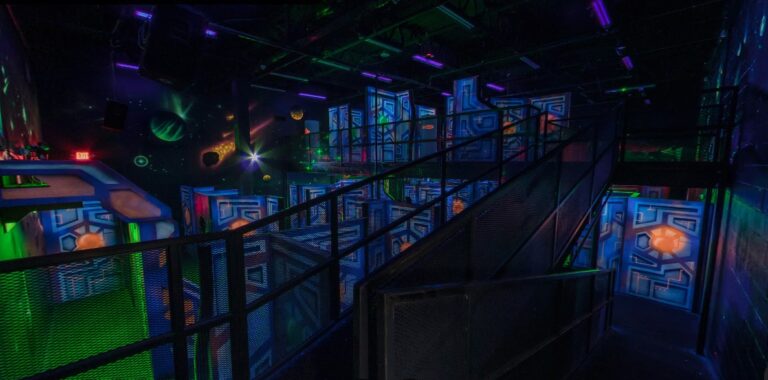
Laser tag games typically feature large arenas with plenty of obstacles and hiding spots, along with innovative laser guns, making the experience even more exhilarating. You can even choose to battle your opponents in a specialized 3-D laser tag arena, equipped with special effects, fog, and even music to up the ante!

Laser tag is a fast‑paced, technology‑driven game in which participants wear light‑sensitive vests and wield hand‑held infrared “guns.” When a player fires, a brief pulse of invisible infrared light is emitted; if it strikes an opponent’s sensor, the hit is recorded by a central computer system. Scores are automatically tallied, and the game can be stopped, paused, or reset with the push of a button.
Unlike traditional paintball, laser tag leaves no mess, requires no protective gear beyond the vest, and can be played in a wide variety of environments—from dimly lit corridors in a shopping mall to sprawling forest trails. The core premise is simple: teams or individuals compete to tag as many opponents as possible within a set time limit while avoiding being tagged themselves. The blend of physical movement, strategic thinking, and instant feedback makes laser tag a uniquely immersive experience that straddles the line between sport and interactive entertainment.
The flexibility of laser‑tag technology lends itself to a multitude of themed scenarios. Game designers and venue operators routinely craft narratives that transform a standard arena into a battlefield, a treasure hunt, or a sci‑fi adventure. Some of the most popular formats include:
Each scenario can be fine‑tuned with variables such as time limits, hit‑point values, and power‑up zones, allowing venue operators to keep the experience fresh for repeat players.
Beyond the obvious thrill of competition, laser tag offers a suite of physical, mental, and social advantages that have made it a favored activity for schools, fitness centers, and corporate wellness programs.
Collectively, these benefits have prompted educators, fitness professionals, and health insurers to consider laser tag as a supplemental tool for promoting active lifestyles.
Researchers in kinesiology and human‑computer interaction have taken a growing interest in laser tag as a model for studying embodied interaction in a controlled yet lively environment. A 2022 paper published in Applied Ergonomics highlighted the technology’s capacity to simulate high‑intensity interval training while capturing detailed motion and biometric data through built‑in vest sensors. The authors argued that laser tag could serve as a low‑cost platform for monitoring physical activity in real‑time, offering valuable insights for rehabilitation programs.
Industry analysts point to the sector’s steady expansion. According to a 2023 market report from Global Play Insights, the worldwide laser‑tag market is projected to grow at a compound annual growth rate of 7 % through 2030, propelled by advances in wireless networking, battery efficiency, and augmented‑reality integration. Experts attribute this momentum to two converging trends: the rise of experiential entertainment—where consumers prioritize immersive, shareable moments over passive consumption—and the increasing demand for safe, contact‑free activities in post‑pandemic societies.
Furthermore, engineers are experimenting with mixed‑reality overlays that project holographic objectives onto physical arenas, blurring the line between pure laser tag and full‑scale virtual‑reality gaming. The consensus among technologists is that as sensor accuracy and latency improve, laser tag will evolve from a niche pastime into a cornerstone of hybrid physical‑digital recreation.
Children are among the most enthusiastic participants in laser‑tag sessions. The game’s vivid lighting effects, simple rules, and lack of physical injury risk align perfectly with youthful energy. Schools often incorporate laser tag into physical‑education curricula to foster teamwork and encourage active play, especially during inclement weather when outdoor fields are unavailable. Because the equipment is lightweight and adjustable, even preschool‑aged children can safely join age‑appropriate versions that emphasize “tagging” over competition.
For adolescents, laser tag offers a socially acceptable outlet for competitive spirit. High‑school clubs frequently organize league play, complete with seasonal rankings and championship tournaments. The sport’s blend of strategy and physical exertion appeals to teens who enjoy both video‑game tactics and real‑world athletic challenges. Many community centers host after‑school leagues that double as mentorship programs, pairing experienced players with newcomers to teach sportsmanship and tactical thinking.
Adult participation has surged as workplaces recognize laser tag’s value for team‑building. Companies schedule “battle days” where employees are divided into cross‑functional teams, encouraging collaboration across departmental silos. The fast‑paced nature of the game forces participants to communicate clearly, adapt on the fly, and celebrate collective victories—attributes that translate directly to improved workplace dynamics.
Overall, laser tag’s demographic reach spans from toddlers to retirees, with each age group finding its own niche within the broader ecosystem of the sport.
A laser‑tag birthday party combines the excitement of a themed adventure with the convenience of an all‑in‑one package. Most venues offer birthday‑specific packages that include private arena time, personalized mission briefings, and optional add‑ons such as photo booths or custom laser‑tag “badges.” Parents appreciate the controlled environment, as staff monitor safety and ensure equitable gameplay for guests of varying skill levels.
Graduates often seek memorable experiences that mark the transition from school to adulthood. Laser‑tag events provide a high‑energy backdrop for group photos and post‑ceremony celebrations. Organizers can tailor scenarios that reflect the graduating cohort’s interests—whether that means a futuristic space battle for engineering majors or a treasure‑hunt quest for liberal‑arts students.
Corporate gatherings, from product launches to end‑of‑year celebrations, increasingly incorporate experiential elements to boost employee engagement. Laser tag fits neatly into this trend, offering a scalable solution that can accommodate anything from a small executive team to an entire organization of several hundred participants. In addition to pure entertainment, many facilities provide debrief sessions where facilitators draw parallels between gameplay tactics and business strategies, reinforcing key takeaways in a memorable context.
Indoor laser‑tag centers are typically housed in repurposed warehouses, malls, or entertainment complexes. These facilities boast controlled lighting, climate, and sound, allowing for consistent gameplay regardless of weather. The walls are often lined with inflatable obstacles, multi‑level platforms, and themed décor—from futuristic sci‑fi corridors to medieval castle ruins. Because the environment is enclosed, operators can easily integrate synchronized music, strobe effects, and projection mapping to enhance immersion.
Outdoor laser‑tag takes advantage of natural terrain, creating expansive battlegrounds that span acres of forest, parks, or even urban rooftops. Participants navigate real trees, hills, and structures, adding an extra layer of tactical complexity. Modern portable laser‑tag systems rely on battery‑powered vests and handheld units that communicate via robust wireless networks, ensuring reliable hit detection even across wide-open spaces. Some companies specialize in “laser‑tag raids,” where teams are dropped into a remote location and must complete mission objectives while evading an opposing force.
A growing number of venues blend indoor and outdoor elements, offering “open‑air arenas” that feature covered sections, built‑in lighting rigs, and weather‑proof equipment. This hybrid model provides the best of both worlds: the controlled ambiance of an indoor setting combined with the expansive freedom of outdoor play. Hybrid arenas are particularly popular for large‑scale events such as festivals, university orientation weeks, and community fundraisers.
When selecting a laser‑tag location, organizers should consider several factors:
By weighing these considerations against the event’s objectives, planners can identify the setting that maximizes enjoyment and safety.
Laser tag has evolved from a novel amusement into a versatile platform that delivers physical exercise, strategic cognition, and social bonding across a broad spectrum of participants. Its adaptable scenarios—from classic capture‑the‑flag to sophisticated mission‑based quests—keep the experience fresh for newcomers and veteran players alike. Scientific research underscores its value as a tool for activity monitoring and rehabilitation, while industry forecasts predict sustained growth driven by technological enhancements and a cultural shift toward immersive, shareable experiences.
Whether it is a child’s birthday, a graduating class’s farewell, or a corporate team‑building day, laser tag offers a dynamic, low‑risk environment that can be customized to suit any occasion. Indoor arenas provide controlled theatrical settings, outdoor fields deliver expansive tactical challenges, and hybrid venues combine the strengths of both. As the technology continues to integrate with augmented reality and advanced biometric tracking, laser tag is poised to remain a cornerstone of active entertainment for generations to come.


 3238 Wrightsboro Rd, Augusta, GA 30909, United States