El Monte
 Log in
Log in
Log in

Tilted 10 Rockford is located inside CherryVale Mall at 7200 Harrison Avenue in Rockford, Illinois.
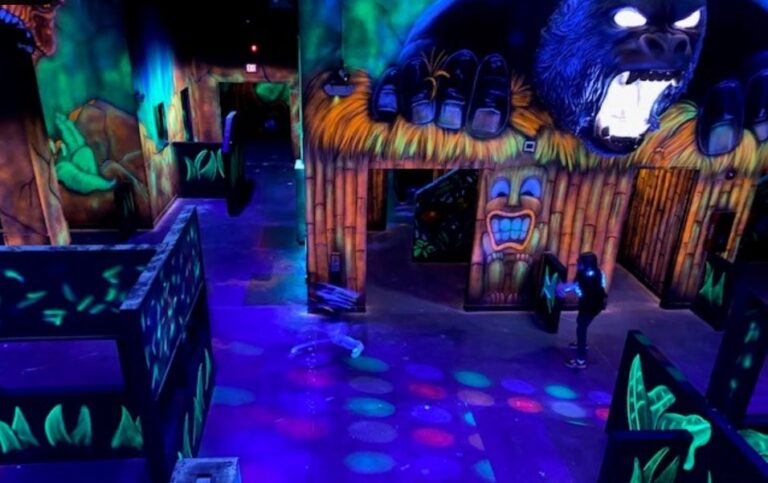
This two-level, 120,000-square-foot entertainment destination combines a full-service restaurant and bar with 12 HyperBowling lanes, a multi-level black light laser tag arena, two 18-hole glow-in-the-dark mini golf courses, bumper cars, over 150 arcade and video games, 30+ pinball machines, and Hologate virtual reality. The venue offers tailored birthday party packages with private rooms and party hosts, group packages with all-you-can-play attractions, and corporate event spaces for team building and celebrations.
Beyond the main attractions, Tilted 10 Rockford features a dedicated Crane Room with claw machines, a pinball alley with Stern tables, and a full-service dining menu with craft cocktails. The venue handles all setup and cleanup for booked events, allows outside desserts, and provides customizable packages for birthdays, corporate events, family reunions, and other group gatherings. Play Cards are used across all games and attractions for convenient spending management.
 Indoors
Volcano Falls Adventure Park is located in Loves Park, Illinois, just off Rock Valley Parkway.
The park offers two 18-hole miniature golf courses (Volcano Course and Palm Course), a martian-themed laser tag arena with 10-minute rounds, a Laser Maze challenge, four go-kart tracks (Rookie, Bridge, Slick, and Kiddie Carts), batting cages with baseball and softball options, and an indoor arcade with over 50 games including a VR Finger Coaster. The park also features a snack bar with signature treats like the “Lava Flow” ice cream sundae.
Themed party rooms with underwater murals are available for birthdays, corporate retreats, and team-building events, with Gold and Silver party packages that include private room time, food, arcade credits, and attraction passes. Picnic areas are scattered throughout the grounds. The staff is known for being friendly and attentive, and the park maintains a family-friendly policy after 7:00 pm on weekends. The park is well-suited for multi-generational outings, school fundraisers, and group celebrations of all kinds.
Indoors Outdoors
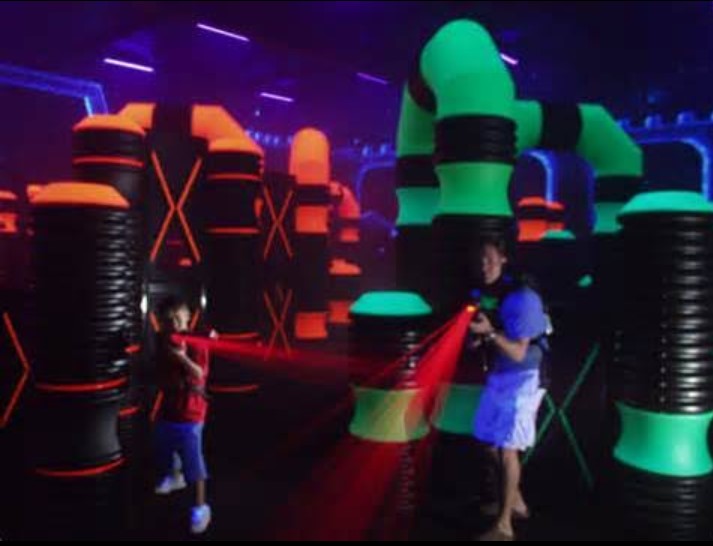
Laser tag is a team‑oriented, technology‑driven game in which participants wear sensor‑equipped vests and wield hand‑held “phasers” that emit harmless infrared beams. When a beam strikes a sensor, the equipment records a hit and updates the player’s score in real time. Unlike paintball or air‑soft, there is no physical projectile, no mess, and the arena can be set up in virtually any space that can accommodate safe movement and darkness or low‑light conditions. Modern systems often integrate sophisticated software that tracks individual and team statistics, offers multiple game modes, and even projects thematic graphics onto walls or floors, turning a simple arena into an immersive battlefield.
The appeal of laser tag lies in its blend of physical activity, strategic thinking, and the thrill of competition. Because the technology handles scoring automatically, players can focus on tactics, communication, and rapid decision‑making without the distraction of manual scorekeeping. The game is suitable for all ages and fitness levels, which has helped it spread from niche hobbyist venues into schools, community centers, corporate training programs, and large‑scale entertainment complexes worldwide.
The flexibility of laser‑tag hardware allows designers to craft a multitude of scenarios, each tailored to a specific audience or objective. Common formats include:
Each scenario can be further customized by adjusting arena lighting, sound effects, and visual overlays, allowing operators to keep the experience fresh for repeat visitors.
While the primary draw of laser tag is entertainment, the activity offers a range of physical, cognitive, and social advantages.
Research in sports science and educational psychology indicates that activities combining physical movement with cognitive challenges, such as laser tag, can improve attention span and foster a growth mindset among participants of all ages.
A growing body of scholarly work evaluates laser tag as a tool for both recreation and professional development. Exercise physiologists point to studies showing that a 30‑minute laser‑tag session can elevate heart rate to 70‑85 % of maximum, comparable to brisk jogging, while producing lower impact on joints than running on hard surfaces. Cognitive psychologists highlight the game’s capacity to train “executive functions” – planning, working memory, and inhibitory control – because players must simultaneously track opponents, manage resources, and adapt to evolving scenarios.
From an industry perspective, experts in experiential marketing stress laser tag’s value as an immersive brand‑activation platform. The technology’s ability to collect anonymized player data (e.g., dwell time in specific zones, hit frequency) enables businesses to analyze visitor behavior and tailor future experiences. Meanwhile, safety engineers emphasize the importance of rigorous arena design standards, such as clear egress routes, padded obstacles, and regular equipment calibration, to maintain a risk‑free environment.
Collectively, these viewpoints illustrate that laser tag is more than a pastime; it is a multidisciplinary arena where health science, behavioral research, and commercial innovation intersect.
Children are among the most enthusiastic participants. The game’s low‑impact nature makes it a safe alternative to contact sports, while its built‑in scoring system provides instant feedback that fuels motivation. Schools incorporate laser tag into physical‑education curricula to teach teamwork, spatial awareness, and basic tactical concepts. Parents appreciate that the activity encourages outdoor or indoor physical movement without the mess associated with paintball or the noise of traditional video games.
For adolescents, laser tag offers a socially acceptable outlet for competitive energy. Many community centers host league play, complete with season standings, awards, and advanced scenario rotations. The blend of physical exertion and technology appeals to a generation that values interactive, digitally enhanced experiences.
Corporate teams increasingly turn to laser tag for team‑building events. The game’s emphasis on communication, role clarity, and adaptive strategy mirrors real‑world workplace challenges. Adult leagues also exist in many metropolitan areas, providing a regular outlet for fitness‑focused individuals seeking a fun alternative to conventional gyms.
Even older adults can benefit from laser tag’s low‑impact cardio and mental stimulation. Adapted scenarios with slower pacing and larger arena spaces enable senior participants to engage safely while enjoying social interaction.
Laser tag is a popular choice for children’s birthday celebrations because it combines excitement, competition, and minimal cleanup. Party packages often include private arena time, themed decorations, and customizable game modes that align with the birthday child’s interests (e.g., space‑adventure, superhero rescue). The automatic scoring system eliminates the need for adult referees, allowing parents to relax while the kids enjoy themselves.
Graduation marks a transition, and many schools organize laser‑tag outings to commemorate the occasion. The activity serves as a symbolic “battlefield” where graduating seniors can demonstrate leadership, cooperation, and resilience—qualities they will soon apply in higher education or the workforce. Photo‑op moments captured during the game add a memorable visual record of the milestone.
Corporate gatherings benefit from laser tag’s ability to break down hierarchical barriers. By placing executives and entry‑level employees on the same team, the game encourages authentic collaboration. Many venues offer post‑game debrief sessions where facilitators extract lessons on communication styles, decision‑making processes, and conflict resolution, transforming a fun afternoon into measurable professional development.
Indoor arenas dominate the market because they provide controlled lighting, climate, and safety conditions. Typical indoor venues feature dark corridors, multi‑level platforms, inflatable obstacles, and reflective surfaces that enhance the infrared tracking accuracy. Urban centers host dedicated laser‑tag franchises, often co‑located with arcades, bowling alleys, or trampoline parks. For organizations seeking a private experience, many venues rent out entire floors or rooms, allowing customization of lighting cues, soundtrack, and scenario narrative.
Advances in battery life and sensor durability have expanded laser tag into outdoor environments. Parks, forests, and even abandoned industrial sites can become expansive battlegrounds, offering natural terrain features such as trees, hills, and structures. Outdoor play is especially popular for summer camps, military‑style training exercises, and large‑scale festivals. Operators must consider ambient light, weather conditions, and line‑of‑sight interference, but the payoff is a realistic, immersive experience that mimics real‑world tactical scenarios.
Some providers blend indoor and outdoor elements by creating “glow‑in‑the‑dark” courses that transition from a darkened lobby into an open‑air courtyard. These hybrid arenas allow participants to experience rapid shifts in lighting and terrain, challenging both their physical adaptability and strategic planning.
Laser tag has evolved from a novelty attraction into a versatile platform that serves entertainment, education, health, and corporate objectives. Its core technology—infrared‑based scoring combined with adaptable software—makes it suitable for a wide spectrum of scenarios, from simple team deathmatches to complex mission‑based training exercises. The activity delivers tangible physical and cognitive benefits, a fact corroborated by scientists studying exercise physiology, cognitive development, and workplace dynamics.
A diverse audience—from children celebrating birthdays to seniors seeking low‑impact cardio—finds value in laser tag’s blend of movement, strategy, and social interaction. Whether hosted in a purpose‑built indoor arena, a sprawling outdoor field, or a hybrid space that merges the two, laser tag continues to capture imaginations and foster connections across generations.
As technology advances further—introducing augmented‑reality overlays, AI‑driven opponent behavior, and richer data analytics—the future of laser tag promises even deeper immersion and more precise measurement of its benefits. For now, the infrared beams that crisscross arenas worldwide remain a brilliant illustration of how a simple concept can evolve into a multifaceted experience that entertains, educates, and elevates its participants.



 7200 Harrison Ave Space S-01, Rockford, IL 61112, United States