
 El Monte
 Log in
Log in
Log in

Tilted 10 Rockford is located inside CherryVale Mall at 7200 Harrison Avenue in Rockford, Illinois.
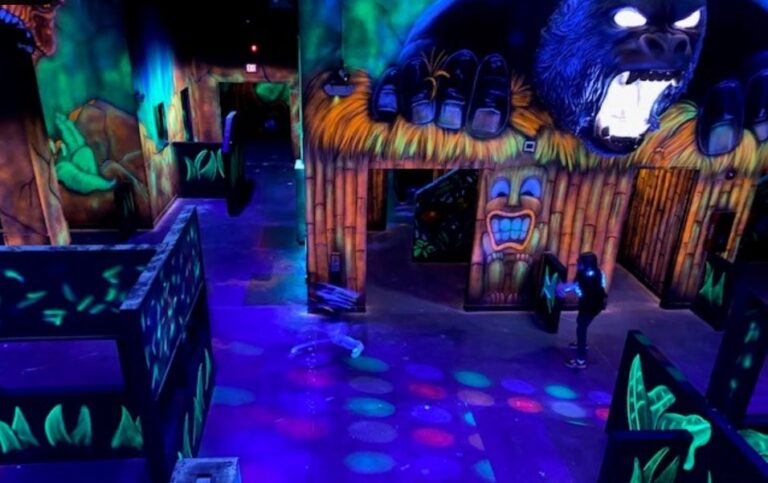
This two-level, 120,000-square-foot entertainment destination combines a full-service restaurant and bar with 12 HyperBowling lanes, a multi-level black light laser tag arena, two 18-hole glow-in-the-dark mini golf courses, bumper cars, over 150 arcade and video games, 30+ pinball machines, and Hologate virtual reality. The venue offers tailored birthday party packages with private rooms and party hosts, group packages with all-you-can-play attractions, and corporate event spaces for team building and celebrations.
Beyond the main attractions, Tilted 10 Rockford features a dedicated Crane Room with claw machines, a pinball alley with Stern tables, and a full-service dining menu with craft cocktails. The venue handles all setup and cleanup for booked events, allows outside desserts, and provides customizable packages for birthdays, corporate events, family reunions, and other group gatherings. Play Cards are used across all games and attractions for convenient spending management.
 Indoors
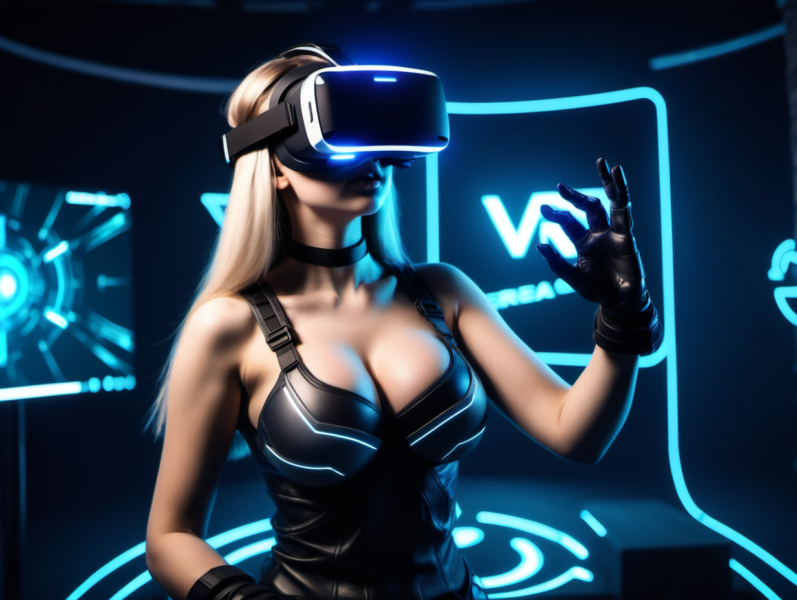
A free‑roam virtual‑reality arena is a purpose‑built space where participants move unhindered by cables or confined play areas. The venue is fitted with an array of motion‑tracking sensors, often ceiling‑mounted or embedded in the floor, that constantly locate each headset and controller in three‑dimensional space. Because the environment can follow a user’s exact position, the illusion of stepping into a different world feels natural: users can sprint, crouch, leap, or even climb without the risk of tripping over a cord. The physical arena is typically padded or carpeted, and safety nets or soft barriers keep the experience enjoyable for both novices and seasoned players.
The technology behind free‑roam VR enables a wide spectrum of scenarios, each designed to exploit the full range of motion that the arena provides. Adventure‑style games let guests explore ancient ruins, alien spacecraft, or fantasy kingdoms, solving puzzles that require real‑world gestures such as pulling levers or assembling artifacts. Team‑based shooters place rival squads in sprawling battlegrounds where tactical positioning and flanking become genuine physical actions. Escape‑room experiences use the environment’s scale to hide clues behind virtual walls that are only reachable by climbing a real ladder or crawling under a low tunnel. Educational modules simulate scientific laboratories, historical reenactments, or medical procedures, turning abstract concepts into tactile lessons. Because the arena tracks each participant individually, developers can design asymmetric gameplay where a “master” controls environmental hazards while others react in real time.
The audience for free‑roam VR is remarkably diverse. Young adults and college students dominate the weekend‑night crowds, drawn by the intense, social competition that traditional at‑home VR cannot match. Gaming enthusiasts appreciate the ability to fully embody avatars, while esports teams experiment with new formats that incorporate physical skill. Families with teenagers often visit during holidays, seeing the arena as a safe way to satisfy a hunger for immersive entertainment without the expense of personal hardware. Corporate teams use the space for team‑building exercises, leveraging the shared challenge to foster communication and trust. Even senior citizens are finding a place in the arena, especially in sessions tailored to gentle movement and cognitive stimulation, proving that the medium can bridge generational gaps.
Designers of child‑focused arenas prioritize safety, accessibility, and age‑appropriate content. The tracking system is calibrated to lower heights, and the flooring is soft yet durable to cushion falls. Game narratives often revolve around whimsical themes—magical forests, dinosaur expeditions, or space‑ship repairs—encouraging imagination while subtly teaching problem‑solving and cooperation. Session lengths are typically limited to 10‑15 minutes to match shorter attention spans, with built‑in cooldown periods for hydration and stretching. Many venues offer parental monitoring dashboards that display real‑time location data and allow staff to intervene instantly if a child ventures into a restricted zone. These kid‑centric experiences have become popular birthday‑party alternatives because they combine the thrill of technology with the physical activity that parents appreciate.
Event planners are increasingly turning to free‑roam VR as a flexible venue solution. For a birthday party, the arena can be booked for a private session where a themed adventure—such as a treasure‑hunt on a pirate island—guides the celebrants through a series of challenges that culminate in a virtual “cake” reveal. Graduation celebrations benefit from the novelty factor: a senior class can walk through a custom‑crafted virtual campus, reliving memorable moments while snapping group photos in a digitally enhanced setting. Corporate gatherings profit from the arena’s capacity to host large groups in parallel experiences—team‑building missions that require collaboration, product‑launch simulations that let attendees interact with a 3‑D prototype, or branded challenges that reinforce company values. Because the space can be reconfigured quickly, organizers can tailor lighting, sound, and even scent to match the event’s tone, delivering an immersive experience that traditional banquet halls cannot replicate.
Researchers in neuroscience and human‑computer interaction view free‑roam VR as a fertile testing ground for embodied cognition studies. The precise tracking of bodily movement, combined with rich sensory feedback, allows scientists to examine how spatial awareness, balance, and motor learning evolve when the brain receives congruent visual‑vestibular cues. Experiments have demonstrated that participants develop stronger place‑cell activity—neurons tied to navigation—within free‑roam setups compared to seated or tethered VR, suggesting a closer approximation of real‑world perception. Moreover, because the arena can simulate hazardous or inaccessible environments safely, it becomes a valuable tool for studying stress responses, decision‑making under pressure, and rehabilitation protocols for patients recovering from stroke or traumatic brain injury.
From an industry standpoint, analysts see free‑roam VR as a catalyst for the broader adoption of immersive entertainment. The capital cost of installing a sensor network and high‑spec PCs is offset by the venue’s ability to host multiple groups per day, generating a steady revenue stream. Experts predict that advances in wireless edge‑computing will reduce latency further, making the experience indistinguishable from native, fully untethered systems. Integration with mixed‑reality technologies—such as holographic projection and tactile feedback suits—could blur the line between the physical arena and the virtual world, opening opportunities for hybrid events that combine live performers with digital avatars. As hardware prices continue to fall, the expectation is that more mid‑size cities will launch their own free‑roam centers, democratizing access beyond major metropolitan hubs.
A critical component of any free‑roam operation is its safety protocol. Staff undergo certification in first‑aid and VR‑specific emergency procedures, and each session begins with a brief orientation covering movement limits, exit routes, and the use of emergency stop buttons on the headsets. Accessibility features include adjustable harnesses for wheelchair users, customizable controller layouts for individuals with limited dexterity, and audio‑visual options for those with sensory impairments. The arena’s software can dynamically scale difficulty, ensuring that participants of varying skill levels can enjoy the same experience without feeling left out or overwhelmed.
Beyond entertainment, free‑roam VR arenas contribute to local economies. They create jobs ranging from technical engineers and safety coordinators to hospitality staff who manage bookings and refreshments. The venues often partner with nearby restaurants, hotels, and transport services, forming a micro‑ecosystem that boosts tourism. In regions where traditional amusement parks are scarce, the arena offers a high‑tech alternative that attracts both domestic visitors and international tourists seeking novel experiences. Revenue reports from established centers show steady growth, driven by diversified offerings such as corporate training packages, educational field trips, and recurring membership models.
The trajectory of free‑roam VR points toward increasingly personalized and context‑aware adventures. Machine‑learning algorithms can analyze a player’s biometric data—heart rate, gaze direction, and movement patterns—to adapt difficulty on the fly, delivering a tailored challenge that maximizes engagement while minimizing fatigue. Cloud‑based asset streaming will enable developers to update worlds in real time, keeping content fresh without downtime for hardware upgrades. Finally, the convergence of free‑roam VR with social platforms could allow participants to share live recordings of their sessions, fostering a community of creators who remix and expand upon existing scenarios. As the technology matures, free‑roam VR is poised to become a staple of modern leisure, education, and professional development.
In summary, free‑roam VR arenas represent a sophisticated synthesis of motion‑tracking, immersive storytelling, and physical safety. Their versatility appeals to gamers, families, educators, scientists, and corporate planners alike. By offering fully unrestricted movement, rich scenario design, and the capacity to host bespoke events, these arenas are redefining what it means to step inside a virtual world. As research validates their cognitive benefits and industry forecasts anticipate continued expansion, free‑roam VR is set to become an integral part of the cultural and economic fabric of communities worldwide.


 7200 Harrison Ave Space S-01, Rockford, IL 61112, United States