El Monte
 Log in
Log in
Log in

Zombageddon Paintball Hayride is a seasonal fall attraction set on Drew Farms in the small town of Fredonia, Pennsylvania, in Mercer County.
The main draw is the Zombie Battle Wagon, a tractor-drawn trailer with mounted paintball guns where riders shoot at zombies that never shoot back. Each ticket includes 150 paintballs, and a drill sergeant guides the group through the roughly twenty-minute ride. A Ride Along pass lets non-shooters watch the action, and the farm also offers a traditional dark hayride, a barrel train through the cornfield, a hay bale play pit, and multiple campfires.
Beyond the ride, guests can try axe throwing, pumpkin chucking with the Gourd Grenade, and gel-blaster zombie target practice, with food and s’mores available at concessions. The farm runs a Z-Farm Daylight Pass for daytime visits with a petting zoo, yard games, and photo ops, and books private events like birthdays, bachelor parties, wedding parties, and work team-building outings. Groups of fifteen or more receive a discount, and the family-friendly crew provides instructions for first-time shooters.
 Outdoors
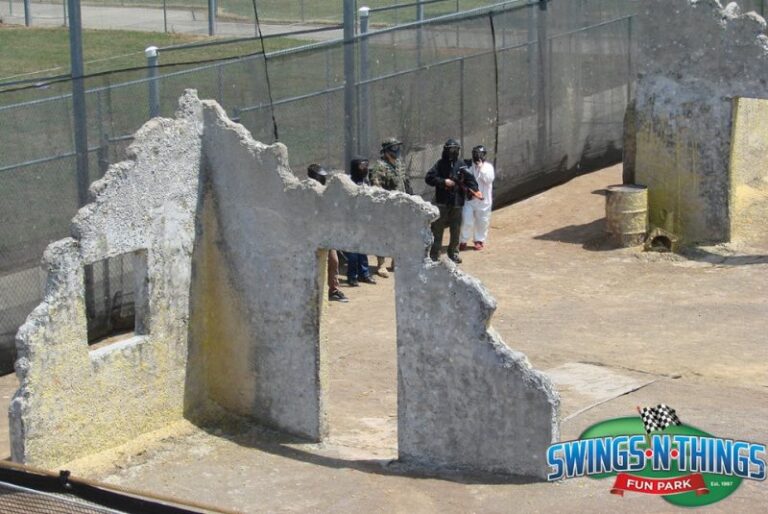
Paintball Village is located at Swings-N-Things Family Fun Park in Olmsted Falls, Ohio, just southwest of Cleveland. It is an outdoor paintball field built around a professionally designed scenario layout that looks like a bombed-out village, complete with burned-out cars and sandy streets enclosed by 20-foot-high netting. The field hosts classic capture-the-flag games for teams ranging from a few players to more than 50 per side, and it welcomes walk-up players, beginners, and veterans alike. No experience is required, and the staff provides instruction, rental equipment, and compressed air tanks, with safety enforced by on-field referees.
Beyond paintball, the field is part of a larger family entertainment park offering go-karts, bumper boats, miniature golf, batting cages, and laser tag. Paintball Village is a popular spot for birthday parties, corporate team-building days, school field trips, and youth groups, with party packages that include field access, rentals, paintballs, pizza, and soda. Between games, players can relax on a shaded patio or in a picnic pavilion that seats up to 500 people, and the park’s homemade ice cream parlor offers indoor and outdoor seating.
OutdoorsSynergy Woods Paintball Park sits in Grafton, Ohio, a short drive southwest of Cleveland along Route 83. This outdoor park spreads across roughly 35 acres of wooded land and is open on weekends from spring through fall. It offers about seven distinct playing fields — including the large Mounds, a hyperball course, a jungle field, Fort Synergy, and the vehicle-filled Impound — with rotating game modes like capture the flag, bomb defuse, president escort, and D-day battles. Equipment rental is available, field paint is required, and Pint Size Paintball lets kids ages 5 to 9 join in with lower-impact gear.
Beyond paintball, the park features a three-story ropes course with a quick drop and a 600-foot zip line, plus a concession stand and pizza ordering for groups. It hosts birthday parties, bachelor parties, and corporate team-building events, with group discounts for parties of around 20 or more. The staff and referees are known for being friendly and safety-focused, and there is plenty of seating and restroom space for large crowds. Season passes and a pro shop round out the offerings for regular players.
OutdoorsPaintball has evolved from a niche hobbyist activity into a global phenomenon that bridges the gap between tactical training and high-octane recreational sport. By combining physical athleticism with intense strategic planning, it offers an immersive experience that few other leisure activities can replicate. Whether played in a professional tournament setting or a casual weekend gathering, paintball remains a cornerstone of the modern adventure industry.
At its core, a paintball is a spherical capsule designed for specialized delivery at high velocities. These projectiles consist of a thin, gelatinous outer shell—similar to a vitamin or fish oil capsule—which is filled with a non-toxic, water-soluble, and biodegradable dye.
When a marker (the paintball gun) is fired, compressed air or CO2 propels the ball through the barrel. Upon impact with a target, the shell is engineered to rupture, marking the spot with a vibrant splash of color. This mechanical failure upon impact is the fundamental mechanism that allows players to “eliminate” opponents. Because the paint is food-grade and environmentally friendly, it washes out of clothing easily and leaves no lasting footprint on the forest floor or indoor turf, making it a safe and sustainable projectile for recreational combat.
While rules can vary depending on the specific field or league, the universal objective of paintball is integrity. Because the sport relies on the “honor system,” players are expected to be honest about being hit.
The most fundamental rule is that a hit anywhere on the body or equipment—such as the marker or the hopper—resulting in a paint splatter the size of a quarter or larger constitutes an elimination. Once hit, a player must raise their marker, call out “Out!” or “Hit!,” and immediately exit the playing field to the designated “dead zone.”
Safety is the paramount concern in every game. The universal rule of “mask-on” prevents any player from removing their protective goggles while on the field. Even if a player is eliminated, they are strictly prohibited from removing their face protection until they have reached a fully enclosed safe zone. Furthermore, “blind firing” (shooting without looking at the target) is generally prohibited to prevent unnecessary injuries, and players are expected to adhere to velocity limits, usually capped at 280–300 feet per second, to ensure the impact remains within a safe, stinging threshold.
Paintball is not merely about shooting; it is about objective-based problem solving. Players engage in various scenarios designed to push their communication and tactical skills to the limit.
The most classic scenario is “Capture the Flag,” where two teams compete to retrieve an object from the enemy’s base. “Elimination” or “Team Deathmatch” is a simpler, faster-paced mode where the goal is to remove every member of the opposing team. Moving beyond basic skirmishes, “Scenario Paintball” or “Woodsball” involves large-scale, multi-hour missions often based on historical conflicts or fictional narratives, where teams must hold specific bunkers, protect a VIP, or recover intelligence documents. These scenarios transform the game from a quick sprint into a complex strategic exercise involving flanking maneuvers, suppression fire, and leadership hierarchies.
Beyond the adrenaline rush, paintball offers significant psychological and physiological benefits. It is a full-body cardiovascular workout that requires sprinting, crouching, ducking, and crawling. Players often find themselves burning hundreds of calories in a single afternoon without realizing it, as the focus is shifted entirely toward the game rather than the effort.
From a mental perspective, paintball is an excellent exercise in team-building, critical thinking, and communication. It forces individuals to make split-second decisions under pressure. It also teaches resilience; players learn how to handle failure and loss, recalibrate their strategy after an elimination, and depend on their teammates for success. It acts as a rare environment where digital-age individuals can disconnect from screens and engage in tangible, high-stakes collaboration.
The demographics of paintball are surprisingly diverse. While it is often stereotyped as a sport for teenagers, the reality is that the community spans a wide range of ages and backgrounds. On any given weekend, a field might host a corporate team-building retreat, a group of college students, and seasoned tournament veterans in their fifties.
Because the game offers varying levels of intensity—from casual low-impact sessions for children and novices to high-speed tournament-style play—it is accessible to almost anyone. Families often play together, making it a multigenerational bonding experience. In addition, paintball is a staple of military and law enforcement training, where professionals utilize the equipment to practice close-quarters combat and room-clearing techniques in a low-risk environment.
Industry experts and sports scientists view paintball as a highly effective form of functional fitness and tactical education. Researchers have noted that the game demands high levels of anaerobic power and endurance. Experts often highlight that the sport’s unique combination of high-intensity interval training (HIIT) and cognitive load—where players must process complex spatial information while moving—can improve executive function and spatial awareness.
From an industry standpoint, growth is being driven by innovations in marker technology and safety gear. The industry has increasingly focused on making the sport “low-impact,” utilizing smaller paintballs and lower velocity settings to make the entry barrier less intimidating for beginners. This shift has been praised by safety experts, as it preserves the tactical excitement of the game while significantly reducing the incidence of bruising and injury, ensuring the sport remains sustainable for long-term growth.
Paintball accessibility depends on the environment, with two distinct types of venues dominating the landscape:
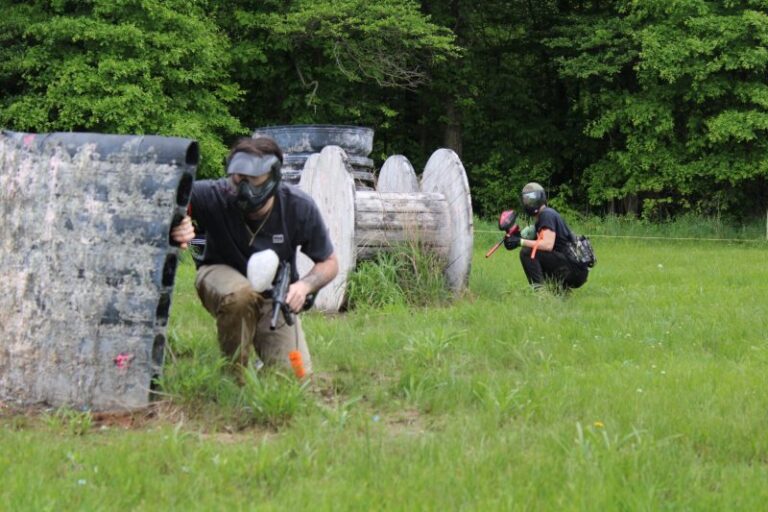
Outdoor Venues: Often set on expansive, wooded properties, outdoor fields emphasize natural cover. Players utilize trees, trenches, bunkers, and even man-made wooden forts to navigate the terrain. This environment is ideal for “woodsball” and scenario games where camouflage and long-range shooting become key assets.
Indoor Venues: Usually found in converted warehouses or climate-controlled facilities, indoor fields utilize artificial turf and inflatable “air bunkers.” These fields are designed for speed and consistency. Because they are unaffected by weather, indoor venues allow for year-round play and are generally favored by competitive tournament teams who require a perfectly level playing field to hone their snap-shooting skills and lane control.
Whether one prefers the raw, rugged experience of the forest or the fast-paced, controlled environment of an indoor arena, the variety of venues ensures that the sport can be tailored to fit the preferences of every player. As the game continues to grow, both outdoor and indoor venues remain vital hubs for fostering the community, competition, and tactical spirit that define the world of paintball.


 356 Bower Rd, Fredonia, PA 16124, United States