El Monte
 Log in
Log in
Log in

Main Event sits on the south side of Chester Road in Avon, Ohio, just off I-90 between the Ohio-83 and Nagel Road exits, on the west side of Cleveland and next to Cabela’s.
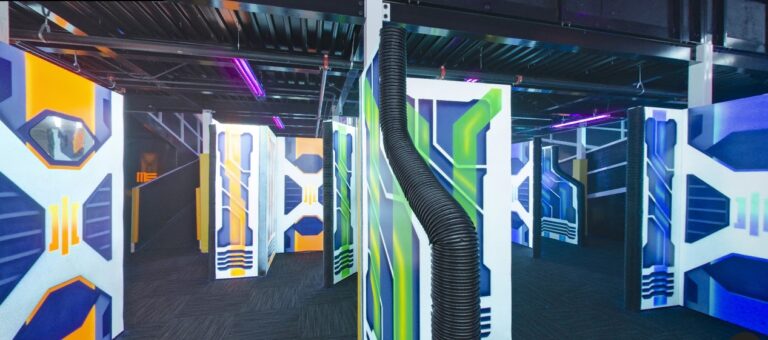
The venue is a large family entertainment hub offering professional-level bowling lanes, an arcade with more than 100 modern and retro games, a multi-story laser tag arena with fantasy-style decor and neon lighting, a 20-foot gravity ropes course, billiards, virtual reality and mini-golf. A full-service restaurant serves pizza, burgers and wings, while a sports bar offers cocktails and big-screen viewing, with seating right at the lanes.
Main Event Avon is well suited to kids’ birthday parties, holiday parties, school events, corporate gatherings and team building, with dedicated party hosts, reserved party space, private party rooms, full-service catering, free WiFi and meeting room space. The friendly, attentive staff and clean facilities make it a dependable choice for family outings, date nights and group celebrations alike.
 Indoors
Bill’s Crib is a virtual reality arcade tucked inside Perplexity Games in Ohio City’s Hingetown neighborhood of Cleveland, Ohio.
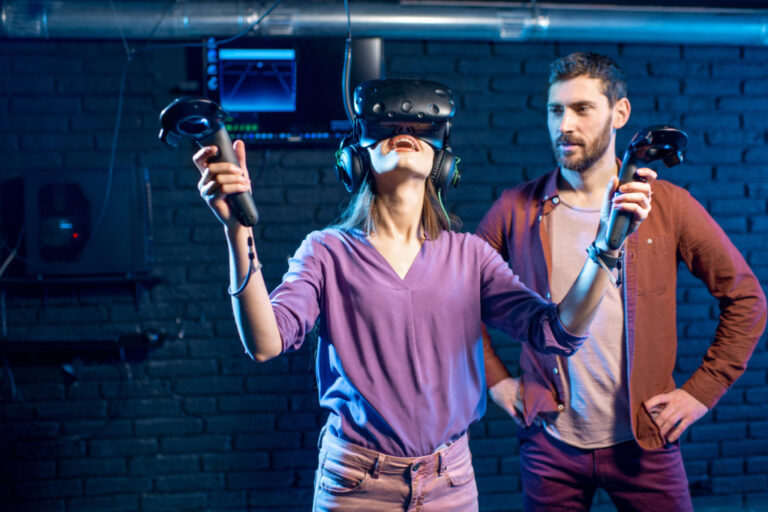
The station-based arcade welcomes up to eight players at a time, ages eight and up, with a library of more than a hundred titles spanning casual classics like Fruit Ninja and Angry Birds to intense shooters like Pavlov. High-end headsets, haptic vests, and props create a fully immersive, multisensory experience, and on-site multiplayer lets friends play together in the same room. Popular picks include Walk the Plank, zombie shooters, Half-Life: Alyx, and Blade & Sorcery.
The venue is a favorite for birthday parties and bachelor or bachelorette celebrations, and it pairs naturally with the escape rooms at Perplexity Games for a longer outing. Founded by a software engineer passionate about STEM and gaming, the arcade is staffed by VR experts who guide newcomers and seasoned players alike. Walk-in hours are limited to weekends with weekday visits by appointment, and the Hingetown location sits near restaurants and breweries for a full evening out.
IndoorsSandbox VR Westlake is located in the Crocker Park lifestyle center in Westlake, Ohio, a western suburb of Cleveland. It’s a room-scale, full-body virtual reality venue where groups of up to six book private rooms for 30- or 60-minute sessions. Players are tracked with motion-capture sensors and wear haptic vests, so their whole body moves naturally and they feel in-game impacts in real time. The lineup includes exclusive experiences like Deadwood PHOBIA, Squid Game Virtuals, Stranger Things: Catalyst, Age of Dinosaurs, Rebel Moon: The Descent, and Curse of Davy Jones.
The venue spans about 6,300 square feet and includes a dedicated party room, making it a strong fit for birthdays, corporate team building, bachelor and bachelorette parties, and family gatherings. Packages range from birthday bundles with private celebration time and activity kits to corporate bundles for up to eighteen guests with catering permitted. Because it sits inside Crocker Park, visitors can easily combine a VR session with shopping and dining nearby.
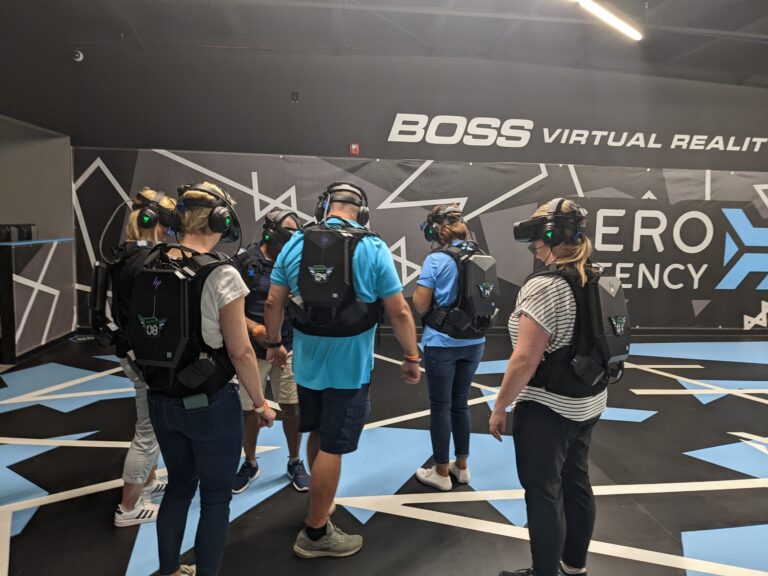
IndoorsZero Latency at BOSS VR Arena sits in the Brookpark neighborhood of Cleveland, Ohio, just a mile from Hopkins International Airport inside the BOSS Pro-Karting complex.
The arena is Cleveland’s only free-roam virtual reality experience, offering a roughly 1,500-square-foot space where up to eight untethered players move freely through missions like zombie survival, space warfare, and player-versus-player battles. A standard session costs $50 per person and includes a 15-minute mission briefing plus up to 30 minutes of game time, with six different game packages to choose from. The venue is ADA compliant and family friendly.
Beyond VR, the complex adds high-speed pro karting, competition-level axe throwing, a bar, food service, and a gift shop. Dedicated event planners customize packages for birthdays, bachelor parties, corporate retreats, and team building, with banquet space for up to 150 guests and reception capacity for 500. It’s a complete indoor destination for groups of all sizes.
IndoorsThe landscape of entertainment has undergone a dramatic shift in recent years. While home gaming consoles and stationary VR headsets offer isolated experiences, a new frontier has emerged that prioritizes physical immersion and collective movement: the free-roam virtual reality (VR) arena. This evolution in gaming technology removes the limitations of a tethered chair or a small living room, allowing users to step into vast digital landscapes where their own bodies serve as the controller.
A free-roam VR arena is an expansive, customized physical space designed to host multiple players simultaneously. Unlike traditional VR, which often traps users in a seated position or a confined “room-scale” square, a free-roam arena provides a large, unobstructed floor area equipped with advanced tracking technology. Players wear cordless headsets and often carry haptic gear—vests or peripherals—that ground the virtual experience in physical reality.
The core of the technology lies in high-precision motion tracking systems, often utilizing infrared cameras or sophisticated computer vision, which map the physical movements of players into the digital domain with millisecond latency. Because the player can physically walk, run, and duck to avoid obstacles, the brain is tricked into accepting the digital environment as genuine space. This phenomenon, known as presence, is significantly more profound in a free-roam setting than anywhere else in modern gaming. By eliminating wires and providing a large, open footprint, these arenas transform virtual reality from a visual activity into a full-body athletic endeavor.
The scenarios available in free-roam VR arenas are limited only by the imagination of developers. These experiences are structured to leverage the physics of the real-world space to enhance the narrative.
In the realm of action, players might find themselves in the heart of a zombie apocalypse or a futuristic battlefield. Because the arena allows for real spatial movement, these games often incorporate “tactical movement,” where players must physically peek around corners or huddle together to avoid incoming threats. The sensation of walking through a virtual corridor becomes tangible because the player is actually covering the distance on a physical floor.
Beyond combat, free-roam VR excels in collaborative puzzle-solving and exploration. Imagine a high-stakes escape room where the floor shifts and the walls expand, or a scientific simulation where teams must navigate the surface of an alien planet to collect samples. Some arenas offer educational adventures, such as walking through a photorealistic reconstruction of ancient Rome or exploring the microscopic world of biology. By tying the virtual story to physical navigation, these scenarios turn spectators into agents, ensuring that every player feels like they are the protagonist of their own epic journey.
The demographic profile of free-roam VR users is evolving rapidly. While the technology was once the exclusive playground of hardcore tech enthusiasts and gamers, it has become a staple of modern social entertainment.
Regarding the younger generation, free-roam VR has proven to be a massive success with children and teenagers. Because the equipment is designed to be intuitive—relying on natural movement rather than complex button inputs—kids can master the virtual environment within minutes. For parents, these arenas provide a unique opportunity for active play that encourages teamwork and cognitive engagement. Furthermore, many arenas implement strict safety protocols and age-appropriate content filters, ensuring that the experience remains safe and engaging for younger participants. The physical nature of these games also serves as a healthy alternative to sedentary screen time, offering an immersive way to get children moving and thinking on their feet.
The versatility of free-roam VR makes it a premier choice for event hosting. As people move away from traditional party formats, the demand for “experience-based” gatherings has skyrocketed.
For a birthday party, the arena offers a high-octane venue that stands out from standard arcades or movie outings. Whether it’s a group of friends celebrating milestones or a family bonding activity, the experience provides a shared narrative that creates lasting memories.
Graduations and corporate parties also benefit from the team-building potential inherent in free-roam VR. In a professional setting, these arenas are often utilized as an icebreaker or a strategic workshop. Because many VR scenarios necessitate communication, coordination, and collective problem-solving, they serve as excellent tools for strengthening office dynamics. Employees are forced to work together in a neutral, exhilarating environment, stripping away professional hierarchies and allowing for organic collaboration. Whether it is a celebratory bash or a team-building retreat, the shared spectacle of surviving a virtual gauntlet brings groups together in a way that stagnant conference room activities never could.
The academic and professional community views free-roam VR not merely as a gaming fad, but as a significant milestone in human-computer interaction (HCI). Scientists have long studied “simulator sickness,” often caused by a discrepancy between sensory input and physical movement. Experts argue that free-roam VR mitigates these issues; because the user’s vestibular system—which dictates balance and orientation—is engaged through real movement, the brain is less likely to register the conflict that causes nausea in non-moving VR experiences.
Industry experts also point toward the potential for training and simulation. Beyond pure entertainment, the technology is being adapted for high-stakes fields such as emergency response training, firefighting, and hazardous material handling. In these instances, the free-roam arena acts as a “digital twin” of a workplace, allowing trainees to practice dangerous scenarios with zero real-world risk.
Moreover, urban planners and social scientists see these arenas as the next step in the “third place” phenomenon—a social environment separate from home and work. As these venues become more prevalent in shopping centers and urban hubs, they promote social cohesion by providing a shared, interactive space. The expert consensus is clear: the future of virtual reality is not about sitting in a chair at home, but about stepping into a communal, physical-digital reality that expands the boundaries of what humans can experience, create, and achieve together. By blending the physical and the digital, free-roam VR arenas have established a foundation for a new form of human engagement that will continue to evolve alongside the next generation of sensory technology.


 35605 Chester Rd, Avon, OH 44011, United States