El Monte
 Log in
Log in
Log in

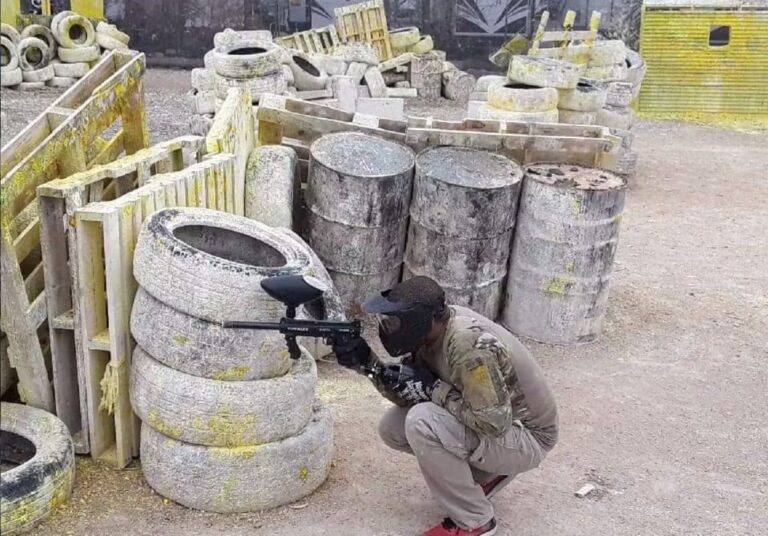
Las Vegas Premier Paintball is located at the Las Vegas Sports Park in the Summerlin district of Las Vegas, Nevada, on the corner of Rampart and Vegas Drive, just north of Summerlin Parkway.
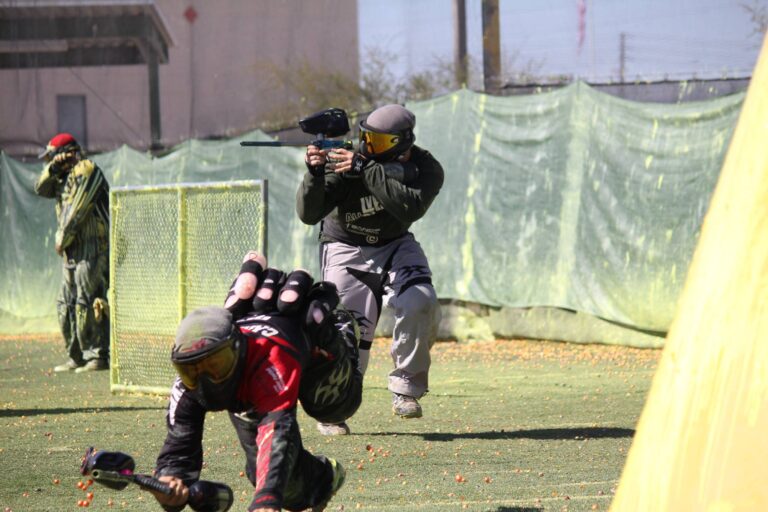
The park runs four large outdoor fields with a shaded, misted staging area and stadium lighting for night play. Beyond classic paintball, it offers low-impact paintball, paintless bazooka ball, a kids’ program called Kid Splat, and airsoft, so groups of mixed ages and skill levels all have something to play. The club fields a competitive squad and holds the UPL Division 3 Regional Champions title.
The venue specializes in group events, including birthday, bachelor, corporate, and private parties, with reserved seating, closed games, and a dedicated party host. A shuttle service picks up groups from Strip hotels, and the shaded common area with picnic tables, lockers, and a reservable party room makes it comfortable to spend a full day there. Memberships and a pro shop round out the experience for regular players.
 Outdoors
Combat Zone Paintball Inc sits on South Las Vegas Boulevard, roughly twenty minutes south of the Strip near the M Resort in the southern Henderson stretch of the Las Vegas valley.
The family-owned venue, operating since 2010, offers four outdoor fields with inflatable bunkers, permanent obstacles, and tactical layouts. Players can choose traditional .68-calibre paintball, lower-impact .50-calibre paintball, or three gel blaster formats (Surge, Surge XL, and Barracuda) that use water-based, biodegradable gel beads — suitable for ages five and up. All equipment is available to rent on site, and referees guide play on every field.
Beyond the games, the venue shines for group events: birthday parties, bachelor and bachelorette celebrations, corporate team-building, and family outings. More than thirty shaded picnic tables, a water misting system, indoor restrooms, and night lights make it comfortable between rounds. Guests can bring their own food, drinks, cake, and decorations, and private events can be booked outside regular hours for groups of any size.
OutdoorsAirsoft is a modern, dynamic combat sport in which participants eliminate opponents by striking them with spherical pellets launched from low-power, imitation firearms called airsoft guns. Unlike paintball, which uses messy, breakable paint-filled capsules, airsoft relies on an honor system where players must call themselves out when hit. This foundational principle shapes every aspect of the culture. The sport simulates military and law enforcement engagements with a strong emphasis on realism, tactical movement, and mission-based objectives. It is played on diverse outdoor and indoor terrains, from dense forests and urban sprawls to purpose-built complexes, creating an immersive experience that blends athletic prowess with strategic thinking.
What fundamentally separates airsoft from many other team sports is its commitment to realism and the consequent demand for coordinated teamwork and sophisticated strategy. Players are not simply running around shooting; they are acting as units within a squad or platoon. The weight and look of the replica gear, the need for communication through hand signals and whispered commands, and the implementation of actual fireteam maneuvers like bounding overwatch or peeking corners all contribute to a suspended belief that one is in a tactical scenario.
This environment makes teamwork non-negotiable. A lone player, regardless of individual skill, is highly vulnerable to a coordinated team. Success is derived from roles—designated marksmen providing covering fire, medics simulating aid, squad leaders directing movement. Strategic planning before a match, involving reconnaissance of the field and assignment of objectives, is as critical as on-field adaptability. The sport rewards patience, observation, and collective decision-making, creating a powerful sense of shared accomplishment when a complex plan comes together under pressure.
The tactical framework is brought to life through a rich tapestry of game modes, each demanding a different skillset and approach. The classic “Team Deathmatch” focuses on pure elimination and territorial control. “Capture the Flag” or “Domination” introduces objective-based play, requiring teams to seize and hold specific points on the field. “Search and Destroy” pits an attacking team against a defending team in a high-stakes mission to plant or defuse an explosive.
Perhaps the most compelling modes are the narrative-driven ones. “Rescue” or “Hostage” scenarios involve protecting or extracting a non-player character (NPC). “Supply Run” tasks teams with retrieving and returning an object. These modes transform the field into a storytelling arena, where roles and objectives create dynamic, ever-changing narratives. The variety ensures that no two game days are alike, constantly challenging players to think on their feet and adapt their strategies to new parameters.
A cornerstone of airsoft’s appeal is the deep level of personal customization available to players. The replica firearms, or “airsoft guns,” are not merely tools; they are projects. Players invest time and resources into upgrading internal components like gearboxes, barrels, and hop-up units to improve range, accuracy, and rate of fire. Externally, the customization is virtually limitless. Rail systems allow for the attachment of mock red dot sights, scopes, lasers, flashlights, and foregrips. Players attach mock suppressors, change stock configurations, and apply camouflage patterns or customized skins to their replicas to match specific real-world firearm models or personal aesthetic.
This customization extends to the player’s loadout. Gear is selected for both function and form. Plate carriers, chest rigs, battle belts, and pouches are arranged to carry magazines, hydration systems, and other essential equipment efficiently. The choice of camouflage pattern—from woodland to desert to urban—is often dictated by the playing environment. This process of building and refining a loadout is a hobby unto itself, allowing players to embody a specific “operator” concept, whether it’s a modern special forces soldier, a historical WWII infantryman, or a futuristic sci-fi warrior, fostering a powerful personal connection to their in-game persona.
While customization is a long-term pursuit, beginning airsoft requires a focused set of gear centered on safety and basic functionality. The absolute non-negotiable priority is eye protection. Certified ANSI Z87.1 rated full-seal goggles or a full-face mask are mandatory at all sanctioned fields. The risk of a pellet shattering or ricocheting into the eye is real and severe, making proper eyewear the single most important investment.
Beyond safety, foundational gear includes:
The starting loadout should prioritize durability, safety certification, and comfort over high-end tactical features. Many fields offer rental gear, a perfect way for newcomers to try the sport before committing to a full personal kit.
Airsoft operates on a strict code of conduct that ensures safety, fairness, and enjoyment for all. The primary rule is “Safety First.” This encompasses strict muzzle discipline (never point your gun at anyone, loaded or unloaded, off the field), finger off the trigger until engaging, and the use of chronographs to chronograph all guns to ensure they meet the field’s power limits (measured in feet per second or joules). “Bang Bang” or “Courtesy Kill” rules often apply, where a player can call a very close-range hit verbally instead of firing, preventing unnecessary pain.
The legendary “Honour System” is the sport’s ethical backbone. Since pellets leave no obvious mark, players are honor-bound to call their own hits, even when no one saw it. This requires a level of integrity uncommon in many competitive activities. Related directly to this is the rule of “Respect.” This means respecting fellow players, referees, the field’s property, and the game’s rules. It means not arguing over hits, not engaging in aggressive or unsportsmanlike conduct, and playing with a spirit of camaraderie. Fields have a zero-tolerance policy for cheating, excessive roughness, or reckless behavior, and violations result in ejection.
Airsoft guns are categorized by their power source, each with distinct characteristics suited to different playstyles.
Automatic Electric Guns (AEGs) are the workhorses of the sport. Powered by a rechargeable battery and using an electric motor to drive a gearbox that compresses air to propel BBs, they are known for their high rate of fire, reliability, and ease of use. They are the preferred choice for most beginner and intermediate players and dominate in sustained fire roles.Popular brands like G&G, Tokyo Marui, and ICS are renowned for their AEGs.
Gas Airsoft Guns use stored propellant (typically green gas or propane) to propel BBs and often power a blowback mechanism that simulates the recoil and slide/bolt cycling of a real firearm. They offer a very realistic shooting feel and often have a higher muzzle velocity and better range out of the box than standard AEGs. However, they are more sensitive to temperature, require more maintenance, and have a higher cost per shot. They are favored by players seeking maximum realism, particularly in pistol roles or for specialized sniper replicas.
Spring-powered Airsoft Guns operate via a simple, manually cocked spring mechanism. They are exceptionally reliable, quiet, and require no external power source. Their simplicity makes them very consistent and often very powerful, making them the standard for bolt-action sniper rifles. They are also common in cheap, single-shot pistols. Their rate of fire is, of course, limited to the player’s ability to cock the spring, placing them at a disadvantage in fast-paced CQB (Close Quarters Battle) but making them precise and powerful tools for designated marksmen.
The airsoft community is strikingly diverse. The demographic spans all ages (typically 18 and above at most fields, with some youth programs), professions, and backgrounds. It attracts military and law enforcement personnel for realistic training (often using specialized, more expensive “trainers”), but also office workers, teachers, students, and tradespeople seeking an active, strategic hobby. The common thread is not a specific profession but a mindset: an interest in tactical games, military history, physical activity, and team-based objectives.
The community is built on mutual respect. The shared experience of enduring long days in the elements, relying on teammates, and playing by the honor system fosters strong bonds. Many players join local teams or clubs that practice together, travel to events, and socialize off-field. It is a hobby that deeply appeals to those who enjoy problem-solving, physical challenge, and immersive play. The stereotype of a solely teenage “tacticool” enthusiast is long outdated; the sport thrives on its mature, inclusive, and dedicated participant base.
An airsoft gun is useless without a venue. Play occurs in three primary settings.
Sanctioned Airsoft Fields are the most common and accessible. These are commercial or non-profit operations that manage dedicated terrain—either natural forests and fields or constructed urban environments with buildings, bunkers, and towers. They have staffed referees, enforce strict safety and power rules, and run scheduled game days with organized rotations and scenarios. They provide a safe, structured environment perfect for beginners and casual players.
Local Teams and Clubs often have agreements with private land or even organize their own games at sanctioned fields. Joining a team offers a deeper, more consistent experience. Teams practice drills, develop tactics, and often run their private scenarios. This is where the highest levels of coordination and MilSim (Military Simulation) preparation occur. Being part of a team provides built-in camaraderie and a support network for learning the sport.
MilSim Events represent the pinnacle of the airsoft experience for many. These are large-scale, often multi-day, highly organized events that simulate specific military campaigns or fictional conflicts. They involve hundreds of players, intricate storylines, chain-of-command structures, radio communication, and sometimes even field artillery or vehicle support. MilSim demands serious commitment, extensive gear, and a high degree of role-playing and discipline. It is the closest approximation to a real military operation that a civilian can legally and safely experience.
Airsoft is a multifaceted discipline that combines the adrenaline of a competitive sport with the depth of a strategy game and the creativity of a costume hobby. Its foundation is a robust ethical code centered on safety and honor. From the careful selection of starting gear to the meticulous customization of an advanced loadout, from simple elimination matches to sprawling 24-hour MilSim operations, the sport offers a spectrum of experiences. It draws a dedicated, diverse community united by a passion for tactical play, teamwork, and immersive simulation. More than just shooting plastic BBs, airsoft is about living a story, trusting your team, and testing your skills in an environment that respects both its participants and the realism it strives to achieve.


 1400 N Rampart Blvd, Las Vegas, NV 89128, United States