El Monte
 Log in
Log in
Log in

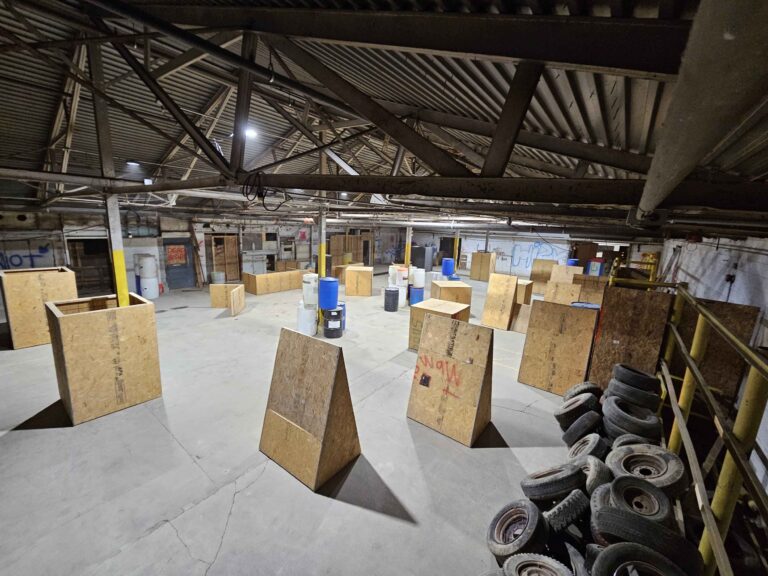
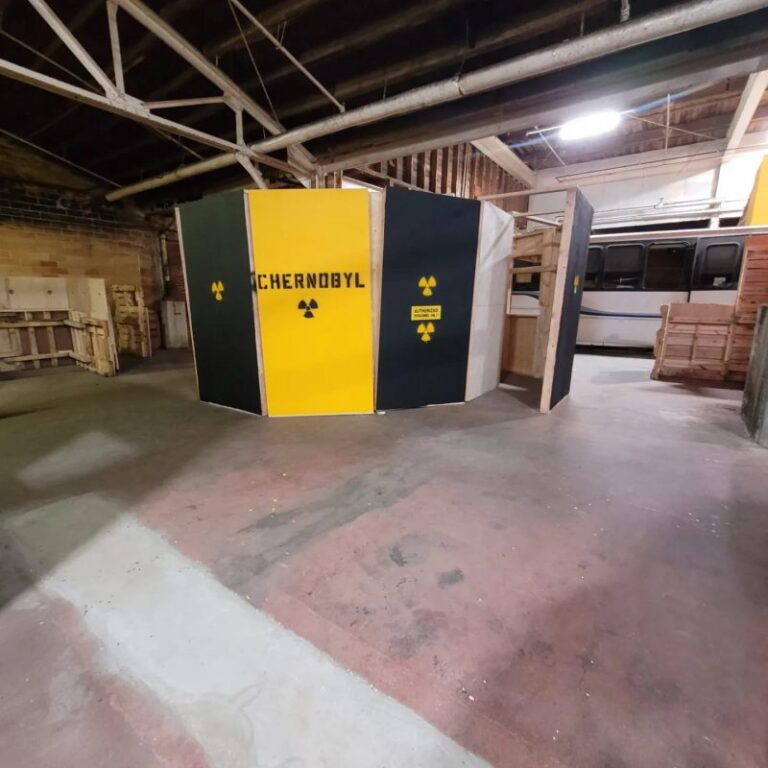
MK Airsoft is located in the Brunswick/Medina area of Ohio, just outside Cleveland, in a large indoor facility that’s part of the MKAirsoft chain. The club runs regular open-play sessions several days a week across a roughly 33,000-square-foot arena filled with wooden structures and obstacles, plus a dedicated speedsoft section. Players can bring their own gear or rent everything they need, and the on-site pro shop (an Evike partner) stocks guns, parts, and BBs.
Beyond open play, the club hosts special events like MilSims, lock-ins, and tournaments, and offers memberships and weekly passes for frequent players. Private parties — birthdays, team building, and group sessions — come in three package tiers with rental gear included, and the facility is climate-controlled with a welcoming, community-focused staff. Family Night offers a relaxed, lower-intensity experience with free pizza, making it a good fit for newcomers and younger players.
 Indoors
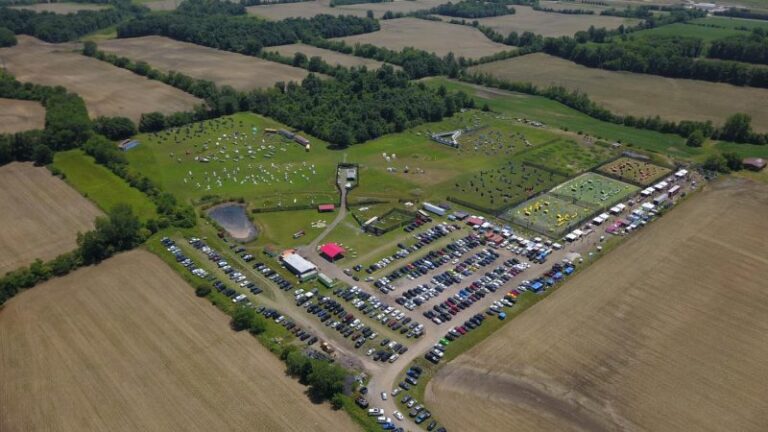
SplatterPark sits in Mount Gilead, Ohio, in Morrow County roughly an hour north of downtown Columbus, on a 40+ acre rural site the brand has called home since 2000.
The park offers 13 themed outdoor paintball and airsoft battle zones, with fields built around cargo crates, a castle, a crashed plane, hillsides, creeks, and trees. Game modes include Capture the Flag, Elimination, Domination, King of the Hill, and survival scenarios, plus the legendary Big Game event. Open play runs on weekends with no reservations, and all skill levels are welcome with full equipment rentals, professional referees, and safety briefings included.
Private groups of ten or more can book the entire facility for birthdays, corporate team building, bachelor and bachelorette parties, church and youth groups, and family outings, with a dedicated referee, private shelter, and covered pavilion. A concession stand, discounts for groups, and the option to bring your own food round out the experience. Players aged ten and up are welcome, and the friendly staff keeps safety and fun at the center of every visit.
 Outdoors
Odin’s Paradise Indoor Airsoft Field sits in the small city of Norwalk, Ohio, in Huron County, roughly midway between Cleveland and Toledo. It is a 42,000-square-foot indoor facility with about 35,000 square feet of play space, offering long-range, close-quarters, and speedsoft play. The crew has created original game modes like “Day of Dax,” “Tug-of-Bob,” “Chaos,” “Odin’s Weight Loss,” and “Refs Revenge,” and hosts speedsoft tournaments such as the Pitfighter 5v5 series.
The club is a family-run business founded by Army veteran Shane “Kirby” Krebs, with a volunteer staff that referees and helps newcomers learn the sport. An on-site airsoft shop and equipment rentals (full face mask, rifle, and BBs) let first-timers jump in without any gear. With its welcoming atmosphere for youth, first responders, and military, it suits birthdays, team-building events, and casual group outings.
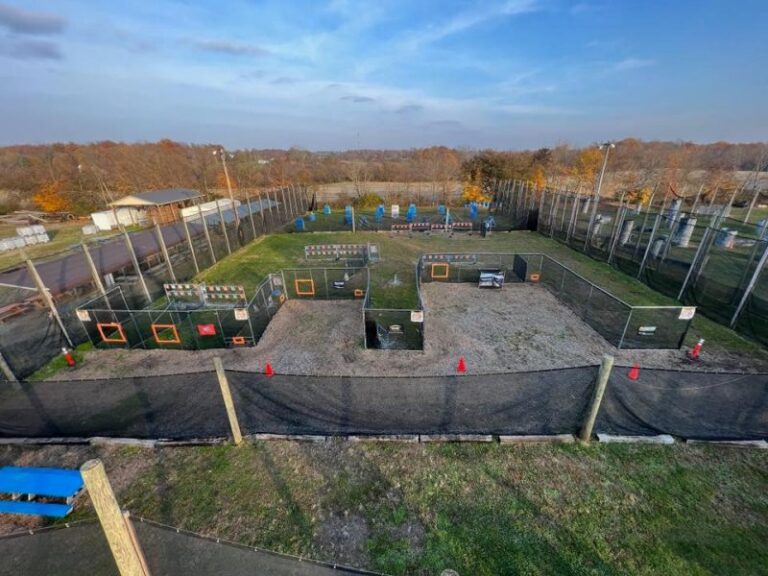
IndoorsLVL UP Sports Paintball Park sits in Grove City, about 15 miles south of downtown Columbus and Ohio State University, spread across a 36-acre property on Harrisburg Pike.
The park offers ten distinct playing fields, from two-story castles and army trucks to six acres of woods and a tournament-style speedball course. Guests can join public games every Saturday and Sunday without a reservation, or book a private group seven days a week with a dedicated staff host. Traditional paintball, low-impact paintball for younger players, airsoft by reservation, and after-dark Glowball under a UV arena round out the options.
Private party packages cover birthdays, bachelor parties, church outings, and corporate team building, with flat rates that include rental gear, access to all maps, and paintballs. A large covered pavilion with picnic tables is free for parties, guests can bring their own food or have it delivered, and a fully stocked pro-shop carries gear and upgrades. The staff are consistently praised for their safety focus and welcoming approach to first-timers.
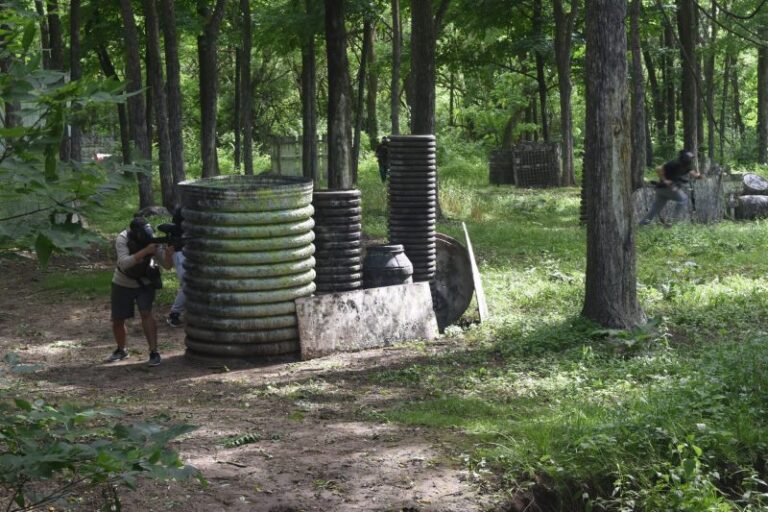
OutdoorsParker’s Airsoft Field sits on the Circle C Ranch in Bethel, Ohio, a 25–30 acre wooded property about a half-hour east of Cincinnati. It’s one of the larger dedicated airsoft venues in the region, with a rotating open play schedule, a field store, HPA fill, and a companion 1.5-acre field called Action Acres in New Richmond.
Open play features a rotating lineup of game modes including Team Death Match, Capture the Flag, Search and Destroy, and rescue scenarios, with teams split by sleeve color. The field is best known for large-scale themed events like the Vietnam-era “No Front Line” MilSim, the WWII “Operation Queen” reenactment, and the zombie “The Rift” storyline. Onsite gear rentals run $25 all day, and private events, birthday parties, and bachelor parties can be arranged. The veteran-run field offers a relaxed farm setting with firewood and eggs for sale, making it a welcoming spot for casual players, MilSim veterans, and groups alike.
Outdoorsi70 Paintball & Airsoft is located in Huber Heights, Ohio, just outside Dayton, on Wildcat Road. It is an outdoor club with an eight-acre woodsball paintball field and a four-acre airsoft field, open all year round on weekends. Players can choose from a rotating lineup of game modes — Elimination, Capture the Flag, Medic, Fort, Predator, and Marines vs. Aliens — all supervised by trained referees. The on-site pro shop stocks gear, offers high-pressure air and CO2 fills, and matches online pricing, while rental packages cover markers, masks, vests, and paintballs for first-timers.
The club is a natural fit for birthday parties, company outings, team-building days, bachelor and bachelorette parties, and church groups, with private weekday events available for groups of ten or more. Walk-ons are welcome every Saturday and Sunday without a reservation, and gift certificates are available. With a two-story fort, around 130 bunkers, and plenty of natural cover, it offers a full day of outdoor play for both newcomers and regulars.
Outdoors
Airsoft is a rapidly growing recreational sport that blends the excitement of military‑style simulations with the safety of non‑lethal projectile play. Participants—known as “players” or “airsofters”—use replica firearms that fire 6 mm plastic BBs powered by electricity, compressed gas, or a spring mechanism. Unlike paintball, airsoft ammunition leaves no visible mark, which encourages a focus on tactical movement, situational awareness, and realistic combat drills. The sport can be enjoyed in indoor arenas, outdoor fields, or even in specially designed urban environments that mimic abandoned buildings or city streets. Because the equipment looks and feels like real weapons, airsoft offers a uniquely immersive experience that appeals to hobbyists, tacticians, and anyone who enjoys a blend of sport and simulation.
One of the core attractions of airsoft is the level of realism it can provide. Replicas often feature authentic weight, recoil, and external controls, allowing players to practice handling, reloading, and maintenance techniques that mirror those used by actual firearms. This realism extends beyond the hardware; many fields employ scenario‑based missions that require players to think like a squad on a real operation.
Teamwork is equally essential. Successful engagements hinge on clear communication, coordinated movement, and the ability to adapt to evolving battlefield conditions. Players learn to assign roles—such as point man, support, or designated marksman—and to execute fire‑and‑movement tactics that emphasize cover, concealment, and mutual support.
Strategy in airsoft is not limited to individual skill. Large‑scale matches often involve objectives like “capture the flag,” “hostage rescue,” or “point control,” each demanding a distinct tactical approach. Teams must balance aggression with caution, manage limited ammunition, and exploit terrain features. The strategic depth is what keeps seasoned players returning for more.
Airsoft’s flexibility shines through its diverse game modes. Traditional formats include:
More specialized formats have emerged, such as MilSim (Military Simulation) events that span several hours or even days, incorporating role‑playing elements, supply drops, and logistical challenges. Speedball arenas, characterized by a compact field surrounded by inflatable barriers, emphasize fast‑paced action and quick reflexes. The breadth of modes means that newcomers can find a style that suits their preferences, while veterans can continually explore new tactical landscapes.
Customization is a hallmark of the hobby. Modern airsoft replicas are built on modular platforms that accept aftermarket hop‑up units, upgraded barrels, tighter tolerances, and electronic triggers. Players can fine‑tune velocity, accuracy, and reliability to match their playing style. Cosmetic modifications—such as rail systems, camouflage skins, and grip enhancements—allow each rifle or pistol to reflect personal taste and mission requirements.
Beyond the weapons themselves, players often outfit their gear with tactical plates, load‑bearing vests, and modular pouches. The ability to adapt equipment to specific scenarios heightens immersion and encourages a culture of continual improvement.
The airsoft community is a global network of enthusiasts who share a passion for the sport’s blend of competition, camaraderie, and craftsmanship. Online forums, social media groups, and local clubs provide platforms for knowledge exchange, gear reviews, and event organization. Many fields host “rookie nights” or mentorship programs where experienced players guide newcomers through safety protocols, basic tactics, and equipment maintenance. This supportive environment not only fosters skill development but also cultivates lasting friendships that often extend beyond the battlefield.
Entering the sport safely requires a baseline set of protective equipment. While the specific items may vary by field rules and personal preference, a well‑rounded starter kit includes the following:
The most critical piece of gear, eye protection, must meet ANSI Z87.1 standards or be a certified polycarbonate mask designed for airsoft. Full‑face masks provide additional shielding for the nose and cheeks, reducing the risk of BBs penetrating the facial area.
Durable, close‑fit gloves protect the hands from BB impacts and rough terrain. Reinforced knuckle pads are advisable for players who frequently engage in close‑quarters combat or climb obstacles.
Footwear should offer ankle support, a thick sole, and water resistance. Tactical boots enable players to navigate mud, gravel, and uneven ground while minimizing the chance of foot injuries.
Impact pads absorb the shock of rapid movements, drops, and slides. Padding that straps securely prevents shifting during intense action and keeps joints protected during prolonged engagements.
A ballistic‑grade helmet or a specialized airsoft headgear—often equipped with a mounting rail for accessories—protects the skull and reduces the likelihood of concussion from high‑velocity BBs.
A lower face mask, often referred to as a “mandible guard,” shields the chin and teeth, areas that are especially vulnerable during low‑angle engagements or when a player is prone.
Investing in high‑quality protective gear not only safeguards the player but also demonstrates respect for the sport’s safety culture, encouraging others to follow suit.
Airsoft fields worldwide operate under a set of universal principles that maintain a safe and enjoyable environment.
All participants must treat every replica as if it were loaded with live ammunition. This mindset drives practices such as keeping the muzzle pointed downrange, engaging only when within clear line of sight, and maintaining a safe shooting distance—often a minimum of 10–15 meters for high‑velocity guns. Most fields require a “kill confirmation” protocol, where a player must visibly acknowledge a hit by raising a hand, shouting “hit,” or following a pre‑established signal.
Because airsoft BBs leave no permanent mark, honesty is essential. Players are expected to call their own hits and respect the decisions of referees or field marshals. This self‑regulation builds trust among participants and prevents disputes that could jeopardize the game’s flow.
Respect extends to fellow players, staff, and the venue. This includes adhering to field rules, cleaning up spent ammunition, and avoiding aggressive language or gestures. A respectful attitude ensures that newcomers feel welcome and that the sport maintains a positive reputation within the broader community.
Airsoft firearms fall into three primary categories, each with distinct operating principles and performance characteristics.
AEGs dominate the market due to their reliability and ease of use. Powered by a rechargeable battery, an internal gearbox drives a piston that compresses air to launch BBs. Most AEGs offer selectable fire modes—semi‑automatic, burst, or fully automatic—allowing players to adapt to different combat scenarios. Modern AEGs can achieve muzzle velocities between 300 and 400 fps (feet per second) with standard 0.20 g BBs, making them suitable for both indoor and outdoor play.
Gas guns use compressed propellant—commonly green‑gas (propane with silicone oil) or CO₂—to fire BBs. These replicas emulate the blow‑back action of real firearms, providing realistic slide movement and recoil. Gas pistols and rifles excel in close‑quarters scenarios where rapid follow‑up shots are essential. However, performance can be temperature‑dependent; colder conditions may reduce gas pressure and affect reliability.
Spring guns rely on a manually cocked spring to store energy. When the trigger is pulled, the spring releases, propelling a single BB per cock. While they lack the rapid fire capability of AEGs and gas guns, spring weapons are prized for their simplicity, durability, and low maintenance. They are often used in sniper roles, where high accuracy and consistent velocity are more valuable than rate of fire.
Understanding the strengths and limitations of each type helps players select a platform that aligns with their preferred tactics and budget.
Researchers studying airsoft have highlighted both its benefits and considerations. From a physiological standpoint, the sport offers moderate aerobic activity, improves hand‑eye coordination, and encourages fine motor skill development. Cognitive research points to enhanced decision‑making speed and spatial awareness, as players must process dynamic information and execute tactical responses under pressure.
Safety experts emphasize that, when proper protective gear is used, the risk of serious injury is minimal. Studies have shown that head and eye protection dramatically reduce the incidence of orbital fractures and retinal damage. Nevertheless, experts caution against the use of oversized or low‑quality masks, which can fail under high‑velocity impacts.
From an industry perspective, the airsoft market is viewed as a driver of innovation in polymer engineering and battery technology. Advances in hop‑up mechanisms, gear materials, and electronic triggers have applications beyond the hobby, influencing the design of training simulators for law enforcement and military organizations. Consequently, many manufacturers collaborate with research institutions to test new concepts in a controlled, low‑risk environment.
Overall, the consensus among scientists and professionals is that airsoft, when practiced responsibly, offers a constructive outlet for stress relief, teamwork development, and technical skill acquisition.
Airsoft’s appeal transcends age, gender, and occupational background. Teenagers often discover the sport through school clubs or local youth leagues, drawn by the excitement of simulated combat and the opportunity to make new friends. Adults—ranging from corporate team‑building participants to military veterans—appreciate the tactical depth and physical challenge. Some professionals use airsoft as a low‑cost training tool to rehearse squad movements, communication protocols, and weapons handling without the logistical burden of live‑fire exercises.
Women’s participation has grown steadily, supported by inclusive clubs and equipment lines designed for ergonomic comfort. Internationally, players from Europe, Asia, North America, and Oceania form a vibrant global community, with cross‑border tournaments and online exchanges fostering cultural exchange and shared knowledge.
Finding a suitable venue is essential for a rewarding airsoft experience. Options vary based on geography, desired intensity, and the type of engagement sought.
Regulated fields provide a structured environment with clear safety guidelines, professional referees, and pre‑set game scenarios. These venues often feature varied terrain—such as wooded zones, urban ruins, and open fields—allowing players to test different tactics. Membership or day‑pass fees typically cover equipment rentals, ammunition, and access to on‑site gear shops.
Grassroots clubs meet regularly at nearby parks, wooded areas, or private properties. These groups prioritize camaraderie, skill development, and community building. New players benefit from mentorship programs, while seasoned participants enjoy the flexibility to organize custom scenarios or host friendly competitions.
MilSim (Military Simulation) events represent the pinnacle of airsoft immersion. Spanning anywhere from a single day to several weeks, MilSim missions replicate real-world operations with detailed briefing packets, supply caches, and role‑specific objectives. Participants often adopt call signs, adhere to radio discipline, and follow a chain of command. While the logistical demands are higher—requiring personal gear, ample ammunition, and sometimes travel—MilSim offers an unparalleled depth of strategy and role‑play.
Regardless of the setting, players should verify that the venue enforces mandatory safety protocols, provides adequate medical support, and respects local regulations regarding airsoft gun transportation and usage.
Airsoft stands at the intersection of sport, simulation, and community. Its blend of realistic weapon handling, strategic teamwork, and customizable equipment draws a diverse crowd ranging from casual hobbyists to dedicated tacticians. By adhering to strict safety standards, embracing the honour system, and respecting fellow players, participants create an environment where skill development and enjoyment coexist.
Choosing the right gear—starting with reliable eye protection, sturdy boots, and comprehensive body armor—lays the foundation for a safe entry into the sport. Understanding the distinctions among Automatic Electric Guns, gas‑powered weapons, and spring‑powered replicas enables newcomers to select a platform that aligns with their tactical preferences and budget.
Scientific research underscores the positive physical and cognitive effects of airsoft, while industry experts recognize its role as a testbed for emerging technologies. The sport’s inclusive community, diverse game modes, and plentiful venues—from sanctioned fields to sprawling MilSim events—ensure that airsoft will continue to thrive as a dynamic, engaging activity for years to come. Whether a first‑time player stepping onto a local field or a veteran commander leading a multi‑day simulation, airsoft offers a compelling arena for teamwork, strategy, and the pure thrill of the chase.


 220 N State Rd, Medina, OH 44256