
 El Monte
 Log in
Log in
Log in

Phoenix VR is located in Pelham, AL.
Phoenix VR: An Immersive Virtual Reality Amusement Center in Pelham, AL. Phoenix VR in Pelham, AL, offer cutting-edge Virtual Reality technology, expansive VR gaming areas, and a variety of specially crafted games and experiences designed for location-based VR Gaming, promising the ultimate immersive gaming adventure. Their offerings include:
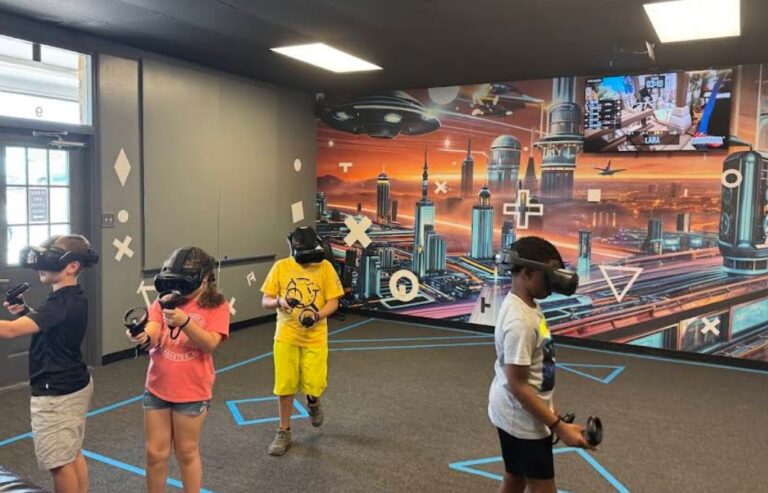
Phoenix VR is presented as perfect for kids, teens, and adults seeking a thrilling escape from the everyday routine. Whether planning a birthday party, corporate event, or just a fun day out with friends and family, they assert they have something for everyone.
 Indoors
A free‑roam virtual‑reality (VR) arena is a physical space that blends the limitless imagination of the digital world with the freedom of movement in the real world. Unlike the tabletop or seated setups that dominate most home‑based VR experiences, a free‑roam arena is designed so that participants can walk, run, duck, and even jump while wearing a headset. The arena’s boundaries are defined by a combination of floor‑mounted sensors, infrared cameras, and sometimes high‑precision optical tracking rigs that map every user’s position and orientation in three‑dimensional space. The result is a seamless, low‑latency translation of a player’s body language into the virtual environment, making it feel as if the world on the screen truly expands beneath their feet.
Because the technology no longer forces users to stay within a small play area, designers can craft experiences that are larger than life—towering castles, sprawling alien landscapes, or even entire city blocks. The arena itself can be a modular warehouse, a repurposed gym, or a purpose‑built facility with padded walls, safety nets, and soft flooring to protect participants from accidental collisions. The overarching goal is to give people the sensation of stepping into another realm while retaining the safety and control of a physical environment.
The freedom to move translates directly into richer storytelling and more varied gameplay mechanics. Several categories of scenarios have emerged as staples in free‑roam venues:
Adventure Quests
Players embark on narrative‑driven journeys that require exploration, puzzle‑solving, and combat. A common format is a “hero’s path” where teams must locate artifacts, decipher ancient runes, and defeat a final boss that towers over the arena’s ceiling. The physical act of climbing a ladder, opening a chest, or dodging a fireball feels authentic because the user’s body mirrors the action.
Sports Simulations
From futuristic zero‑gravity soccer to archery tournaments set on floating platforms, free‑roam arenas excel at recreating kinetic sports that would be impossible or unsafe in the real world. The ability to sprint across a field, leaping to catch a virtual ball, creates a visceral thrill that seated shooters can’t match.
Escape Rooms
The escape‑room genre has migrated into VR with great success. Participants must locate hidden clues, manipulate virtual levers, and cooperate under a ticking clock. Because the arena tracks each player’s exact location, designers can hide objects in corners, under tables, or even on the ceiling, turning the entire space into a three‑dimensional puzzle box.
Horror Experiences
The combination of immersion and physical freedom amplifies the psychological impact of horror. Dimly lit corridors, sudden apparitions, and real‑world haptic feedback (such as a low‑frequency rumble in the floor) make heart rates spike and adrenaline surge. Safety protocols—like an “out‑of‑bounds” button that instantly ends the experience—ensure that the terror remains controlled.
Creative Sandbox Play
Some arenas offer open‑ended experiences where users can sculpt digital clay, paint with light, or build structures block by block. Because the environment tracks hand gestures and whole‑body motion, the act of shaping a virtual masterpiece feels akin to real sculpting, fostering a sense of presence that static controllers cannot deliver.
Each scenario is built around the central premise that users can navigate the virtual world with their bodies, not just their thumbs. This creates a deeper emotional connection to the content and opens the door for group interaction that mirrors real‑world social dynamics.
The demographic spread for free‑roam VR is surprisingly broad, reflecting the technology’s ability to accommodate varying ages, skill levels, and social contexts.
Families and Children
Parents often look for safe, supervised entertainment options that can keep kids active while satisfying their appetite for digital play. Free‑roam arenas provide a controlled environment where children can expend energy without the risk of bumping into furniture or walls at home.
Teenagers and Young Adults
This group is drawn to the social aspect of multiplayer quests, competitive sports simulations, and high‑intensity horror experiences. The collaborative nature of many scenarios encourages teamwork and communication—skills that resonate with school clubs, gaming squads, and casual friend groups.
Corporate Teams
Companies use free‑roam VR for team‑building exercises, leadership workshops, and innovation sprints. The immersive setting strips away workplace hierarchies, forcing participants to rely on trust and rapid problem‑solving. A typical corporate session might involve a timed mission to retrieve a “data core” before a virtual virus spreads, prompting cross‑functional collaboration.
Event Organizers and Celebrants
Birthday parties, graduations, and gala celebrations increasingly incorporate free‑roam VR as a centerpiece attraction. The novelty factor makes the event memorable, while the adaptable nature of the content allows organizers to tailor the experience to the theme—be it a space‑exploration birthday or a futuristic corporate gala.
Special‑Needs Communities
Some therapeutic programs have begun integrating free‑roam VR for physical rehabilitation, sensory integration, and social skills training. The ability to control movement in a safe, gamified context can motivate participants to practice motions they might otherwise avoid.
Overall, the common thread among all users is the desire for an experience that feels both physically engaging and mentally stimulating—something that traditional arcade games, consoles, or even stationary VR cannot fully deliver.
When children enter a free‑roam arena, the first priority is safety. Most facilities employ a layered approach:
Physical Safeguards – Padded walls, soft flooring, and motion‑capture zones that automatically pause the experience if a user steps outside the safe perimeter.
Supervision – Trained staff members monitor participants via live video feeds from the tracking system, ready to intervene if a collision or disorientation occurs.
Age‑Appropriate Content – Game libraries are segmented into age brackets, ensuring that younger players encounter whimsical, low‑intensity adventures rather than mature horror titles.
Beyond entertainment, free‑roam VR can be an educational platform. Interactive science simulations allow kids to explore the human circulatory system from the inside, travel through the solar system, or dissect a virtual dinosaur skeleton—all without the mess or risk of real lab work. By physically moving through these lessons, children develop spatial reasoning and kinesthetic memory, which research shows can improve retention compared to passive observation.
Parents also appreciate the balance between screen time and physical activity. While a headset still delivers visual stimulation, the user’s body is constantly engaged: walking, crouching, reaching, and sometimes even sprinting. This hybrid model encourages healthier habits and can be a compelling alternative to sedentary gaming.
Children’s birthday celebrations have traditionally revolved around cake, balloons, and a few party games. Adding a free‑roam VR session transforms the event into an immersive adventure that feels tailor‑made for the celebrant. Packages typically include:
Themed Scenarios – A pirate treasure hunt, a superhero training academy, or a magical kingdom quest that aligns with the party’s motif.
Personalization – Custom avatars featuring the birthday child’s likeness, along with in‑game “birthday candles” that participants can blow out virtually.
Group Sessions – Multiple lanes allow several teams to run simultaneous quests, ensuring that each guest gets equal playtime without long queues.
Safety Briefings – Short, child‑friendly introductions that teach participants how to move safely and what the “stop” button does.
Parents report that children remember the experience months after the party, often describing it as “the best present ever.” The physical activity also means fewer post‑party “tired” complaints, as kids have already burned off a good portion of their energy.
Graduation ceremonies celebrate a transition from one life stage to another. Free‑roam VR can amplify that symbolism through immersive storytelling. A typical graduation package might involve:
Journey Narrative – Participants start in a digital representation of their school campus, then embark on a quest that mirrors the challenges they have faced, culminating in a virtual “graduation hall” where avatars receive diplomas in a spectacular fireworks display.
Photo‑Ready Moments – The arena’s surrounding screens capture group photos of players in their avatars, providing unique memorabilia that blends physical and virtual identities.
Interactive Alumni Networking – Graduates who cannot attend in person can join a live session via remote headsets, allowing the event to be partially hybrid while still preserving the tactile experience for those on site.
Such experiences make the ceremony more than a passive rite of passage; they turn it into an active, memorable story that each graduate can relive.
Corporate events have long sought ways to break down silos and foster a shared culture. Free‑roam VR offers several advantages:
Scalable Scenarios – From small groups tackling a puzzle to large cohorts competing in a “Capture the Flag” style competition, the arena can host anywhere from 4 to 30 participants simultaneously.
Brand Integration – Companies can embed logos, product prototypes, or corporate values directly into the virtual world, turning the experience into a subtle marketing exercise.
Data‑Driven Insights – Tracking software records metrics such as time taken to solve challenges, communication patterns, and decision‑making speed. Post‑event analytics help HR teams identify strengths and development areas within teams.
Inclusive Design – Since the arena accommodates various physical abilities (e.g., participants can use seated modes or hand‑tracking alternatives), the experience can be inclusive for a diverse workforce.
Events often culminate in a celebratory “after‑party” zone where participants can remove their headsets and mingle in a physical lounge, reinforcing the blend of virtual teamwork and real‑world camaraderie.
Running a free‑roam arena is a complex operation that combines technology, safety protocols, and creative design. Key components include:
High‑Precision Tracking – Multi‑camera setups capture the position of each headset and controller at sub‑30‑millisecond intervals, ensuring that virtual motion matches real movement without noticeable lag.
Robust Hardware – Headsets used in arenas are typically tethered to powerful PCs or high‑end wireless units that can render photorealistic graphics at 90+ frames per second, preventing motion sickness.
Sanitation Procedures – Given the tactile nature of the experience, staff clean headsets, straps, and controllers between sessions using UV light or antimicrobial wipes.
Staff Training – Operators learn the basics of VR safety, emergency stop functions, and how to guide participants through troubleshooting (e.g., adjusting headset fit or recalibrating tracking).
Content Refresh Cycle – To keep repeat visitors engaged, venues rotate scenarios every few months, add seasonal events, or commission custom experiences for corporate clients.
These operational details, while invisible to the end user, are essential for delivering a smooth, repeatable, and safe experience that encourages word‑of‑mouth referrals.
As hardware continues to shrink and tracking algorithms become more efficient, the cost barrier for setting up a free‑roam arena is gradually lowering. Emerging trends point toward:
Mixed‑Reality Integration – Combining holographic projections with VR headsets can blur the line between the physical arena and the virtual world even further, allowing participants to interact with tangible props that correspond to digital objects.
AI‑Driven Narratives – Adaptive storylines that respond to a group’s performance, mood, or even biometric feedback (heart rate, galvanic skin response) will create personalized adventures on the fly.
Location‑Based Networks – Chains of arenas across cities could share player profiles, enabling users to carry achievements and avatar customizations from one venue to another, fostering a broader community.
Accessibility Enhancements – Voice‑controlled menus, haptic‑feedback gloves, and variable locomotion options will open the experience to users with limited mobility, ensuring that the magic of free‑roam is truly universal.
The convergence of these innovations suggests that free‑roam VR will evolve from a niche entertainment offering into a mainstream platform for education, corporate training, and social connection.
A free‑roam VR arena represents the intersection of physical activity and digital imagination, delivering a level of immersion that static VR setups cannot match. By allowing users to walk, run, and interact with a virtual world as naturally as they move in the real one, these arenas unlock a spectrum of scenarios—from epic adventure quests and adrenaline‑pumping sports to collaborative escape rooms and calming creative sandboxes. The appeal spans children eager for safe, active play; teenagers searching for novel thrills; corporate teams craving fresh avenues for collaboration; and event planners looking for unforgettable celebrations.
For kids, the technology offers a balanced mix of fun, education, and movement, while birthdays, graduations, and corporate gatherings gain a dynamic centerpiece that can be customized to any theme or brand. Behind the scenes, sophisticated tracking, rigorous safety protocols, and meticulous content design ensure that each session is both exhilarating and secure.
As hardware becomes more affordable and software more intelligent, free‑roam VR arenas are poised to become a staple of modern entertainment and learning spaces. Whether stepping into a medieval castle, scoring the winning goal in a zero‑gravity arena, or solving a puzzle that feels physically real, participants discover a new definition of presence—one that proves the future of virtual reality is not just seen, but also walked, leapt, and lived.


 2015 Valleydale Rd Suite 8, Pelham, AL 35244, United States