
 El Monte
 Log in
Log in
Log in

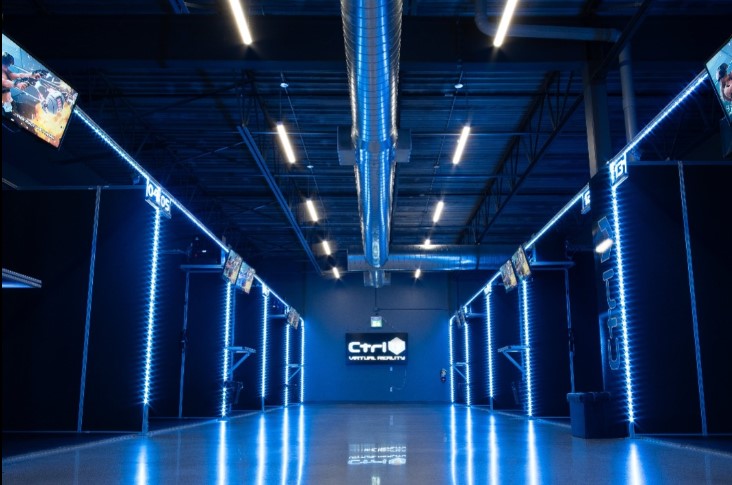
Ctrl V: Indoor Virtual Reality Arcade & Escape Room is located in Bear, DE.
Ctrl V is a popular VR arcade and escape room center located in Bear, DE. They specialize in providing unique and immersive experiences for players of all ages. At their arcade, you can try out a variety of VR games and experiences, from thrilling roller coaster rides to multiplayer shooter games. They also offer escape rooms, where you and your friends must work together to solve puzzles and escape before time runs out. With their state-of-the-art technology and friendly staff, Ctrl V is the perfect destination for an unforgettable gaming experience.
 Indoors
A free‑roam virtual‑reality arena is a purpose‑built physical space where participants move unencumbered while wearing a head‑mounted display (HMD). Unlike seated or tabletop VR experiences that confine motion to a chair or a limited play area, free‑roam venues are outfitted with sophisticated tracking systems—often a combination of infrared cameras, lidar sensors, or ultra‑wide‑angle optical markers—that map the wearer’s exact position in three‑dimensional space. The arena’s floor is typically covered with a non‑slip, low‑friction material, and the walls may incorporate padded panels or soft barriers to keep users safe while they dash, duck, or leap inside the virtual world.
Because the tracking data is processed in real time, the virtual environment mirrors the user’s physical movements with sub‑millisecond latency. This creates a seamless illusion of presence: a participant can sprint down a digital hallway, vault over a virtual obstacle, or lean to peer around a corner, and the visual and auditory cues adjust instantly to match. The result is an immersive playground that blurs the line between the real and the synthetic, opening up gameplay, storytelling, education, and training possibilities that would be impossible on a stationary setup.
The flexibility of a free‑roam arena lends itself to a broad spectrum of scenarios, each designed to capitalize on the freedom of movement:
Adventure Quest – Players assume the role of explorers navigating a lost temple, a haunted forest, or an alien planet. Physical obstacles—such as low beams, climbing walls, or moving platforms—are integrated into the virtual architecture, compelling participants to crawl, climb, and solve spatial puzzles.
Competitive Sports – From futuristic laser‑tag to VR adaptations of basketball, soccer, or dodgeball, the arena can host fast‑paced team matches where players’ actual sprinting and dodging translate directly into in‑game actions. Scoring systems track hits, goals, or captures, and spectators can view live overlays on large screens.
Cooperative Storytelling – Narrative‑driven experiences allow small groups to work together to unravel a mystery or complete a mission. The environment reacts to collective decisions, encouraging communication and teamwork. Environmental effects—such as wind generated by fans or temperature changes—augment the story’s emotional beats.
Training Simulations – Safety‑critical professions—firefighters, first responders, or industrial technicians—use free‑roam VR to rehearse hazardous scenarios. The arena can mimic confined spaces, smoke, or machinery, while the digital overlay supplies performance metrics and debriefing tools.
Artistic Installations – Artists create immersive galleries where visitors walk through surreal landscapes, interacting with dynamic sculptures, soundscapes, and light shows. The physicality of walking through the space deepens the sensory impact, making the artwork a lived experience rather than a passive display.
Each scenario is modular; operators can reconfigure the arena’s layout, adjust lighting, and swap software modules within hours, delivering fresh content for repeat visitors.
Free‑roam VR appeals to a remarkably diverse audience. Demographic studies from major operators reveal three primary user groups:
Casual Gamers – Individuals who regularly play video games on consoles or PCs but are seeking a novel, physically engaging experience. For them, free‑roam VR offers an adrenaline‑pumping alternative that feels like a blend of arcade action and outdoor sports.
Experience Seekers – People motivated by novelty and social media shareability. They gravitate toward immersive attractions that promise “Instagram‑worthy” moments, such as battling dragons or exploring a neon‑lit cybercity. This cohort often includes tourists and urban dwellers looking for weekend entertainment.
Professional Users – Companies, educational institutions, and research labs that employ the arena for training, team‑building, or research purposes. These users value the high fidelity of motion capture and the ability to simulate real‑world constraints safely.
Age distribution skews toward the 18‑35 bracket, yet the platforms are increasingly accommodating older adults and younger children through adjustable difficulty levels, safety harnesses, and age‑appropriate content filters. Accessibility features—such as seated options, wheelchair‑compatible play zones, and auditory assistance—are also expanding the user base.
Designing free‑roam experiences for children requires a careful balance between excitement and safety. Operators typically implement the following adaptations:
Scaled‑Down Play Areas – Smaller zones with reduced ceiling heights prevent accidental collisions with overhead infrastructure. Soft, foam‑filled walls replace hard barriers, and all moving props are calibrated to slower speeds.
Age‑Specific Content – Narrative themes lean toward whimsical adventures—magical forests, pirate treasure hunts, or superhero training camps—using bright colors and gentle soundtracks. Gameplay mechanics avoid violent combat, opting for collaborative problem‑solving and non‑lethal challenges.
Supervision Protocols – Trained staff members monitor each session, equipped with handheld tracking tablets that display real‑time positions of every headset. If a child approaches a boundary, the system can automatically pause the experience and guide them back to the safe zone.
Physical Conditioning – Sessions are limited to 10‑15 minutes for younger participants to prevent fatigue. Break periods are built in, during which kids can hydrate and discuss their progress, reinforcing learning outcomes such as spatial awareness and teamwork.
These measures make free‑roam VR a compelling educational tool. Teachers have reported increased engagement in STEM topics when lessons are embedded within interactive quests—for example, a chemistry‑themed adventure where children collect virtual elements by physically moving between stations.
The adaptable nature of free‑roam arenas makes them an attractive venue for a wide range of celebrations and corporate gatherings.
Parents increasingly choose free‑roam VR as a “next‑level” birthday experience. Packages typically include a private play session, a themed storyline (e.g., “Space Explorer” or “Dinosaur Safari”), and optional photo‑capture stations that overlay party hats or birthday banners onto the participants’ avatars. The high‑energy environment encourages group interaction, fostering memories that last beyond the usual cake‑and‑balloon routine.
Universities and high schools have begun integrating free‑roam VR into graduation festivities. A custom scenario can simulate the campus’s most iconic landmarks in a fantastical style—graduates walk through a virtual quad, toss their caps in slow motion, and receive digital accolades displayed on a surrounding screen. The immersive ceremony provides a fresh alternative to traditional podium speeches, especially for remote graduates who can attend virtually.
Companies leverage free‑roam VR for both celebration and skill development. For holiday parties, a “Winter Wonderland” adventure can blend competitive mini‑games with festive décor. For team‑building, problem‑solving missions require cross‑functional groups to coordinate movements, share information, and make rapid decisions under pressure. Post‑session analytics generate performance dashboards—tracking metrics such as communication latency, task completion time, and collaborative efficiency—allowing HR teams to identify strengths and improvement areas.
Because the arena can be rebranded with corporate logos, custom color schemes, and tailored narratives, organizations often view the space as an extension of their brand identity, turning a simple gathering into a memorable experiential marketing opportunity.
The scientific community has taken a keen interest in free‑roam VR, recognizing its potential to bridge gaps between laboratory research and real‑world application.
Neuroscientists appreciate that free‑roam environments produce naturalistic sensorimotor data. By recording neural activity (via EEG or portable fNIRS) while participants navigate a virtual maze, researchers can study spatial cognition, allocentric versus egocentric mapping, and the brain’s adaptation to altered sensory feedback. The high ecological validity of free‑roam setups surpasses traditional treadmill‑based VR, leading to more reliable findings about how the brain integrates visual, vestibular, and proprioceptive cues.
Physical therapists and occupational therapists are exploring free‑roam VR as a tool for motor recovery after stroke or traumatic injury. The immersive experience motivates patients to practice reaching, balance, and gait exercises within a safe, gamified context. Early clinical trials have reported increased adherence rates compared with conventional therapy, attributed to the novelty and immediate visual feedback.
Industry engineers use free‑roam VR to evaluate ergonomics and workflow design. By simulating a factory floor or aircraft cockpit in a walk‑through environment, designers can observe how workers interact with equipment, identify bottlenecks, and refine layout before committing to costly physical prototypes. The ability to “walk the line” virtually reduces design cycles and improves safety outcomes.
Experts also caution about data privacy and the psychological impact of highly immersive experiences. Motion‑capture data can reveal detailed movement patterns that, if mishandled, could be used to infer health conditions or behavioral traits. Consequently, many research institutions implement strict anonymization protocols and obtain informed consent that explicitly describes data usage.
Overall, the consensus among scientists and industry leaders is that free‑roam VR stands at the intersection of entertainment, education, and empirical inquiry. Its capacity to deliver high‑fidelity embodied interaction positions it as a transformative technology across multiple sectors.
As hardware costs continue to decline and tracking algorithms become more robust, free‑roam VR arenas are poised for rapid expansion. Anticipated trends include:
In the coming years, free‑roam VR is expected to move from niche entertainment venues into mainstream public spaces—shopping malls, museums, and even outdoor festivals—where the boundaries between the physical world and the digital canvas become increasingly fluid. The technology’s capacity to make movement a core component of virtual interaction ensures that it will continue to captivate audiences, empower professionals, and inspire groundbreaking research for years to come.


 142-144 Fox Hunt Dr, Bear, DE 19701, United States