TOP 10 best of the best Free-roam VR in Fort Collins, CO – Battleonix
El Monte
Log in
0

Advanced Search:

City

Rating

Playground


Price:

Main / Catalog / VR / Colorado, US / Fort Collins, CO

The best Free-roam VR in Fort Collins, CO

img
from $5
VR

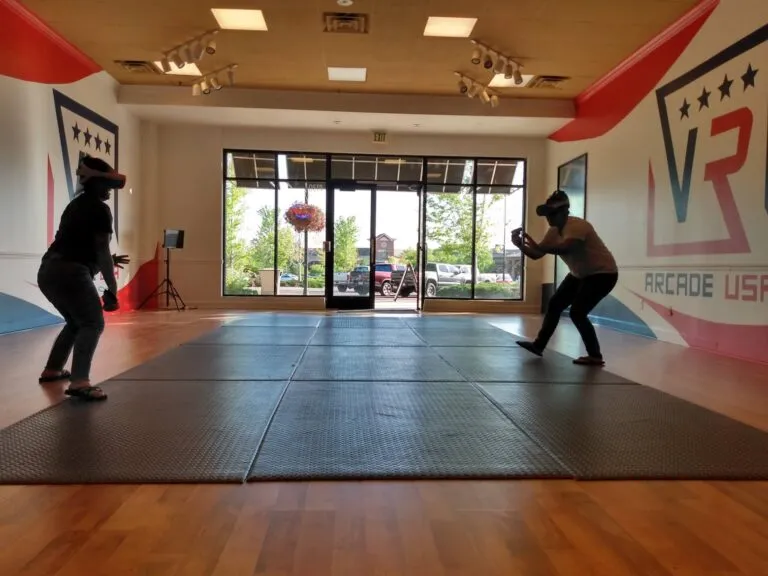
VR ARCADE USA Loveland Indoor Center is located in Loveland, CO


VR ARCADE USA in Loveland, CO offers a cutting-edge virtual reality gaming experience. Equipped with some of the latest VR technology, this arcade features a variety of games and experiences to choose from, including shooting games and unique puzzles. VR ARCADE USA also offers multiplayer options, allowing guests to compete against each other or work together to complete challenges. The arcade provides a safe and clean environment, with knowledgeable staff on hand to assist guests with any questions or concerns. Bookings can be made online or in person.

Indoors

Best of the best Free-roam VR in Fort Collins, CO


If you’re a virtual reality enthusiast in Fort Collins, Colorado, you’ll be excited to hear about the VR arenas popping up around town. These arenas offer a fully immersive experience that allows you to explore virtual worlds without ever leaving home. With the increasing popularity of virtual reality, these arenas are becoming a popular destination for gamers and tech-savvy folks alike.


What Is a Free‑Roam VR Arena?

Free‑roam virtual‑reality (VR) arenas are purpose‑built spaces where participants can move unrestricted while immersed in a digital world. Unlike seated or tethered systems that limit motion to a small play area, free‑roam arenas combine wireless headsets, precise indoor‑positioning technology, and a physical environment that mirrors the virtual one. The result is a seamless blend of real‑world locomotion and computer‑generated scenery: users walk, duck, reach, and even sprint, while the system tracks every step and translates it into the corresponding action inside the simulation.

The technology stack typically includes a fleet of high‑resolution, inside‑out tracking headsets (such as the Oculus Quest 2, HTC Vive Focus, or Pico Neo 3), a network of infrared or lidar sensors that map the room, and a robust Wi‑Fi or 5 GHz backbone that streams the graphics from a powerful on‑site PC or a cloud server. The floor is often covered with a non‑slip mat, and safety barriers or soft padding outline the play boundary. Because the arena is a controlled environment, developers can design experiences that make full use of six‑degrees‑of‑freedom (6‑DoF) motion without worrying about users colliding with furniture or walls.

The appeal of free‑roam VR lies in its ability to deliver a level of presence that conventional setups simply cannot match. When a user can physically walk a mile‑long corridor in the virtual world, the brain registers the motion as genuine, reducing motion sickness and deepening emotional engagement. This makes free‑roam arenas especially attractive for entertainment, education, training, and research applications where immersion is a critical factor.


Free‑Roam VR Scenarios: From Adventure to Training

The versatility of free‑roam arenas has given rise to a broad spectrum of scenarios, each exploiting the freedom of movement to create memorable experiences.

  1. Adventure and Storytelling – Designers craft narrative‑driven quests that unfold across sprawling virtual landscapes. Participants might explore a haunted castle, race through a futuristic city, or solve puzzles on an alien planet, all while physically navigating the arena’s layout.

  2. Competitive Sports and E‑Sports – Multi‑player arenas host battle‑royale style games, laser‑tag hybrids, or virtual dodgeball. Because every player can move independently, team tactics evolve beyond the constraints of a small play zone, leading to more strategic and physically demanding competition.

  3. Simulation and Training – Industries such as aviation, logistics, and emergency response use free‑roam VR to rehearse complex procedures. Trainees can practice aircraft maintenance, warehouse navigation, or fire‑rescue drills in a safe environment that replicates real‑world spatial dynamics.

  4. Fitness and Wellness – Exercise‑focused experiences turn a workout into an immersive adventure. Users might jog through a rainforest, box against holographic opponents, or practice yoga on a virtual mountaintop, with the arena tracking calories burned and movement accuracy.

  5. Educational Expeditions – Schools and museums employ free‑roam VR to transport students to historical periods, distant ecosystems, or microscopic realms. The ability to physically walk through a reconstructed ancient city or a cell’s interior enhances comprehension and retention.

The common thread across these scenarios is the emphasis on embodied interaction—the notion that the body’s natural movements are an integral part of the digital experience. By aligning physical locomotion with virtual feedback, free‑roam arenas generate a sense of agency that flat, seated VR cannot achieve.


Who Plays on Free‑Roam VR Arenas?

The audience for free‑roam VR is surprisingly diverse, spanning age groups, professional backgrounds, and leisure interests. Understanding the demographic landscape helps explain why the technology is proliferating across entertainment venues, schools, and corporate campuses.

1. Casual Gamers and Thrill‑Seekers

Young adults and teenagers form a core segment, drawn by the novelty of walking through a digital world without wires. For many, the arena offers an alternative to traditional arcade games, promising a physically active form of entertainment that can be shared with friends.

2. Families and Children

Parents increasingly view free‑roam VR as a family‑friendly activity. The technology’s safety features—guardian boundaries, soft padding, and supervised operators—make it suitable for children aged six and up. Parents appreciate that the experience encourages movement, coordination, and teamwork.

3. Education Professionals

Teachers and curriculum designers integrate free‑roam VR into classroom projects and field trips. The immersive nature of the arena aligns with experiential learning models, allowing students to “travel” to historical sites or conduct virtual chemistry labs while remaining within the school’s safety protocols.

4. Corporate Teams

Businesses use free‑roam VR for team‑building exercises, product demos, and client presentations. The shared physical space promotes collaboration, while the immersive backdrop can showcase complex concepts—such as a 3‑D prototype of a new machine—in a way that static images cannot.

5. Researchers and Industry Experts

Scientists, ergonomists, and human‑computer interaction specialists conduct experiments in free‑roam arenas to study perception, motion sickness, and spatial cognition. Their findings feed back into hardware design, software optimization, and safety standards.

This eclectic user base underscores that free‑roam VR is no longer a niche novelty; it is a platform that serves entertainment, education, corporate, and scientific purposes alike.


VR for Kids: Safety, Education, and Fun

When children enter a free‑roam arena, operators must balance excitement with rigorous safety protocols. Most venues enforce a minimum age—commonly six years—based on headset fit, visual acuity, and the child’s ability to follow instructions. Headsets are equipped with adjustable straps, foam padding, and hygiene covers that are sanitized between sessions.

From an educational perspective, VR offers a unique advantage: presence‑based learning. For example, a lesson on ancient Egypt can be transformed into an exploratory walk through a reconstructed pyramid, where students physically navigate chambers, discover hieroglyphs, and solve riddles that reinforce historical facts. Such embodied learning has been shown to improve memory recall compared to textbook study alone.

Beyond formal education, free‑roam VR provides a safe outlet for physical activity. In contrast to traditional screen‑time, kids are encouraged to move, reach, and react, which supports motor‑skill development. Many venues design child‑focused scenarios that blend bright, whimsical aesthetics with simple controls, ensuring that the experience remains intuitive and non‑intimidating.

Parents also value the social aspect. Multiplayer sessions let siblings or friends collaborate on quests, fostering communication and teamwork. Because the arena environment is supervised, children enjoy the thrills of VR without the risk of unsupervised internet interactions or uncontrolled physical hazards.


Free‑Roam VR for Special Events: Birthdays, Graduations, and Corporate Parties

Event planners have discovered that free‑roam VR arenas can serve as the centerpiece of a wide range of celebrations, delivering a memorable experience that goes beyond conventional party activities.


Birthday Parties

A birthday session can be customized around the honoree’s interests—whether they dream of becoming a space explorer, a pirate captain, or a superhero. The arena can host a themed storyline where the birthday child leads the group through challenges, culminating in a virtual “cake‑cutting” ceremony where fireworks explode in the digital sky. The physical movement component also helps expend the excess energy that typically accompanies a group of excited children.


Graduations

Graduation ceremonies traditionally involve speeches and photo‑ops, but a free‑roam VR celebration adds a futuristic twist. Graduates can step into a virtual auditorium that projects their names onto a digital marquee, then journey through a simulated timeline of their academic journey—visiting lecture halls, lab experiments, and field trips—all recreated in VR. The experience can conclude with a shared “launch” where each graduate presses a virtual button that sends a fireworks display soaring, symbolizing the start of a new chapter.


Corporate Parties and Product Launches

Companies looking to impress clients or reward employees often seek innovative experiences. A free‑roam arena can host a customized brand narrative, where participants navigate a virtual version of the company’s headquarters, interact with 3‑D product models, and solve collaborative puzzles that highlight key features. For product launches, the arena offers a dramatic reveal: a sleek vehicle, a new gadget, or a piece of architecture can be unveiled in a spectacular, immersive fashion that leaves attendees with a lasting impression.

Event organizers benefit from the arena’s scalability; sessions can be scheduled in blocks, allowing multiple groups to experience the same scenario while maintaining social distancing if needed. Additionally, data analytics—such as time spent in each zone, number of interactions, and participant feedback—can be captured to evaluate event success and refine future programming.


Scientists and Industry Experts View on Free‑Roam VR

The academic and professional community regards free‑roam VR as a pivotal step toward truly embodied digital experiences. Researchers in cognitive science point out that spatial navigation in a physical space activates neural pathways distinct from those engaged by joystick‑based locomotion. By preserving the vestibular and proprioceptive cues associated with walking, free‑roam systems reduce the dissonance that often causes motion sickness in conventional VR.

Ergonomics specialists emphasize that the six‑degrees‑of‑freedom (6‑DoF) interaction model supported by free‑roam arenas yields more accurate assessments of human performance. For instance, in industrial training simulations, the ability to physically reach for a virtual control panel provides richer data on hand‑eye coordination and response times than a hand‑controller can deliver. This data is valuable for designing safer workplace procedures and improving equipment ergonomics.

From a hardware perspective, industry engineers acknowledge that wireless headsets, while offering freedom of movement, still face challenges such as battery life, processing power, and latency. However, advances in edge computing—where rendering farms are placed locally within the arena—have dramatically reduced motion-to-photon latency to sub‑20 ms, a threshold considered imperceptible to most users. Moreover, the adoption of inside‑out tracking eliminates the need for external cameras, simplifying arena setup and maintenance.

In the realm of education, pedagogical researchers argue that free‑roam VR aligns with constructivist learning theories. By allowing learners to manipulate virtual objects with their own bodies, the environment supports discovery‑based learning and promotes deeper conceptual understanding. Early studies have reported improved test scores in subjects such as anatomy and physics when lessons were delivered through free‑roam simulations compared with textbook instruction alone.

Finally, ethicists and policy analysts caution that as free‑roam VR becomes more ubiquitous, considerations around data privacy, informed consent, and equitable access must be addressed. The tracking sensors collect detailed movement data that could be used to infer health metrics or behavioral patterns. Transparent data handling policies and anonymization techniques are therefore essential to maintain public trust.


Looking Ahead

Free‑roam VR arenas are rapidly evolving from experimental installations to mainstream venues that cater to entertainment seekers, learners, and professionals alike. The convergence of wireless hardware, low‑latency networking, and sophisticated motion tracking has unlocked a new dimension of immersion—one where the body’s natural movements drive the narrative.

As developers continue to explore the creative possibilities of embodied interaction, we can expect richer storylines, more nuanced training modules, and broader adoption across sectors. Simultaneously, ongoing research will refine safety standards, enhance ergonomic design, and ensure that the technology respects user privacy.

In the coming years, stepping into a free‑roam arena may become as commonplace as entering a movie theater or bowling alley. Whether celebrating a child’s birthday, rehearsing a critical emergency response, or simply escaping into a fantastical realm, the experience promises a blend of physical activity and digital wonder that redefines what virtual reality can be.