El Monte
 Log in
Log in
Log in

Urban Air Trampoline and Adventure Indoor Park is located in Meridian, ID.
Urban Air Trampoline and Adventure Park in Meridian, Idaho is a perfect destination for both kids and adults. It features over 15 attractions including trampolines, warrior obstacle course, rope course, bumper cars, climbing walls and much more. This indoor amusement park features a safe and fun environment with unique attractions and various packages for birthday parties, corporate events and group outings. From toddlers to adrenaline seekers, everyone can experience the thrill at Urban Air Trampoline and Adventure Park.
 Indoors
VR1 Arcade Indoor Center is located in Eagle, ID.
VR1 Arcade in Eagle, ID offers an immersive virtual reality gaming experience for all ages. With state-of-the-art technology, guests can explore new worlds and participate in thrilling adventures. The arcade features a variety of games, from multiplayer team battles to individual challenges. Each experience is fully immersive and offers realistic graphics and sound. VR1 Arcade is the perfect destination for group events, birthday parties, and family outings. The friendly and knowledgeable staff ensure that every guest has an unforgettable experience. Come visit VR1 Arcade in Eagle, ID and discover a whole new world of entertainment.
IndoorsVR1 Arcade at Jumptime Indoor Center is located in Meridian, ID.
VR1 Arcade is a popular attraction located at Jumptime in Meridian, Idaho. This arcade offers a unique gaming experience with virtual reality technology. Visitors can immerse themselves in a range of exciting games and experiences, such as racing, shooting, and adventure games. The facility features multiple VR stations, giving groups and individuals the chance to enjoy the games together. With realistic graphics and interactive gameplay, VR1 Arcade is an excellent choice for people of all ages who want to explore new worlds and have fun with friends and family.
IndoorsPyrrhic Indoor Family Fun Center is located in 2104 Caldwell Blvd, Nampa.
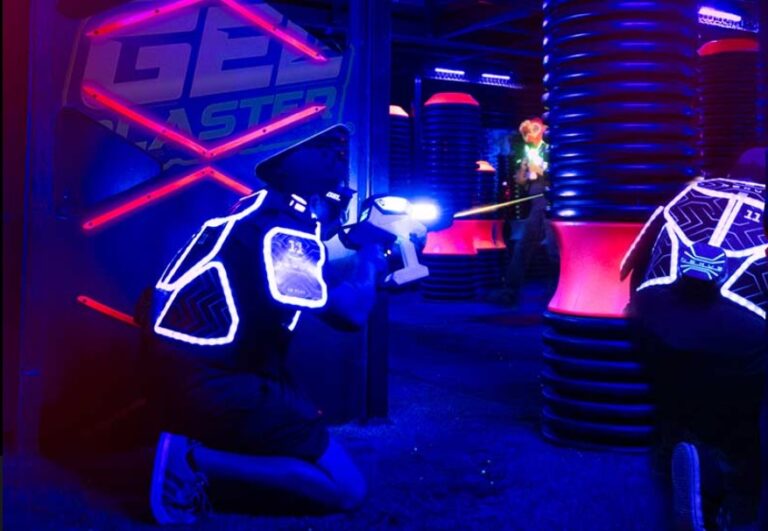
Pyrrhic Indoor Family Fun Center in Nampa, ID, offers a wide variety of indoor games designed to provide excitement for the entire family. Visitors can enjoy activities such as Nerf, Airsoft, Laser Tag, Gel Blaster Nexus, and Virtual Reality (VR) in a newly constructed 22,500-square-foot facility. This location marks the first indoor Airsoft arena in the region. The two-story venue ensures total excitement with casual, all-weather fun for families. Activities are suitable for participants aged 6 and above, with VR available for ages 10+.
Pyrrhic has long been recognized as Treasure Valley’s most memorable destination for birthday parties. With the addition of the indoor location in Nampa, they have expanded their offerings. Event rooms will soon be available for birthdays, reunions, group parties, team training events, bachelor(ette) parties, and more.
IndoorsA free‑roam virtual‑reality arena is a purpose‑built space where participants can move unencumbered while their actions are captured and translated into a digital world. Unlike the seated or tabletop setups that dominate most home‑based VR experiences, a free‑roam arena removes the physical constraints of cables, limited play‑area boundaries, and headset weight. The environment is typically outfitted with a combination of motion‑tracking cameras, infrared sensors, or ultra‑wide‑angle lidar systems that map the participants’ positions in real time. The headset itself is lightweight and often battery‑powered, allowing users to sprint, duck, jump, or even climb without the risk of tripping over cords. The arena’s walls are either painted a neutral matte color to aid visual tracking or covered in modular panels that can be rearranged to create different thematic backdrops.
Beyond the hardware, the software that runs a free‑roam arena is designed to accommodate multiple players simultaneously. Multiplayer engines synchronize each participant’s avatar, ensuring that movements, gestures, and even facial expressions are reflected accurately in the shared virtual space. The result is a fully immersive playground where the boundary between the physical and the digital blurs: a child can swing a plastic sword and see their virtual counterpart light up with a neon aura, while an adult can duck behind a virtual barricade that appears to materialise around a real‑world foam wall.
The flexibility of a free‑roam arena gives designers an almost limitless canvas for crafting experiences. Some of the most popular scenarios fall into three broad categories: adventure, education, and collaborative challenge.
Adventure scenarios transport participants to fantastical realms. In a “Dragon’s Lair” adventure, users navigate a dimly lit cavern, dodge projectiles launched by a towering dragon projection, and cooperate to retrieve a glowing relic. The arena’s physical obstacles—rising platforms or low‑lying barriers—are mirrored in the virtual world, adding a tactile dimension that static VR cannot replicate. Another favorite is “Space Rescue,” where participants float through a zero‑gravity simulation, using hand‑tracked thrusters to guide a stranded astronaut back to a spacecraft dock.
Educational scenarios leverage the same technology for learning. A virtual museum tour can guide children through a reconstructed ancient Egyptian tomb, where they physically step over hieroglyph‑etched thresholds and use hand gestures to unseal hidden chambers. In a “STEM Lab” experience, participants assemble a virtual robot using real‑world props that the system recognizes, reinforcing concepts of circuitry and programming through kinetic interaction.
Collaborative challenge scenarios are built around teamwork and problem solving. “Escape the Facility” places a group of four to six players inside a simulated high‑security compound. They must locate keycards, hack virtual terminals, and coordinate movement to avoid laser grids that are projected onto the arena’s walls. The pressure of a ticking timer is amplified by the physical sensation of sprinting down a hallway, making the experience both mentally and physically engaging.
These scenarios can be mixed and matched, allowing venue operators to customize sessions for specific audiences. A birthday party might combine a short, story‑driven adventure with a competitive mini‑game, while a corporate training session could focus exclusively on a collaborative challenge that mirrors real‑world project management hurdles.
The demographic landscape of free‑roam VR is surprisingly broad. While early adopters were predominantly teenage gamers and tech enthusiasts, the technology’s evolution and the diversification of content have drawn in families, educational institutions, and businesses.
Families and kids are now among the most frequent visitors. Parents appreciate the safe, supervised environment where children can enjoy the physicality of play without the risk of damaging expensive home equipment. The arenas are often equipped with adjustable safety harnesses, padded flooring, and staff members trained to monitor motion sickness or fatigue. Because the experiences can be scaled in difficulty, younger children can start with simple “collect‑the‑orbs” games, while older kids tackle full‑story quests that demand coordination and strategic thinking.
Teenagers and young adults remain a core audience, especially those drawn to competitive multiplayer arenas. Esports leagues have begun to experiment with free‑roam formats, organizing tournaments where teams face off in first‑person shooter (FPS) style matches that combine the rapid reflexes of traditional gaming with the physical exertion of laser tag. The adrenaline rush of ducking behind a real barrier while a virtual projectile ricochets across the room creates a unique spectator experience that livestreams can capture in vivid detail.
Corporate groups have discovered a niche for team‑building and innovation workshops. Companies rent arenas for half‑day or full‑day sessions, using bespoke scenarios that mimic business challenges—such as crisis management simulations, product design sprints, or virtual hackathons. The embodied nature of the experience forces participants out of their comfort zones, encouraging spontaneous communication and rapid problem solving. Studies conducted in several multinational firms report measurable improvements in cross‑functional collaboration after a series of free‑roam VR workshops.
Educational institutions employ free‑roam arenas as extensions of classroom curricula. Schools and universities have piloted STEM modules that let students physically assemble a virtual bridge while feeling the weight distribution through haptic feedback devices. History teachers can reenact historical battles, allowing students to physically experience the scale and chaos of a medieval siege without the logistical nightmares of staging a live‑action role‑play.
When it comes to children, safety is the foremost concern. Free‑roam arenas address this through layered protocols. All equipment undergoes routine sanitation, and headsets are fitted with removable, washable facial cushions. The arenas are equipped with soft‑foam padding on walls and floor tiles that absorb impact, reducing the risk of bruises from accidental collisions. Staff members—often referred to as “guides”—provide a brief orientation that covers basic headset operation, spatial awareness, and signals for indicating discomfort.
Accessibility has also been a design priority. Adjustable harnesses accommodate a range of body sizes, from petite toddlers to taller adolescents. For children with limited mobility, certain experiences feature seated modules or wheelchair‑compatible controls that still allow full participation in the virtual narrative. Audio cues are paired with visual prompts, ensuring that children who are hard of hearing can still follow the storyline.
Beyond the immediate thrill, free‑roam VR offers developmental benefits. The kinetic aspect of the medium encourages gross‑motor skill development, as children must navigate obstacles, maintain balance, and coordinate limb movements in three dimensions. Cognitive gains arise from problem‑solving tasks embedded in the narratives—players must recall clues, sequence actions, and adapt strategies on the fly. Socially, the shared experience fosters teamwork, communication, and empathy, especially when scenarios require players to assume different roles, such as a “medic” who must tend to virtual injuries or a “strategist” who coordinates group movements.
The immersive nature of free‑roam VR makes it a compelling option for a range of celebrations. Organizers can craft bespoke packages that align with the theme of the event, ensuring that the virtual experience amplifies the occasion rather than merely serving as a backdrop.
Birthday parties have become a hotspot for free‑roam venues. Parents can choose a storyline that reflects the birthday child’s interests—whether it’s a pirate treasure hunt, a superhero training academy, or a magical forest quest. The session typically begins with a welcome ceremony where each guest receives a personalized avatar badge, followed by a series of tiered challenges that culminate in a “final boss” showdown. After the main adventure, a free‑play period allows kids to explore a sandbox environment, where they can experiment with props, take selfies inside the headset, and even design a short virtual fireworks display that coincides with the real‑world cake cutting.
Graduation celebrations benefit from the communal and reflective aspects that free‑roam VR can provide. A “Future Visions” experience could guide graduates through a series of simulated career pathways, allowing them to step into a virtual lab, a courtroom, or a design studio, each rendered with interactive tools that hint at the skills they will need. The narrative can be interwoven with personal milestones—photos of the graduating class projected onto the arena walls as the participants walk past them, creating a moving tribute. The final segment might involve a collective “launch” where the group releases virtual lanterns that rise toward a sky dome, symbolising new beginnings.
Corporate parties leverage the arena’s capacity for both entertainment and brand reinforcement. Companies can commission a custom scenario that incorporates their logo, product line, or corporate values. For instance, an automotive firm might design a “Future Drive” race where participants pilot virtual autonomous vehicles through a cityscape that mirrors the company’s upcoming concept designs. The competitive element—leaderboards, time trials, and team relay races—keeps the atmosphere lively, while the underlying narrative subtly showcases the brand’s innovation agenda. After the core activity, a networking lounge area equipped with headsets allows attendees to continue exploring the virtual world at their own pace, fostering informal conversation in a shared digital space.
In each of these event contexts, the physical arena doubles as a social hub. While participants are immersed in the virtual storyline, they remain physically proximate, sharing laughter, high‑fives, and moments of surprise. The duality of presence—being in a shared physical room while simultaneously inhabiting a personalized digital realm—creates a sense of community that traditional screens cannot replicate.
As sensor technology becomes more affordable and software engines grow more sophisticated, free‑roam VR is poised to expand beyond its current niche. Emerging trends point toward hybrid experiences that blend augmented reality (AR) overlays with full‑immersion VR, allowing participants to see physical objects enriched with digital information. Imagine a birthday party where a real‑world cake is surrounded by floating holographic candles that participants can “blow out” with a gust of virtual wind.
Furthermore, advances in haptic wearables—gloves that simulate texture, exoskeletons that provide resistance—and spatial audio will deepen the sense of embodiment. A corporate training module could give participants the feeling of lifting a heavy virtual equipment piece, reinforcing safety protocols with muscle memory. For educational settings, tactile feedback could enable students to feel the resistance of virtual muscles, offering a hands‑on understanding of biomechanics.
The business model for arenas is also evolving. Subscription‑based access, where schools or corporations purchase a certain number of session hours per month, can provide a steady revenue stream while encouraging repeat visitation. Mobile free‑roam setups—compact, modular arenas that can be transported to schools, festivals, or corporate campuses—are already being piloted, extending the reach of the technology to locales that lack permanent installations.
In sum, a free‑roam VR arena represents a convergence of physical activity, digital storytelling, and social interaction. By removing the traditional constraints of stationary VR, it opens a playground where imagination can be run, leaped, and lived out in three dimensions. Whether a child is chasing glittering orbs on a birthday quest, a graduate is exploring future career vistas, or a team of executives is racing through a virtual product launch, the arena provides a versatile canvas that adapts to the aspirations of its participants. As the technology matures and content libraries broaden, free‑roam VR stands ready to become a staple of modern entertainment, education, and corporate culture—inviting everyone to step inside a world where the only limits are those they choose to leave behind.


 3876 E Lanark St, Meridian, ID 83642, United States