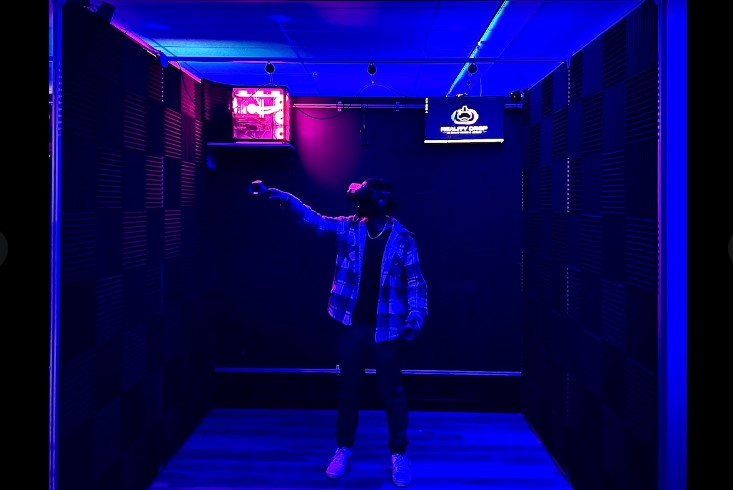
REALITY DROP Indoor Rooms is located in Winnipeg, MB
As the city’s pioneering Virtual Reality (VR) Escape Room, REALITY DROP takes immense pride in offering unparalleled adventures that seamlessly transport customers into enthralling virtual worlds.
Utilizing state-of-the-art technology and advanced game design, they create captivating realms filled with intricate puzzles, mysterious narratives, and adrenaline-pumping adventures. Each virtual environment is meticulously crafted to engage your senses and challenge your intellect, presenting you with scenarios that are as dynamic as they are immersive. At REALITY DROP, they believe in the power of collaboration and camaraderie. Their VR escape room serves as a unique platform for friends, families, and coworkers to come together.
Safety is at the forefront of their priorities. They boast top-tier equipment that not only enhances gameplay but also provides a secure environment for all participants. Their VR headsets, motion sensors, and controllers are sanitized frequently and meticulously, ensuring a hygienic experience. Additionally, their staff undergoes rigorous training to assist you should any technical issues arise, so you can focus solely on your virtual journey without any concerns.
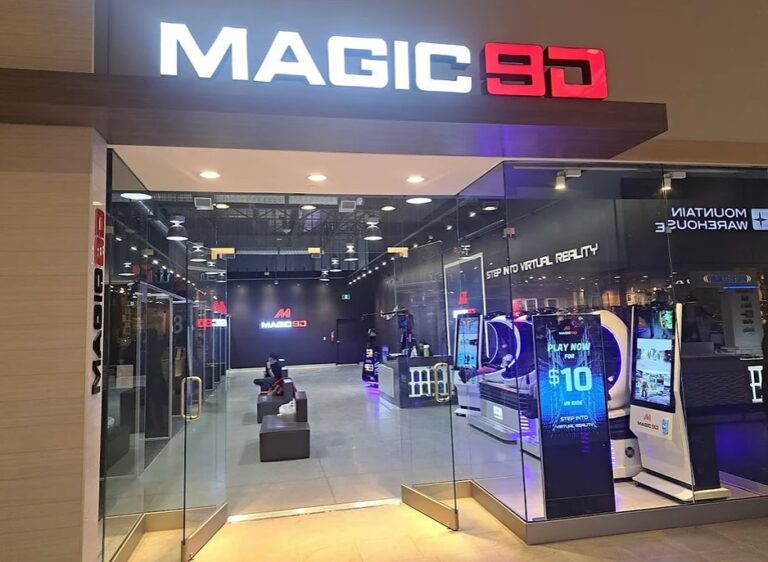
Magic 9D VR Outlet Indoor Center is located in Winnipeg, MB.
The Magic 9D VR Outlet, located in Winnipeg, Manitoba, offers an immersive virtual reality experience that allows visitors to explore and enjoy various interactive activities, games, and simulations. This entertainment destination provides a unique opportunity for people of all ages to step into a captivating, 9-dimensional world filled with excitement and fun.
The Rise of Free‑Roam VR Arenas: A New Playground for Everyone
Virtual reality has moved far beyond the headset‑‑only experience of a living‑room couch. Today, free‑roam VR arenas—large, sensor‑filled spaces where users can walk, run, and interact with digital worlds at full scale—are popping up in malls, entertainment districts, universities, and even corporate campuses. They combine the immersion of a VR headset with the freedom of a real‑world playground, turning an ordinary room into a limitless, interactive universe.
In this article we’ll explore what free‑roam VR arenas are, the wildly imaginative scenarios they enable, who’s stepping inside them, how they’re reshaping celebrations from birthdays to boardrooms, and what scientists and industry experts think about this rapidly evolving technology.
What Is a Free‑Roam VR Arena?
A free‑roam VR arena (sometimes called a “VR sandbox,” “VR lab,” or “location‑based VR (LBVR) center”) is a dedicated physical space equipped with a network of tracking sensors, safety barriers, and high‑performance computers that together create a seamless virtual environment.
Core Components
What It Does
Positional Tracking System (infrared cameras, lidar, or inside‑out sensors)
Continuously maps each user’s exact location, orientation, and hand gestures in 3‑D space with millimetre precision.
Provides tactile feedback that makes virtual objects feel “real.”
Content Management Platform
Allows operators to load, schedule, and customize experiences on demand.
Because the arena is a controlled environment, designers can push the envelope: the virtual world can be massive, the physics can be fantastical, and the user’s body can become a sword, a spaceship, or a paintbrush. The key difference from home‑based VR is physical freedom—no longer are you tethered to a 3‑meter play area; you can sprint across a 20‑meter room, jump over obstacles, or crouch under virtual arches, all while staying safely within the arena’s bounds.
Free‑Roam VR Scenarios: From Epic Quests to Everyday Fun
The versatility of free‑roam VR has inspired a booming catalogue of scenarios. Below are some of the most popular—and some that are just beginning to surface.
1. Immersive Story Adventures
Mythic Quest: Players become heroes in a living, breathing mythological world, battling dragons, solving ancient riddles, and forging alliances with AI‑driven companions.
Detective Noir: A crime‑scene investigation where clues are hidden in the virtual environment; players walk around a fog‑filled alley, examine evidence with a haptic magnifier, and interrogate holographic suspects.
2. Competitive Sports & E‑Sports
Laser‑Tag 2.0: Traditional laser tag upgraded with realistic projectile physics, score‑tracking HUDs, and dynamic arenas that morph mid‑match.
VR Dodgeball: A fast‑paced, physics‑based game where players throw virtual balls that ricochet off walls, with real‑time leaderboards for tournaments.
3. Creative Playgrounds
Virtual Graffiti Wall: Users wield a motion‑tracked spray can and can paint massive 3‑D murals that stay on the wall for later viewing.
Music Jam Sessions: A digital stage where each participant’s movements generate sound, letting a group create a live, synesthetic performance.
4. Educational Simulations
Historical Time‑Travel: Walk the streets of ancient Rome, interact with NPC citizens, and witness historical events from a first‑person perspective.
STEM Lab: Assemble a virtual rocket, experiment with chemical reactions, or explore microscopic cells without any risk.
5. Therapeutic & Wellness Experiences
Mindful Forests: Guided meditation in a procedurally generated forest, with gentle wind haptics and breathing‑synchronised visuals.
Physical Rehab: Gamified physiotherapy where patients perform prescribed movements while chasing virtual targets, encouraging compliance.
6. Corporate Simulations
Safety Training: Simulated hazardous environments (oil rigs, chemical plants) where workers practice emergency protocols in a zero‑risk setting.
Team‑Building Escape Rooms: Groups solve multi‑room puzzles that require real‑world coordination and communication, fostering collaboration.
The list is endless, and new concepts appear weekly as indie developers and large studios experiment with the medium.
Who Plays on Free‑Roam VR Arenas?
Free‑roam VR isn’t a niche hobby for ultra‑tech enthusiasts; it attracts a broad spectrum of users. Below we break down the main demographic groups and what draws them in.
Demographic
Typical Age Range
Primary Motivations
Kids (5–12)
Curious, energetic
Playful storytelling, safe physical activity, novelty of “becoming a superhero.”
Teens (13–19)
Social, competitive
Multiplayer battles, escape rooms, brag‑worthy content for TikTok/YouTube.
Controlled experimental setups, immersive curricula, data collection.
Seniors
60+
Low‑impact movement, cognitive stimulation, social outings.
VR for Kids: A Special Focus
Parents often ask whether free‑roam VR is safe for children. The answer is “yes, when the arena follows industry safety standards.”
Physical Safety: Soft padding, clear visual markers, and real‑time monitoring systems prevent collisions and falls.
Content Curation: Operators can select age‑appropriate experiences, filter out violence, and adjust difficulty levels.
Developmental Benefits: Studies show that immersive play can improve spatial reasoning, hand‑eye coordination, and collaborative problem‑solving.
Because kids can move naturally—jump, duck, and run—the experience feels more like real play than a seated video game, making it an attractive alternative to screen‑time‑only activities.
Free‑Roam VR for Special Events: Birthdays, Graduations, Corporate Parties
One of the fastest‑growing revenue streams for arena operators is event hosting. The immersive nature of free‑roam VR turns ordinary celebrations into unforgettable spectacles.
1. Birthday Parties: “Become the Hero of Your Own Story”
Custom Narrative Packages: Kids can choose a theme (pirates, space explorers, jungle adventurers) and the arena’s software generates a tailored storyline where the birthday child is the protagonist.
Photo‑Capture Zones: Integrated 360‑degree cameras capture the party’s highlights, delivering instant VR postcards to parents.
Safety‑First Design: Supervised play zones, staff‑guided equipment checks, and optional “soft‑mode” difficulty ensure a stress‑free environment for parents.
2. Graduation Celebrations: “A Leap Into the Future”
Future‑Vision Experiences: Graduates step into a virtual world that visualises their career aspirations—designing a skyscraper, performing on a world stage, or piloting a Mars rover.
Group Challenges: Teams of graduates compete in collaborative puzzles that celebrate the skills they’ve learned (e.g., coding challenges, engineering tasks).
Memorable Keepsakes: Graduates receive a personalized VR memory capsule—an interactive video that they can revisit on their own VR headsets later.
3. Corporate Parties & Team‑Building: “Work Hard, Play Harder”
Brand‑Integrated Simulations: Companies can showcase products in a virtual showroom where attendees can interact with prototypes that don’t yet exist in the physical world.
Competitive Tournaments: Ladder‑style laser‑tag or VR esports tournaments foster friendly rivalry and can be streamed live to the company’s intranet.
Data‑Driven Feedback: The arena’s analytics platform provides post‑event reports on participant engagement, movement patterns, and teamwork metrics—useful for HR assessments.
Because the arena can be re‑configured within minutes, the same space can host a children’s party one day and a high‑stakes corporate pitch the next, maximizing utilization and revenue.
Scientists and Industry Experts Weigh In on Free‑Roam VR
The rapid expansion of free‑roam VR has attracted attention from academia, research labs, and major tech firms. Below are some key perspectives.
1. Human‑Factors Researchers
Dr. Maya Patel, University of Washington – Cognitive Neuroscience
“Free‑roam VR uniquely combines embodied cognition with immersive visual feedback. When users physically move through a virtual environment, the brain integrates proprioceptive cues that enhance memory encoding. This makes it a powerful tool for education and rehabilitation.”
Prof. Erik Johansson, MIT Media Lab – Motion Sickness Mitigation
“Low‑latency tracking and high refresh rates are essential. In our labs we’ve measured that latency above 20 ms significantly increases simulator sickness, while 5 ms latency keeps discomfort virtually zero, even for high‑intensity games.”
2. Industry Leaders
Anita Gomez, VP of Product, LumiPlay Studios (a leading LBVR content creator)
“Our greatest breakthrough has been the procedural narrative engine that dynamically rewrites story arcs based on a player’s physical actions. Free‑roam VR is the only medium where the player’s body can be a plot device.”
John Liu, CEO, NexGen Sensors (tracking hardware provider)
“We’re moving toward sensor‑fusion: combining optical, inertial, and ultrasonic data to achieve sub‑millimeter accuracy with a 2‑ms update loop. This will unlock truly large‑scale arenas—think 100 m × 100 m warehouses—without the need for a massive camera array.”
3. Health & Safety Regulators
**Dr. Sandra O’Neil, Director, International VR Safety Council
“Standardized safety protocols are emerging: mandatory concussion‑risk assessments, clear signage of ‘safe zones,’ and real‑time monitoring of user vitals for high‑intensity experiences. Compliance will become a market differentiator.”
4. Future‑Foresight Think Tanks
The Future Lab at the World Economic Forum (2025 report) predicts:
By 2030, 30 % of large‑scale events (conferences, festivals) will incorporate a free‑roam VR segment.
Hybrid physical‑virtual venues will emerge, where a live audience watches participants in a shared virtual world via massive LED walls.
Collectively, these voices illustrate that free‑roam VR is no longer a novelty—it’s a multidisciplinary platform shaping entertainment, education, health, and business.
The Road Ahead: Challenges and Opportunities
While the excitement is palpable, several hurdles must be addressed for free‑roam VR to reach its full potential.
Technical Challenges
Scalability of Tracking: As arenas grow, maintaining line‑of‑sight for optical cameras becomes difficult. Emerging solutions include RF‑based tracking and AI‑enhanced occlusion handling.
Latency & Bandwidth: High‑fidelity graphics demand powerful GPUs and low‑latency networking; edge‑computing clusters are being deployed on‑site to keep data processing local.
Business & Operational Hurdles
Capital Intensity: Building an arena can cost $500 k–$2 M. Operators are turning to franchise models and shared‑space partnerships with malls or universities to spread risk.
Content Pipeline: Unlike traditional gaming, free‑roam experiences require bespoke level design. Industry collaborations with indie studios and open‑source toolkits (e.g., OpenVRX) are helping to expand the library quickly.
Social & Ethical Considerations
Accessibility: Designing for wheelchair users, visual impairments, and other accessibility needs is still in its infancy.
Data Privacy: Real‑time motion data is highly personal; operators must adopt transparent data‑handling policies and comply with GDPR, CCPA, and emerging VR‑specific regulations.
Opportunities
Cross‑Reality Integration: Combining free‑roam VR with augmented reality (AR) overlays can enable hybrid games where virtual objects interact with physical props in the arena.
Metaverse Bridges: As the broader metaverse concept matures, free‑roam arenas could become physical gateways to persistent virtual worlds, letting users carry their avatars and assets across spaces.
Education Partnerships: Universities are piloting free‑roam labs for engineering and medical training, offering students a hands‑on, risk‑free environment for complex procedures.
A Playground for Imagination, Learning, and Connection
Free‑roam VR arenas have transformed the way we think about immersive experiences. By marrying unrestricted movement with high‑definition virtual worlds, they give us the chance to become heroes, test limits, and collaborate in ways that were once confined to science‑fiction.
From kids splashing in a virtual water park to seasoned executives brainstorming in a holographic boardroom, the technology is already breaking down barriers between the physical and digital. As tracking systems become more precise, content pipelines more vibrant, and safety standards more robust, the arena will evolve from a spectacular novelty into an everyday venue—much like the bowling alley of the 20th century.
For anyone curious about the future of entertainment, education, or corporate innovation, stepping into a free‑roam VR arena is more than a pastime; it’s a first‑hand glimpse of a world where imagination is no longer limited by the size of a room, but only by the limits of our collective creativity.

 El Monte
 Log in

 Indoors


 UNIT E, 1600 Regent Ave W Winnipeg, MB R2C 3B5