El Monte
 Log in
Log in
Log in

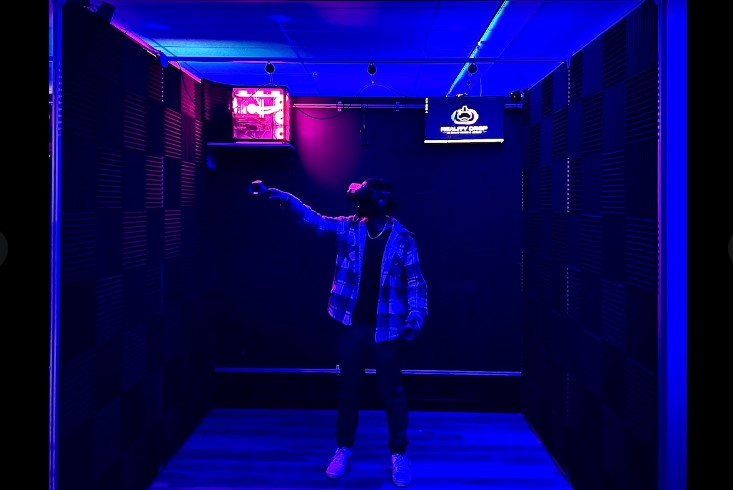
REALITY DROP Indoor Rooms is located in Winnipeg, MB
As the city’s pioneering Virtual Reality (VR) Escape Room, REALITY DROP takes immense pride in offering unparalleled adventures that seamlessly transport customers into enthralling virtual worlds.
Utilizing state-of-the-art technology and advanced game design, they create captivating realms filled with intricate puzzles, mysterious narratives, and adrenaline-pumping adventures. Each virtual environment is meticulously crafted to engage your senses and challenge your intellect, presenting you with scenarios that are as dynamic as they are immersive. At REALITY DROP, they believe in the power of collaboration and camaraderie. Their VR escape room serves as a unique platform for friends, families, and coworkers to come together.
Safety is at the forefront of their priorities. They boast top-tier equipment that not only enhances gameplay but also provides a secure environment for all participants. Their VR headsets, motion sensors, and controllers are sanitized frequently and meticulously, ensuring a hygienic experience. Additionally, their staff undergoes rigorous training to assist you should any technical issues arise, so you can focus solely on your virtual journey without any concerns.
 Indoors
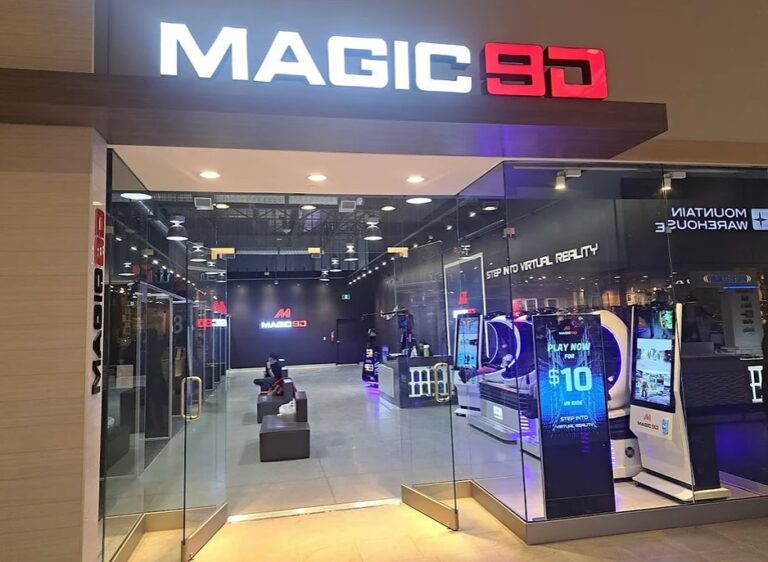
Magic 9D VR Outlet Indoor Center is located in Winnipeg, MB.
The Magic 9D VR Outlet, located in Winnipeg, Manitoba, offers an immersive virtual reality experience that allows visitors to explore and enjoy various interactive activities, games, and simulations. This entertainment destination provides a unique opportunity for people of all ages to step into a captivating, 9-dimensional world filled with excitement and fun.
IndoorsA free‑roam virtual‑reality arena is a purpose‑built physical space in which participants can move unhindered while wearing a head‑mounted display (HMD) and, often, wireless tracking equipment. Unlike seated or tabletop VR experiences that limit a user’s motion to a chair or a small play area, free‑roam arenas map an entire room—or even several rooms—into a digital environment. Infrared cameras, lidar sensors, or inside‑out tracking systems constantly locate each headset and its controllers, translating the wearer’s real‑world position into the virtual world with sub‑centimeter precision.
The result is a seamless blend of physical locomotion and digital immersion. Users can walk, duck, jump, or even climb, and the virtual scene updates in real time, preserving the sense of presence that makes VR compelling. The arenas are typically lined with safety padding, guardrails, and clear visual markers to prevent collisions, while the software enforces invisible boundaries that gently steer users away from hazards. Because the experience is untethered, participants can explore expansive, narrative‑driven worlds that would be impossible in a conventional living‑room setup.
Free‑roam VR has moved beyond experimental labs and theme‑park prototypes. Commercial operators now run dedicated venues in major cities, offering hour‑long adventure packages, multiplayer battlefields, and educational simulations. The technology’s rapid maturation—driven by lighter headsets, robust wireless streaming, and refined tracking—has lowered the barrier to entry and made the arena a viable entertainment and training medium.
The versatility of an untethered, spatially aware VR system enables a broad spectrum of scenarios, each designed to take advantage of the user’s ability to move freely.
Story‑driven experiences place participants at the heart of a plot. Players might become treasure hunters navigating an ancient pyramid, explorers trekking across an alien planet, or detectives solving a murder mystery inside a haunted manor. The physical space acts as a scaffolding for the virtual set, allowing designers to craft puzzles that require actual walking, climbing ladders, or reaching for objects.
Team‑based shooters, arena combat, and sports simulations thrive in free‑roam environments. Because the latency is low and tracking is precise, players can engage in fast‑paced duels that feel as real as a laser‑tag match. Games often incorporate “safe zones” where physical obstacles are mirrored in the virtual world, preventing accidental collisions while preserving strategic depth.
Free‑roam VR excels at experiential learning. Medical students can practice surgical procedures on virtual patients, engineering trainees can assemble complex machinery, and history buffs can walk through reconstructions of ancient cities. The kinesthetic element—physically reaching out, turning, and moving—helps cement knowledge and improves retention compared with passive media.
Sandbox platforms let users build, paint, or sculpt in three dimensions. By moving around a virtual canvas, creators can view their work from any angle without relying on a controller’s joystick. This tactile interaction is particularly appealing to artists and designers who seek a more intuitive interface than a traditional mouse or tablet.
Gamified workouts blend cardio, strength, and balance training with immersive scenery. A user might jog across a virtual forest, swing a virtual sword to fend off foes, or practice yoga in a serene digital studio. The free‑roam format ensures that the body is truly engaged, making exercise feel like play.
Each scenario leverages the arena’s capacity for full‑body interaction, translating real‑world movement into a compelling digital narrative or functional task.
Free‑roam VR attracts a diverse audience, but a notable segment is children and families. The technology’s ability to turn abstract concepts into tangible experiences resonates strongly with younger users.
Operators typically segment experiences by age group, offering simplified controls and shorter sessions for children under twelve. Games emphasize bright visuals, friendly characters, and non‑violent challenges, such as solving riddles in a whimsical garden or rescuing cute creatures from a mystical cavern. Safety protocols—such as lower headset straps, guardian monitoring, and limited movement speed—ensure that the environment remains secure for younger participants.
For children, free‑roam VR can stimulate spatial reasoning, hand‑eye coordination, and problem‑solving skills. Because the experience demands physical navigation, kids develop proprioception and gross‑motor abilities while their brains process visual‑cognitive information. Educational titles that align with school curricula—like virtual field trips to the International Space Station or interactive chemistry labs—provide an engaging supplement to classroom learning.
Family‑oriented sessions encourage cooperative play. Parents can accompany their children in the same arena, sharing a collaborative quest that fosters communication and teamwork. Multiplayer modes let siblings compete in friendly challenges, creating memories that are both entertaining and bonding.
Operators often provide adjustable headset lenses, wheelchair‑compatible pathways, and assisted controls for children with special needs. By offering inclusive design, free‑roam venues broaden their appeal and ensure that the immersive magic of VR is available to a wide spectrum of young users.
Overall, the kid‑friendly segment of free‑roam VR is a growing market, driven by parents seeking novel, safe, and educational entertainment options that go beyond passive screen time.
Beyond individual play, free‑roam VR has become a popular venue for celebrations and group events. Its capacity to host multiple participants simultaneously, combined with customizable content, makes it an attractive alternative to traditional party locations.
A birthday celebration in a free‑roam arena transforms the usual cake‑and‑candles routine into an adventure. Packages often include a themed narrative—such as a pirate treasure hunt or a superhero training camp—where the birthday child leads a team of friends through a series of challenges. Operators handle logistics: safety briefings, equipment sanitization, and optional photo packages that capture participants in their headsets. The immersive nature of the experience creates a memorable story that guests recount long after the candles are blown out.
For high‑school or university graduates, a free‑roam VR event can symbolize the transition from one reality to another. Organizers can design a customized journey that reflects the cohort’s experiences: wandering through virtual representations of campus landmarks, revisiting favorite lecture halls, or embarking on a simulated “future” career path. Group photo opportunities within the virtual environment—such as posing atop a digital mountain or inside a futuristic cityscape—add a unique visual element to the graduation album.
Businesses leverage free‑roam VR to celebrate milestones, launch products, or strengthen team dynamics. Multiplayer escape rooms, collaborative construction projects, or competitive e‑sports tournaments encourage communication, strategic planning, and trust. Because participants must physically coordinate their movements, the environment naturally surfaces leadership tendencies and problem‑solving styles. After the session, facilitators often debrief teams, drawing parallels between in‑game behavior and workplace performance.
A key advantage for event planners is the ability to brand the virtual space. Logos, color schemes, and company slogans can be embedded into the environment, turning the arena into a living advertisement. For birthday parties, favorite characters or mascots can be woven into the storyline, providing a personalized touch that standard party venues lack.
Event organizers appreciate the turnkey nature of VR arena rentals. The venue supplies all hardware, sanitization protocols, and staff to guide participants. Safety briefings are conducted at the start of each session, and staff monitor the play area to intervene if someone strays too close to a physical obstacle. This structured approach allows hosts to focus on the celebratory aspects rather than technical details.
By turning conventional gatherings into immersive adventures, free‑roam VR redefines the possibilities for celebrations, making them more interactive, memorable, and shareable.
Researchers and professionals across multiple fields have taken a keen interest in free‑roam VR, recognizing its potential to advance both scientific inquiry and commercial applications.
HCI scholars study how people perceive and interact with virtual environments when their bodies are fully engaged. Free‑roam setups provide a natural laboratory for examining spatial cognition, presence, and motion sickness mitigation. Early studies have shown that unrestricted movement dramatically reduces the discrepancy between visual cues and vestibular feedback, lowering the incidence of nausea compared with seated VR.
Neuroscientists explore how immersive, embodied experiences can stimulate neural plasticity. In rehabilitation contexts, free‑roam VR enables patients recovering from stroke or traumatic brain injury to practice functional movements within engaging scenarios, thereby enhancing motivation and adherence. Clinical trials have reported improvements in gait symmetry and balance when therapy incorporates full‑body VR tasks.
Industrial engineers use free‑roam VR to prototype physical layouts, test ergonomic designs, and simulate workflow processes. By walking through a virtual factory floor, designers can assess spatial constraints, identify bottlenecks, and iterate on equipment placement without constructing costly physical mock‑ups. The technology accelerates the design cycle and reduces reliance on costly CAD visualizations that lack embodied perspective.
EdTech experts advocate for free‑roam VR as a catalyst for experiential learning. The ability to “visit” historical sites, conduct virtual chemistry experiments, or manipulate 3D models in real space aligns with constructivist pedagogical principles. Studies suggest that learners retain information longer when lessons involve active movement and multisensory input, reinforcing the argument for integrating free‑roam experiences into curricula.
Industry analysts note that the free‑roam market is expanding at a compound annual growth rate of roughly 30 % and is projected to surpass $2 billion in global revenue within the next five years. Drivers include the decreasing cost of wireless headsets, the rise of location‑based entertainment, and corporate investment in immersive training solutions. Experts caution, however, that scalability remains a challenge; maintaining high‑precision tracking across larger spaces requires substantial infrastructure investment.
Some scholars raise concerns about data privacy and the psychological impact of highly immersive environments. Continuous tracking generates biometric data—such as heart rate and movement patterns—that could be sensitive if mishandled. Moreover, the intensity of presence may blur boundaries between virtual and real, potentially affecting users with pre‑existing mental health conditions. Recommendations from ethicists emphasize transparent data policies, opt‑in consent, and post‑experience debriefings.
Overall, the consensus among scientists and industry leaders is that free‑roam VR represents a pivotal step toward truly embodied digital interaction. While technical and ethical challenges persist, the convergence of research insights and commercial momentum suggests that the technology will increasingly permeate entertainment, education, healthcare, and enterprise domains.
Free‑roam VR arenas have evolved from niche research labs to bustling hubs of entertainment, education, and professional development. By marrying unrestricted physical movement with high‑fidelity digital worlds, they deliver a level of immersion that seated or tabletop VR cannot match. A wide array of scenarios—narrative adventures, competitive multiplayer, educational simulations, creative sandboxes, and fitness experiences—demonstrate the format’s adaptability.
Children and families find age‑appropriate, socially enriching experiences that nurture cognitive and motor skills, while celebrations such as birthdays, graduations, and corporate events gain a fresh, memorable dimension through customizable, branded adventures. Scientists and industry experts recognize the platform’s research value, therapeutic potential, and commercial viability, even as they call for careful handling of privacy and ethical issues.
As hardware becomes lighter, tracking more reliable, and content richer, free‑roam VR is poised to become a mainstay of the immersive ecosystem. Whether a teenager is hunting treasure in a digital temple, a surgeon hones delicate procedures, or a team of executives strategizes in a virtual boardroom, the arena offers a space where the boundary between the physical and the virtual is not merely crossed—it is seamlessly blended.


 UNIT E, 1600 Regent Ave W Winnipeg, MB R2C 3B5