Log in
Chase…Your Dreams VR sits in the heart of downtown Great Falls, Montana, on Central Avenue, a short walk from the city’s historic core and its popular restaurants.
The arcade runs four state-of-the-art VR booths with a library of well over 100 games, from co-op zombie shooters and military campaigns to escape rooms, mini golf, and Beat Saber. Guests pay per hour per bay and can switch games freely, with discounts for renting multiple booths. The whole venue can be rented for private parties at a flat rate, and a membership option covers 10 hours of VR over two years.
Beyond the headsets, a game room offers Xbox Ones, a pool table, cornhole, and a PS4 driving simulator, making it easy to mix virtual and classic play. The family-run business, started by a local teenager, is known for its friendly service and welcoming atmosphere, and it suits birthday parties, corporate events, date nights, and casual family outings alike.
IndoorsBig Sky Arcadia sits inside the Gallatin Valley Mall on West Main Street in Bozeman, Montana, the city’s only dedicated video arcade and family entertainment center.
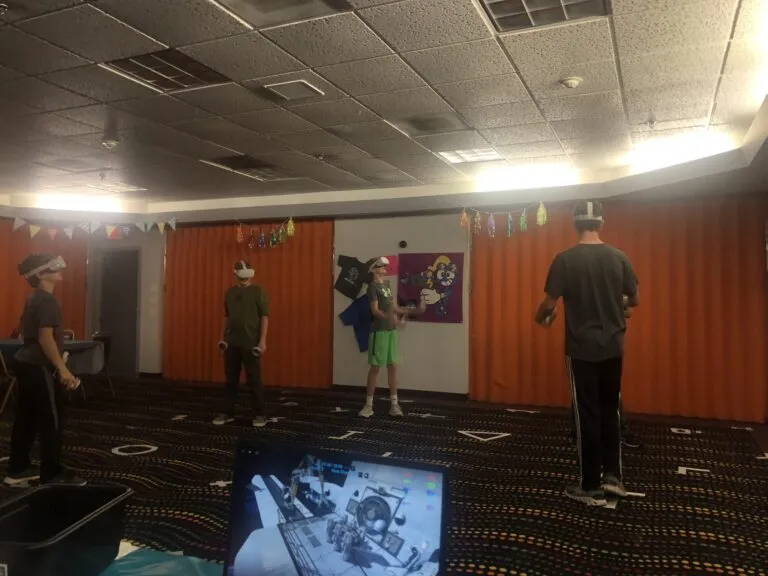
The arcade floor mixes classic and modern games with a reloadable play-card system and ticket redemption for prizes, while a free-roam VR arena lets up to six players enjoy laser tag, escape rooms, cooking competitions, and mini games. Birthday packages add bonus credits for groups of five or more, and a reservable party zone lets guests bring their own food, drinks, and decorations.
The venue also suits corporate events, team gatherings, and casual group outings, with a friendly staff that helps plan and organize celebrations. A comfortable party zone offers a place to relax and eat between rounds, making it a practical choice for birthdays, family outings, and company get-togethers.
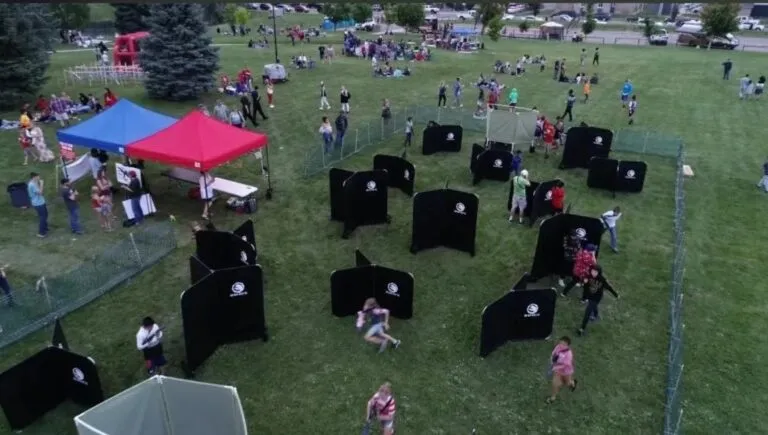
IndoorsWild Rose Paintball & Airsoft sits on the rims above Billings in Acton, Montana, roughly ten minutes west of Zimmerman Trail, with an indoor arena in Billings as its year-round companion. The outdoor site spans 91 acres with seven themed fields — including the Rosewood ghost town, tire, pallet, blow-up, and Alien fields — for .50 and .68 caliber paintball, airsoft, archery wars, gellyball, and laser tag. Rental gear and walk-in play are available, with safety orientations and chrono checks handled on site. The indoor Splat Attack Battle Arena adds VR games and escape rooms, sword battles, and active arcade-style games.
Beyond the fields, the Action Center offers axe throwing, a battle cage, mini golf, and a pro shop, plus party packages with attendants, food, and gifts for the VIP. Venue rental, mobile event services, and special weekday pricing for schools and daycares round out the offerings, making it a natural fit for birthdays, corporate team building, and large group outings.
OutdoorsV-Rex VR Escape Rooms and Games operates out of the Wild Rose Action Center’s indoor facility in Billings, Montana, alongside laser tag, gel battles, and paintball. It offers free-roam virtual reality where players physically walk through the space, with a rotating lineup of VR games and a broad selection of themed escape quests ranging from quick 30-minute challenges to full one-hour adventures. Commercially licensed games not available on home systems, and no minimum group size is required.
The venue is well suited to birthdays, corporate events, and team building, with structured party packages that bundle VR play with pizzas, drinks, and gifts for the guest of honor. Spectators are welcome, snacks and beverages are available for purchase, and the facility supports venue rental and mobile event services. Staff are consistently praised for being helpful and patient, making it a comfortable choice for families and first-time VR players alike.
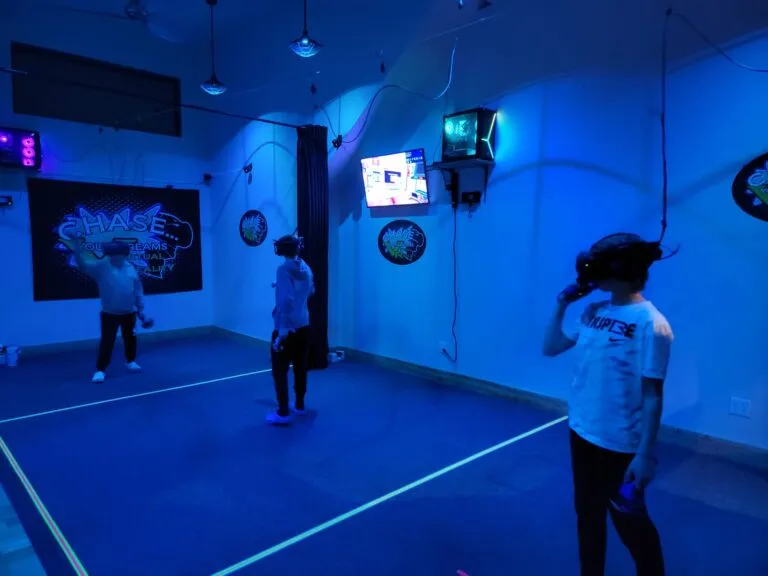
IndoorsBig Sky Arcadia sits inside the Southgate Mall in Missoula, Montana, on Brooks Street. It’s a bright, welcoming arcade where a reloadable play card unlocks a wall of classic and modern games — racing, pinball, claw machines, air hockey, and more — with tickets saved automatically and redeemed for prizes at the Prize Hub. The standout attraction is a free-roam virtual reality laser tag arena, where up to six players move freely through immersive worlds, plus escape rooms and mini-game competitions.
The venue also shines for celebrations, with à la carte birthday parties, a reservable party zone where you can bring your own food and decorations, and group packages for corporate events and team outings. A friendly, helpful staff keeps the atmosphere comfortable and safe, and a weekday happy hour makes games half-off. It’s a relaxed spot that works for a quick visit or a full afternoon of family fun.
IndoorsImagine a world where the boundaries of a video game dissolve not just visually, but physically. Where to dodge a dragon’s fire, you must actually sprint across a warehouse-sized space, your heart pounding as your friends shout real-time directions from across the room. This is not the solitary, stationary VR of living room headsets. This is the realm of the free-roam VR arena—a technological and social frontier transforming how we play, connect, and celebrate.
At its core, a free-roam VR arena is a dedicated, often large-scale physical space—typically ranging from 200 to over 1,000 square meters—equipped with hardware that allows users to move untethered and unimpeded by wires or fixed sensors. The magic lies in a combination of technologies: high-precision tracking systems (using lasers, cameras, or radio waves) map the player’s real-world movements with millimeter accuracy and translate them into the virtual environment. Rugged, backpack-mounted PCs or peripheral compute packs house the processing power, delivering high-fidelity graphics without a trailing cable. Sound is spatial, and haptic feedback vests may add physical sensations like a virtual impact or a gust of wind.
The fundamental principle is 1:1 movement. If you take a step in the real world, your avatar steps in the virtual one. You can crouch behind a virtual crate, lie prone to snipe, or sprint in a full-circle arc to flank an opponent. This removes the primary limitation of traditional VR—the “teleport or smooth-locomotion” debate—and replaces it with pure, intuitive physicality. The arenas themselves are often minimally furnished with soft, safe padding on walls and obstacles, serving as a blank canvas that the software can embellish with virtual walls, cover, and interactive elements that align perfectly with the physical architecture. It’s a sophisticated dance between the tangible and the digital, creating a profound sense of embodied presence—the feeling that your digital self is your physical self, occupying the same shared space as your friends.
The unbounded nature of these arenas gives rise to a stunning diversity of gameplay scenarios, far beyond what a standard room-scale setup could ever accommodate.
Cooperative Adventures and Puzzle Rooms are a mainstay. Teams of 2-6 players might be tasked with defusing a bomb scattered across a vast junkyard, requiring one player to find codes while another races to input them on a physical console mapped to a virtual terminal. Or they might work together to solve environmental puzzles in a mystical temple, with one player pulling a lever (a real object in the space) to open a passage for others.
Competitive PvP (Player vs. Player) scenarios leverage the full arena for heart-pounding action. Classic modes like “capture the flag” or “domination” become dynamic, physical chess matches. Players must physically reload by mimicking the action, take real cover, and coordinate flanking maneuvers that are impossible in a static arena. The physical exertion and tactical spatial awareness create a uniquely intense competitive experience.
Thematic Immersive Journeys are where storytelling shines. A horror scenario might have players slowly exploring a haunted mansion, with the software using the space’s layout to create non-linear scares—a ghost appearing in a corner you just physically walked past. A sci-fi escape room could simulate being trapped on a spaceship, with players needing to crawl through a virtual air duct (mapped to a low physical crawl space under a platform) to reach the engineering bay.
Hybrid Physical-Digital Games cleverly blend real and virtual props. One player might hold a physical “energy core” (a weighted object with lights) that others must protect by forming a physical perimeter around them, while virtual enemies swarm from all directions. These scenarios highlight the arena’s unique selling point: your body is the ultimate controller, and the room is your game board.
The misconception that VR is solely for tech enthusiasts or isolated gamers is shattered in the free-roam arena. The audience is remarkably diverse, driven by a universal craving for active, social entertainment.
Families and Kids: VR for kids is a particularly vibrant segment. Carefully curated experiences—non-violent, fantastical, and educational—allow children to embody explorers, wizards, or engineers. The physical activity is a major draw for parents seeking alternatives to passive screen time. The key here is content curation and often, slightly smaller arena sizes or modified experiences for younger players. The shared laughter of a family solving a puzzle together, or a child’s sheer delight at “flying” on a virtual dragon, creates powerful, positive associations with the technology. It’s not just a game; it’s a memorable activity that feels like stepping into a storybook.
Adult Friend Groups: For adults, it provides a potent antidote to the sedentary social life of bars and movie theaters. Groups of friends seeking a novel “night out” are flocking to these venues. The inherent teamwork and lighthearted competition (often seasoned with post-game drinks and replay-watching) foster camaraderie in a way that traditional online multiplayer cannot. It’s social chemistry accelerated by shared adrenaline and physical exertion.
Tourists and Experience-Seekers: In major cities, free-roam VR arenas have become modern tourist attractions, akin to an escape room or immersive theater, but with infinitely more replayability and scalable themes.
The scalability, customizability, and inherent “wow” factor make free-roam VR arenas a premier destination for life’s milestone celebrations.
For a Birthday Party: Imagine a child’s birthday where the guests are not passive observers but active heroes in a custom birthday adventure—perhaps a quest to deliver a magical cake to a castle. The arena can be themed, and the experience can be tailored to age and interest. For teens and adults, the themes shift to more complex cooperative missions or competitive tournaments. The shared narrative becomes the central story of the celebration, far more memorable than a standard party game. Venues often offer private bookings, decorations, and party rooms, creating a full event package.
For a Graduation: This is a perfect send-off for a class or friend group. A “graduation mission” where the team succeeds or fails together becomes a metaphor for their journey. It’s a dynamic, unifying experience that breaks the mold of a typical dinner or banquet. It celebrates transition not with a formal toast, but with a shared virtual triumph.
For a Corporate Party or Team Building: Here, the applications are profound. Unlike forced, awkward icebreakers, free-roam VR naturally demands communication, strategy, and role delegation under mild pressure. A sales team might need to outmaneuver a virtual rival in a treasure hunt, requiring clear communication and quick adaptation. A development team might solve a complex multi-stage puzzle that mirrors a project workflow. The “arena” is a neutral, engaging space that flattens hierarchies—the intern might have the keenest situational awareness, the CEO might be the best strategist. It fosters authentic collaboration and creates a strong, memorable in-group narrative that can positively impact office dynamics long after the headsets come off.
Free-roam VR arenas represent more than just a new gaming platform; they signify a shift toward experiential social infrastructure. As the technology matures, we can expect even more seamless integration of physical props, larger and more intricate virtual worlds, and potentially more accessible pricing. The core appeal remains timeless: the human desire for playful, physical, shared adventure.
From a child’s first steps into a fantastical world to a corporate team discovering new synergies, the free-roam VR arena provides a rare space where our physical instincts and digital imagination align perfectly. It is a testament to technology’s power not to isolate, but to gather us—to make us move, strategize, laugh, and achieve together in spaces that exist only in code, but feel infinitely real in memory. In an increasingly digital age, it offers the thrilling paradox of a deeply human experience, built on the simple, powerful act of moving through the world, together.