El Monte
 Log in
Log in
Log in

Digital Worlds VR sits in the Cool Springs district of Franklin, Tennessee, a short drive from Nashville, tucked into a modern retail and office corridor off Mallory Lane.
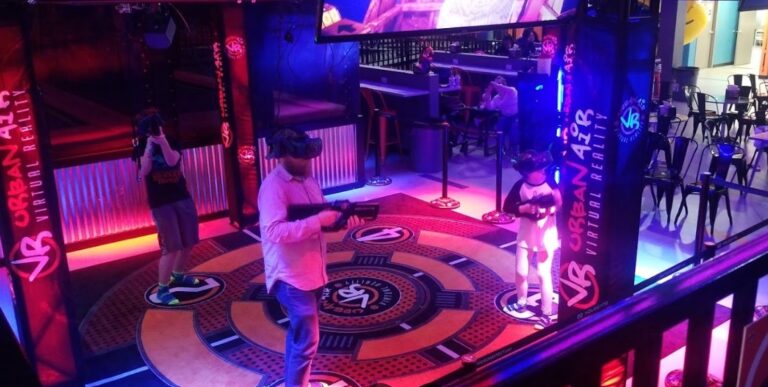
The arcade curates more than 80 virtual reality titles across seven spacious stations, each with a 55-inch TV so spectators can watch live gameplay. Guests can free-climb rock faces, duel in Blaston, tackle co-op zombie shooters, solve 28 quick escape rooms, or fly over the Earth in Google Earth VR. Party mini-games and action-packed shooters round out a menu that suits everyone from first-timers to hardcore VR fans.
The whole location can be booked for private birthdays, bachelor parties, corporate events, and team-building days, with tables, seating, decoration help, and cleanup handled by the crew. Adult parties and corporate events may bring their own beverages, and a nearby Pizza Twist offers a discount on party pizzas. The UNLOCKED membership adds free monthly VR hours, happy-hour pricing, referral credits, and early access to new gear, while owner Craig’s high-score challenges reward skilled players with prizes.
 Indoors
Urban Air Trampoline and Adventure Park sits in the Old Hickory neighborhood of northeast Nashville, Tennessee, serving the Brentwood, Hendersonville, Mount Juliet, and greater Nashville areas as a year-round indoor destination.
The park is a full indoor adventure center with a Sky Rider zipline, Warrior and Ropes courses, Leap of Faith, Battle Beam, Slam Dunk Zone, tumble track, Pro Zone trampolines, dodgeball, and a Tubes playground for younger kids. An All Day Play Promise means one ticket covers every attraction without time limits, and monthly memberships offer unlimited visits with extra perks. Birthday parties come with reserved table space, a shared host, supplies, and a t-shirt and pass for the birthday child, while a Small Squad Party bundles play for groups of five.
Beyond play, the Urban Cafe serves pizza, Dippin’ Dots, ICEEs, and drinks for refueling between sessions. The park welcomes children 40 inches and under through its Shorty tier, offers parent tickets, and hosts a monthly Sensory Jump for a calmer experience. It suits family outings, birthdays, school groups, and corporate team-building events, all sheltered from the weather under one roof.
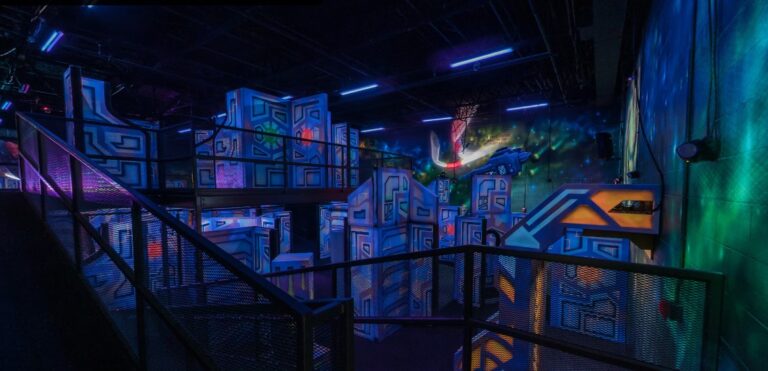
IndoorsMain Event Murfreesboro sits in the Gresham Park area of Murfreesboro, Tennessee, a roughly 50,000-square-foot entertainment center that opened in early 2024. The venue centers on a multi-story laser tag arena with taggers, hit-detectors, and coaching, alongside a state-of-the-art bowling alley with kid-friendly dragon ramps, an arcade gallery of more than a hundred games, a gravity ropes course, and billiards. All-access passes bundle the main activities into one price, and laser tag missions run about fifteen minutes each.
The full-service restaurant and bar give groups a place to refuel between activities, while birthday packages include reserved party space, a dedicated party host, food, and activity credits. The same setup works well for corporate events and team-building days, with event coordinators available to tailor larger group bookings. Between the high-energy attractions and the comfortable dining area, the venue suits birthday parties, school and sports groups, corporate outings, and casual family weekends alike.
IndoorsHendersonville Strike & Spare Family Fun Center sits in Hendersonville, Tennessee, a suburb just north of Nashville, along Volunteer Drive. It’s a long-running family entertainment destination built around dozens of bowling lanes, Cosmic Bowling, leagues, and a pro shop, plus the attached Circus World area where a single wristband unlocks unlimited laser tag, bumper cars, roller skating, a bungee trampoline, a VR roller coaster, Time Freak, and Lazer Frenzy. The sci-fi themed laser tag arena offers fast ten-minute games for kids five and up, and individual attraction pricing is available for those who prefer to pay per game.
Beyond the games, Conway’s Grill provides a seated restaurant and lounge, while an arcade and ticket redemption center keeps the fun going. Five birthday party packages cover everything from unlimited wristband play to mini-bowling and a private soft play gym, each with pizza, drinks, a party room, and a hostess. The center also hosts school outings, teen parties, company events, and fundraisers, making it a versatile spot for family nights and group celebrations alike.
IndoorsUrban Air Trampoline and Adventure Indoor Park is located in Franklin, Tennessee.
The Urban Air Trampoline and Adventure Park in Franklin, Tennessee offers an array of activities for all ages. The park features trampoline areas, virtual reality experiences, and more. The park provides a safe and clean environment and requires all participants to wear special jump socks. The park also offers birthday party packages and corporate event opportunities. Visitors can purchase day passes or take advantage of affordable membership options. Overall, the Urban Air Trampoline and Adventure Park is a fun-filled destination for families and adventurers alike.
IndoorsStars and Strikes Family Entertainment Center sits on North Lowry Street in Smyrna, Tennessee, in Rutherford County just southeast of Nashville, spanning more than 54,000 square feet.
The venue centers on a two-story laser tag arena with immersive lighting and sound, plus 24 bowling lanes (8 VIP lanes with SPARK augmented reality bowling), a 7,000-square-foot arcade and prize store, bumper cars, Escapology escape rooms, virtual reality, and Lumberjack Alley axe throwing.
Beyond the games, guests enjoy a full-service restaurant and bar with chef-inspired dishes and big-screen sports viewing, private party rooms and banquet space, and party packages that include activities, food and drinks, and a dedicated party host. It is a popular spot for birthdays, corporate events, and team building.
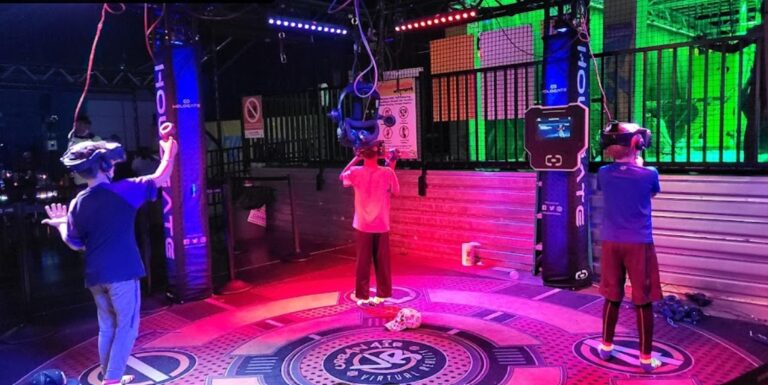
IndoorsVirtual reality has traveled a long road from the tethered, stationary headsets of the early 2010s. For years, the limiting factor of VR was the physical space of the user’s living room. Attempting to walk through a digital world while dodging coffee tables and ceiling fans was a recipe for disaster. However, a new paradigm has emerged that removes these boundaries: the free-roam VR arena. By turning physical warehouses and specialized centers into expansive digital playgrounds, free-roam VR has transformed from a niche tech experiment into a premier form of social entertainment.
At its core, a free-roam VR arena—often called “Location-Based VR” or “Full-Body VR”—is a dedicated, open physical space equipped with advanced tracking technology that allows multiple players to walk, run, and interact naturally within a virtual environment. Unlike home VR, where cables often tether the player to a high-powered PC, free-roam arenas utilize sophisticated wireless battery-powered headsets and often incorporate haptic backpacks that provide processing power and sensory feedback.
The “magic” of a free-roam arena lies in its spatial mapping. Using arrays of optical sensors or sophisticated inside-out tracking systems, the arena tracks the precise coordinates of every player in real-time. This means that if a digital bridge appears in the game, the player can physically walk across a real floor, feeling the same spatial constraints as their avatar. By creating a one-to-one synchronization between physical movement and virtual action, these arenas effectively trick the human brain into suspending disbelief, allowing for a level of immersion that home systems simply cannot replicate.
The versatility of free-roam VR is perhaps its greatest asset. Developers are no longer restricted to stationary experiences; they can now design scenarios that leverage the human instinct for movement.
The most common scenario remains the cooperative combat experience, where teams must navigate labyrinthine corridors, defend high-tech bunkers, or hold back waves of relentless adversaries. These games often utilize environmental haptics—vibrating floors or fans that simulate wind—to heighten the tension.
Beyond combat, there is a growing trend toward “VR escape rooms” and high-concept exploration. These scenarios place players in fantastical settings, such as an abandoned space station, a sunken underwater base, or even, through the use of photogrammetry, a hyper-realistic historical recreation of ancient cities. In these settings, the emphasis shifts from adrenaline to puzzle-solving and collaboration. Players must physically hand items to one another, pull levers in unison, or crouch behind digital cover to bypass automated security systems. The physical requirement makes these tasks feel earned rather than merely clicked through with a controller.
While early VR was often marketed toward the hardcore gaming demographic, free-roam arenas have successfully democratized the technology, attracting a surprisingly diverse range of players. Families, in particular, have become a pillar of this industry.
For children, the attraction of free-roam VR is visceral. Unlike sedentary video games, which can lead to “screen fatigue,” free-roam VR functions as a form of active, gamified exercise. Parents often view these centers as a superior alternative to traditional arcades because they require real-world coordination, spatial awareness, and active communication. Modern venues have tailored their content libraries to ensure that younger audiences have access to age-appropriate adventures—ranging from lighthearted “toy store” escapades to educational missions that involve exploring the human body or deep-sea ecosystems. The ability to play alongside their parents in a safe, monitored, and physically contained environment makes it a high-value experience for families looking to engage in shared, screen-adjacent recreational activity.
The logistical nature of a free-roam arena makes it a natural destination for event hosting. As society shifts toward valuing “experience-based” gifts, these arenas have become a top-tier choice for milestones.
For a birthday party, the arena offers an exclusive, high-tech spectacle that replaces the standard “pizza-and-arcade” routine with a shared, heroic narrative. For graduation parties, it provides an opportunity for groups of friends to engage in one final, high-octane bonding experience before heading off in different directions.
However, perhaps the most interesting shift has been the adoption of free-roam VR by the corporate world. Companies are increasingly booking these facilities for team-building exercises. In a traditional office setting, hierarchy often dictates communication styles. In a free-roam VR arena, those barriers melt away. When a CEO and an intern are forced to work together to navigate a virtual cliffside or defuse a digital bomb, the resulting reliance on clear communication, role delegation, and rapid problem-solving offers a genuine assessment of team dynamics. It is a unique way to foster camaraderie that feels authentic rather than forced.
From the perspective of researchers and industry experts, free-roam VR represents the “holy grail” of spatial computing. Scientists studying human-computer interaction (HCI) are particularly interested in how these environments impact “presence”—the psychological feeling of actually being in a virtual space. Studies have shown that when humans are allowed to walk naturally rather than using a joystick, their spatial memory of the digital world improves dramatically, and the neurological response to virtual threats or rewards becomes indistinguishable from real-world stimuli.
Industry analysts suggest that the success of free-roam VR will serve as the blueprint for the wider “Metaverse.” By training the public to interact with digital interfaces using their bodies, rather than just their thumbs, these arenas are essentially acting as training grounds for the future of digital interaction. Experts believe the next evolution will be “mixed reality” arenas, where physical props—like actual desks and doorways—are mapped into the VR software, allowing players to feel the tactile texture of a wall or the weight of a virtual prop in their hands.
As hardware costs continue to decrease and the resolution of displays improves, the barrier to entry will continue to drop. Industry leaders envision a future where these arenas become as common as movie theaters or bowling alleys. Free-roam VR has moved past the phase of being a mere gimmick; it is now a recognized pillar of modern entertainment, bridging the gap between our physical reality and the boundless potential of the digital frontier.


 1945 Mallory Ln #170, Franklin, TN 37067, United States