
 El Monte
 Log in
Log in
Log in

Sandbox VR Pittsburgh sits inside the historic Strip District Terminal at 1681 Smallman St in the lively Strip District neighborhood, just two minutes from the Heinz History Center and near Puttshack Golf.
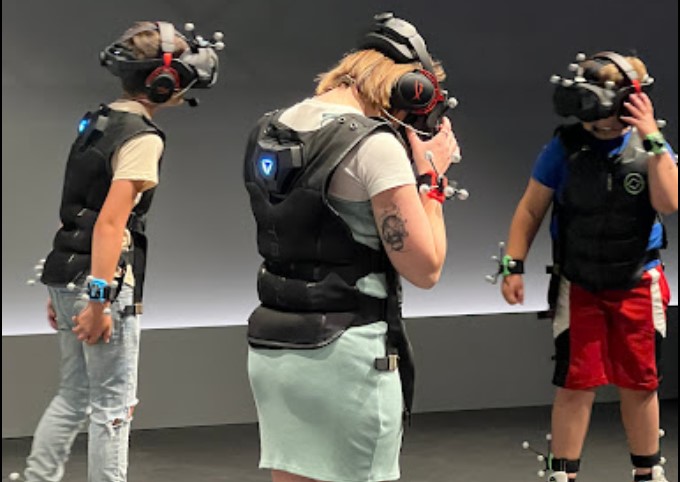
The 5,500-square-foot venue offers full-body, free-roam virtual reality adventures for groups of up to six players per room, with a rotating lineup that includes Age of Dinosaurs, Stranger Things: Catalyst, Squid Game Virtuals, the zombie-filled Deadwood series, and more. Motion-capture trackers, haptic vests, and recoil-reactive props make every session feel remarkably real, with no gaming experience required and no motion sickness.
Beyond the games, the venue features a dedicated party room, on-site parking, and personalized cinematic highlight reels of each session. It’s well suited for birthday parties, corporate team building, date nights, and group outings, with themed social events and tailored party packages throughout the year. The welcoming staff guides newcomers through the gear, making it an accessible and memorable destination for visitors of all ages.
 Indoors
Urban Air Trampoline and Adventure Park sits in North Fayette, Pennsylvania, just west of Pittsburgh near the Robinson area, at 800 Chauvet Drive.
This is a full indoor adventure park rather than a simple trampoline venue. Guests can bounce on wall-to-wall APEX trampolines, race through the Warrior Course, glide on the Sky Rider indoor zipline, climb walls, and test their balance on the Battle Beam. Dodgeball courts sit on trampolines for extra-bouncy competition, while the Tubes Playground and a dedicated Kid’s Area keep younger visitors entertained. The All Day Play promise means one ticket covers the whole day with no time limits.
The park is a popular spot for kids’ birthday parties, with reserved tables or private rooms, a dedicated party host, decorations, and food handled by staff. An on-site café serves pizza and snacks, arcade games add extra fun, and memberships offer unlimited monthly visits. Special programs include Jumperoo for kids five and under and the Camp Urbie summer day camp, making it a year-round destination for families and groups.
IndoorsUrban Air Adventure & Trampoline Park is located in Munhall, Pennsylvania, in the eastern suburbs of Pittsburgh, within The Waterfront district along the Monongahela River.
The park is a year-round indoor adventure center with trampoline zones, dodgeball, a Slam Dunk Zone, a Runway, and a Warrior Course, plus a Sky Rider indoor zipline, ropes course, climbing walls, Leap of Faith, bumper cars in Spin and Flip zones, unlimited virtual reality, a Tubes playground, and a dedicated area for kids seven and under. It offers all-day play passes, monthly memberships, and special nights including sensory-friendly Mondays, Family Night on Thursdays, and Glow Night on Fridays.
Beyond open play, the venue hosts kids’ birthday parties with reserved space and a party host, school field trips, youth sports parties, non-profit fundraisers, corporate team-building events, and private park rentals. An on-site café serves pizza and drinks, the KidHub app provides Fast Lane entry, and the All Day Play Promise means one ticket covers unlimited play with no time limits.
IndoorsIn the rapidly evolving landscape of digital entertainment, few innovations have captured the public imagination quite like the free-roam virtual reality (VR) arena. Unlike the traditional home VR setup, which often leaves the user tethered to a console or confined to the safety of a small rug in a living room, free-roam VR removes the physical boundaries. It transforms empty, warehouse-style spaces into infinite digital worlds where the only limit is the imagination of the software developers. As technology matures, these arenas are shifting from niche gaming experiments to mainstream social hubs.
At its core, a free-roam VR arena is a large, open-plan physical space equipped with advanced motion-tracking technology. Players don lightweight, wireless headsets—often accompanied by haptic vests and motion-tracked physical props—to enter a synchronized digital simulation.
What distinguishes this from standard VR is the concept of “untethered movement.” In an arena, the physical room is mapped precisely to the virtual environment. If a player walks ten feet forward in the real world, they move ten feet forward in the game. This 1:1 mapping eliminates the motion sickness often associated with artificial locomotion, such as using a joystick to walk while the body stands still. By utilizing high-fidelity ceiling-mounted sensors or specialized computer vision cameras, the system tracks the precise coordinates of every player in real-time, allowing for a seamless blend of physical exercise and hyper-realistic digital exploration.
The versatility of the arena format allows for an almost limitless variety of scenarios. Because the scenery is rendered digitally, a single physical room can transform from the claustrophobic corridors of a haunted space station to the lush, sprawling landscapes of an alien planet within seconds.
Common scenarios range from high-adrenaline competitive shooters, where groups of friends work together to hold off waves of zombies or mechanical drones, to collaborative puzzle-solving experiences. In these “escape room” style scenarios, players must physically pick up virtual levers, press buttons, and move heavy objects to solve environmental riddles. More recently, developers have introduced educational and narrative-driven scenarios. Some simulations allow participants to explore historical landmarks, walk through the anatomy of a human heart, or participate in interactive theater where the player acts as the protagonist in a branching story. The ability to physically crouch behind a virtual barricade or poke one’s head around a digital corner provides a sense of presence that traditional flat-screen gaming can never replicate.
The demographic for free-roam VR is expanding far beyond the stereotypical “hardcore gamer.” Because the technology is intuitive—relying on natural human movement rather than complex button combinations—it is remarkably accessible.
For children, free-roam VR represents a radical departure from sedentary screen time. It encourages physical activity, coordination, and teamwork. Parents are increasingly looking toward VR arcades as a way to engage children in an environment that is both mentally stimulating and physically active. Most modern arenas are designed with safety in mind; the software prevents collisions by projecting “virtual walls” or boundaries when a player gets too close to their peers or a physical wall. However, experts generally recommend these experiences for children over the age of eight to ensure the headset fits correctly and the child is cognitively ready to bridge the gap between their physical body and their virtual avatar.
The social nature of free-roam VR makes it a premier venue for milestone events. Traditional parties often struggle to find activities that keep groups engaged together; in a VR arena, the shared struggle or shared victory creates a powerful sense of camaraderie.
For birthday parties, it provides an immersive centerpiece that takes the pressure off the host. Kids and adults alike are completely absorbed by the experience, turning a standard social gathering into a memorable adventure. For graduation parties, it offers a sophisticated alternative to the traditional sit-down venue, giving young adults a space to bond over cutting-edge technology.
Perhaps the most significant growth sector is the corporate world. Companies are increasingly booking arena sessions for team-building exercises. Unlike a trust fall or a standard meeting, VR requires genuine communication and strategic coordination. When a team realizes they must physically talk to one another and “act” as a unit to survive a virtual challenge, the barriers of office hierarchy often dissolve. It is a high-stakes, low-consequence environment where leadership and collaboration are tested in real-time, making it an ideal tool for modern workforce development.
The consensus among scientists and industry experts is that free-roam VR is merely in its infancy. Technology researchers are particularly interested in the “proprioception”—the sense of self-movement and body position—that these arenas trigger. Studies suggest that when the brain receives consistent feedback between visual stimuli and physical movement, the immersion reaches a point where the brain accepts the virtual world as “real.” This psychological state, known as “presence,” is the holy grail of VR development.
From an industry perspective, the focus is currently shifting toward “haptic integration.” Experts are working on suits that provide sophisticated feedback, such as the sensation of wind, heat, or the recoil of a firearm. As these peripherals become lighter and more affordable, the barrier between the physical and virtual will continue to thin.
Furthermore, urban planners and architects have begun to view VR arenas as a permanent fixture of entertainment districts, similar to movie theaters or bowling alleys. There is a growing belief that as remote work and digital isolation increase, the physical, “pro-social” nature of VR arenas will become increasingly vital. By forcing people out of their homes and into a shared physical space to interact with digital assets, these arenas are effectively bridging the gap between the digital future and the human need for community.
While the technology is currently focused on leisure, experts foresee a future where these arenas are used for professional training in high-risk industries, such as firefighting, tactical police response, and emergency medicine. When a trainee can practice life-saving maneuvers in a free-roam environment that mimics the physical stress of a real-world disaster, the educational outcomes are significantly higher than traditional classroom methods.
In conclusion, the free-roam VR arena is more than just a playground; it is a sophisticated intersection of human physiology, social dynamics, and cutting-edge engineering. Whether for a child’s birthday or a corporate retreat, it offers a unique, visceral experience that defines the current state of interactive entertainment and points toward a future where our digital lives are no longer confined to the glowing rectangle of a desk monitor.


 1681 Smallman St, Pittsburgh, PA 15222, United States

