El Monte
 Log in
Log in
Log in

Zone 28 sits in the Harmarville section of Pittsburgh, Pennsylvania, roughly fifteen minutes from downtown along Route 28 and just a couple of minutes from the PA Turnpike.
The complex spans 50,000 square feet and brings together 33 bowling lanes, a 3,000-square-foot laser tag arena called Area 28, two escape rooms, an arcade with more than 85 games, and pool tables. Laser tag runs on a first-come basis with team and free-for-all modes, while the Escape Zone offers Room 113 and Hidden Below, each with an hour-long storyline for up to ten players. Group packages cover bowling, laser tag, and arcade time for parties of 15 or more.
Beyond the games, guests find the Rail House Restaurant, the End Zone Sports Bar, and an outdoor Beer Park with cornhole, bocce, and a 15-foot television. Suite 28 provides a private venue with eight lanes, a banquet room, and a private bar for up to 200 guests. The facility hosts birthdays, corporate team building, field trips, and family reunions, with an in-house kitchen, event coordinators, and wheelchair-accessible spaces throughout.
 Indoors
Urban Assault Paintball sits in McDonald, Pennsylvania, roughly fifteen minutes from downtown Pittsburgh. It’s a family-owned park with more than thirty years of history and six fields spread across thirty acres, offering traditional paintball, low-impact paintball, night games on a lit turf field, airsoft, and GellyBall for younger players. Private groups get dedicated referees, and the park is home to the Iron City Classic, billed as the largest mechanical paintball event in the world.
Beyond the games, the park features a full pro shop, custom event shirts, gift cards, and overnight camping packages with bonfires and s’mores. It hosts thousands of birthday parties, bachelor parties, and corporate team-building events, with covered pavilions, fire pits, and food options on site. Certified referees and techs keep everything safe and running smoothly, making it a great fit for families, beginners, and experienced players alike.
 Outdoors
Zombieburgh Lazer Tag is tucked into the lower level of the Monroeville Mall in Monroeville, Pennsylvania, near Macy’s department store at Ace’s Breakaway and Play Arcade.
The venue centers on high-tech Lazer Runner laser tag played in a 3,000-square-foot, custom-painted post-apocalyptic arena with specialty lighting, pulsating music, and a challenging maze full of obstacles and hiding spots. Players suit up in battle vests with laser guns, score points in real time, and review their stats on screen after each round. Daily specials, a yearly membership program, and group outing and team-building packages with exclusive arena use round out the core offering.
Beyond the arena, guests can enjoy a collection of modern and classic arcade games that pay out redemption tickets for prizes. The club specializes in birthday parties with private rooms, a dedicated party host, pizza, and free tickets, and it also accommodates corporate team-building, school outings, and exclusive by-the-hour arena rentals. Friendly staff and a locally-owned, community-minded atmosphere make it a welcoming spot for families, kids, and groups of all sizes.
IndoorsLaser Storm Pittsburgh sits in the North Hills of Pittsburgh, in the Ross Township neighborhood along McKnight Road, a busy commercial corridor that’s easy to reach from across the city. It’s a family entertainment center that has been part of the local scene since 1996, built around a large, fog-filled laser tag arena that’s reconfigured at least three times a year. Players suit up in lightweight vests and headsets, move through a futuristic space full of barriers, energizers, sentries, and base stations, and get personalized scorecards tracking shots fired and accuracy. Beyond casual play, the club runs draft leagues, specialty tournaments from 1v1 to 6v6, and monthly regional competitions that feed into national championships.
The front of the house holds an arcade with classic and modern games, skee ball, air hockey, and a rock climbing simulator, plus three private party rooms. Birthday packages include exclusive arena use, a private party server, a game controller, MVP awards, and a personalized room sign, while group events range from two- or three-game outings to after-hours exclusive lock-ins. The staff handles the details so hosts can relax, and the venue suits kids’ birthdays, corporate team building, school groups, and family reunions alike.
IndoorsLaser tag has transformed from a niche science-fiction-inspired hobby into a global phenomenon. It is a high-tech recreational activity that blends physical exercise, tactical strategy, and immersive storytelling. As technology continues to bridge the gap between virtual realities and physical spaces, laser tag remains one of the most accessible ways for people of all ages to step out of their comfort zones and into the shoes of a hero.
At its core, laser tag is a recreational shooting game where players use infrared-emitting light guns to tag designated targets, usually worn on the chests of opposing players. Unlike traditional combat games that use physical projectiles, laser tag utilizes infrared beams, making it a safe, non-contact, and pain-free experience.
The game is governed by computerized systems that track hits, misses, and overall performance. When a player’s sensors are triggered by an infrared beam, the system registers a “tag,” often providing instant auditory or visual feedback, such as a localized vibration or a color change in the vest. This digital integration allows for precise scoring, diverse game modes, and real-time statistics that make every match feel like a high-stakes mission.
The true brilliance of laser tag lies in its versatility. Modern arenas are rarely just empty rooms; they are designed to facilitate specific narratives that dictate how players move and interact.
These scenarios turn a simple game of tag into a complex tactical exercise, requiring communication, spatial awareness, and leadership.
Beyond the thrill of the hunt, laser tag offers substantial physical and cognitive benefits. It is an excellent form of cardiovascular exercise that disguises physical exertion as entertainment. Players often spend an hour or more navigating obstacles, sprinting, and ducking, which improves stamina, agility, and hand-eye coordination.
Cognitively, laser tag encourages critical thinking and split-second decision-making. Players must read the environment, monitor their ammunition, and coordinate with teammates in a fluid, high-pressure setting. Furthermore, it serves as a powerful social tool, fostering camaraderie and communication skills. It forces participants to work toward a common goal, breaking down social barriers and building trust through shared experience.
Research into human behavior and play psychology suggests that laser tag serves as an important outlet for cognitive development and stress relief. Industry experts in the leisure and entertainment sector emphasize that the “gamification” of physical movement is the future of fitness. By creating an environment where the brain is fully occupied by strategy and excitement, players naturally push their physical limits further than they would during traditional workouts.
Experts also note that the technology behind laser tag—using light as a medium—is increasingly sophisticated. Modern infrared systems are highly accurate and allow for complex “tagging” mechanics that reduce frustration, ensuring that the game feels fair and responsive. As technology advances, these experts predict that laser tag will integrate more augmented reality (AR) elements, further blurring the line between the physical arena and the digital game world.
While often associated with childhood, laser tag has a demographic that spans generations. For kids, it is a gateway to active play. It allows children to engage in structured, rule-based activity that channels their energy into cooperative success. Pediatric experts often praise laser tag for its ability to encourage physical health and social integration among children who might otherwise prefer screen-based gaming.
The safety of the sport—the absence of projectiles and the light-weight equipment—makes it one of the most inclusive activities for younger participants. It provides an environment where they can build confidence, learn the value of teamwork, and experience the thrill of accomplishment in a controlled, supervised setting.
The adaptability of laser tag makes it a premier choice for milestone events. For birthday parties, it provides an adrenaline-fueled centerpiece that keeps a group engaged for hours, often including private briefing rooms and party areas for post-game refreshments.
For graduation parties, it offers a sophisticated but fun way to blow off steam after the stress of academic exams. However, the most significant shift in recent years has been the rise of corporate laser tag events. Companies increasingly use laser tag for team-building retreats. Stripping away titles and hierarchies in the office to place employees on an equal footing—armed only with a laser phaser and a strategy—reveals natural leaders and fosters communication in ways that traditional seminars cannot. In these environments, laser tag becomes a tool for professional development, teaching teams how to manage pressure, rely on one another, and execute strategies under duress.
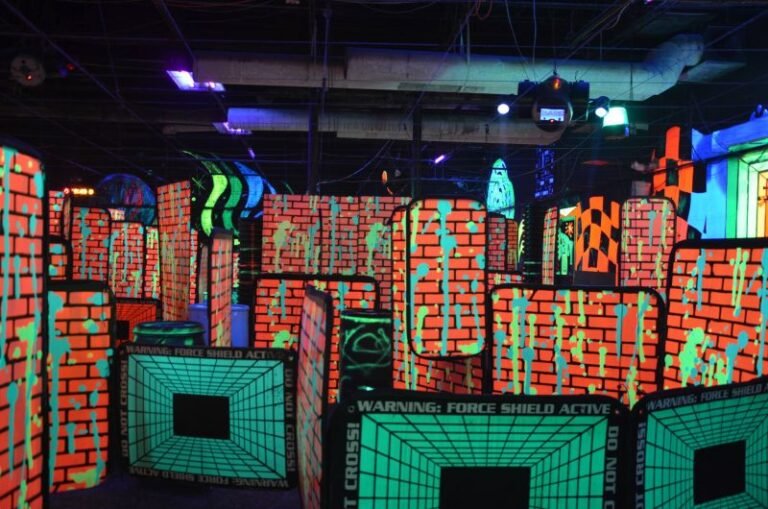
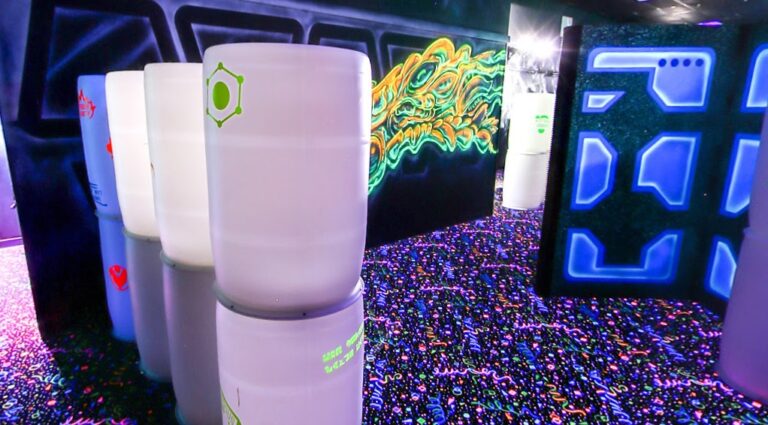
The playing experience changes significantly depending on the venue. Indoor venues are the most common and offer the most controlled environments. These arenas are typically dark, illuminated by blacklights, and filled with neon-painted obstacles, fog machines, and music. This “sci-fi combat” atmosphere is designed to maximize immersion, keeping the pace fast and the focus intense.
Outdoor laser tag, by contrast, offers a more tactical and “milsim” (military simulation) experience. Often played in wooded areas, urban ruins, or custom-built field courses, outdoor laser tag utilizes long-range equipment designed to reach across large distances. It focuses more on camouflage, stealth, and long-range sniping mechanics. While indoor arenas are perfect for weather-protected social gatherings and parties, outdoor venues offer a sense of scale and realism that appeals to those looking for a more rugged, nature-integrated experience.
Whether playing indoors amidst flashing lights and pulsing music or outdoors under the canopy of trees, laser tag continues to evolve. It remains a unique intersection of technology and human instinct, providing a necessary escape from the modern world and an opportunity to reconnect with the simple joy of high-energy play.


 2525 Freeport Rd, Pittsburgh, PA 15238, United States