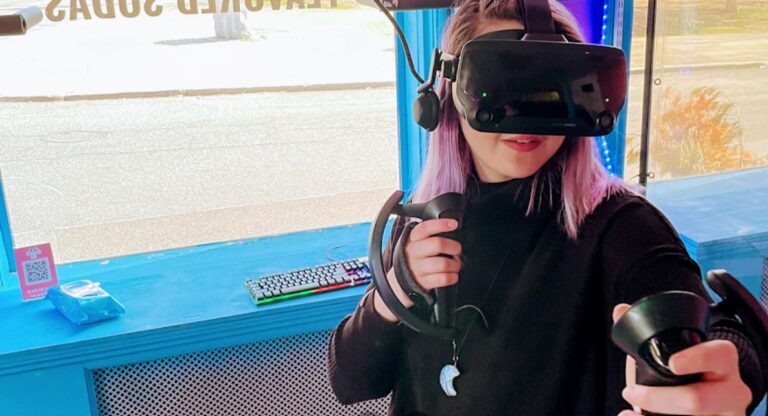
The Bubbler VR sits at 568 Charles Street in Providence, Rhode Island, inside an industrial building about eight minutes from downtown, with free street parking right outside.
It’s a virtual reality gaming lounge with more than ten VR stations and a broad library of games, from shooters like Superhot VR and Arizona Sunshine to rhythm titles, party games, sports, and a sim racing rig, plus PC gaming, board games, and karaoke. Staff guide every first-timer through the headset, and the venue hosts tournaments, karaoke nights, weekly leagues, and social clubs for game design, streaming, and VR oil painting.
The venue is a popular spot for private events, from kids’ and adult birthdays to corporate gatherings, graduations, and fundraisers, with outside food, cake, and decor welcome at no extra charge. It also runs educational VR field trips where students step into careers like welding, nursing, and wind energy or explore ancient civilizations, space, and the deep ocean. A comfortable lounge with on-site crafted dirty sodas, it works well for family outings, celebrations, and team-building alike.
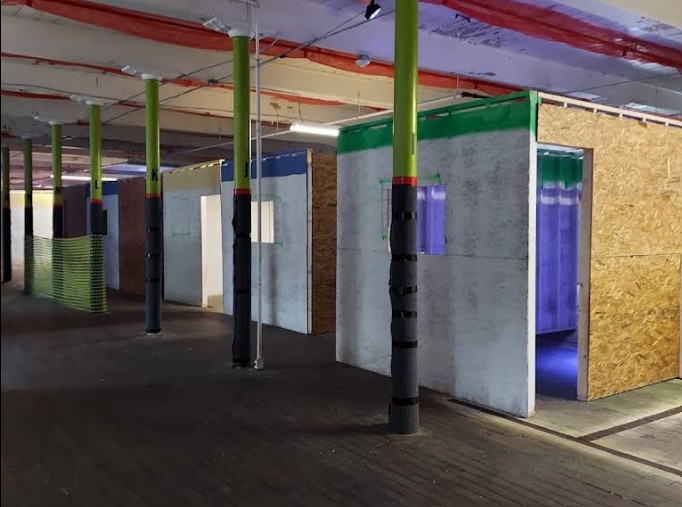
Advanced Action Sports sits in West Warwick, Rhode Island, roughly twenty minutes south of Providence and just off I-95, housed in a 32,000-square-foot indoor action sports center that is the largest of its kind in New England by gross square footage. The venue offers airsoft, reball paintball, laser tag, gel blaster, and Nerf battles across a modular arena that adapts quickly, plus Space VR, Rhode Island’s largest free-roam virtual reality center, with cooperative games and escape rooms. Experienced staff and referees keep play safe and controlled, and a fully equipped retail store with on-site repairs supports both newcomers and dedicated players.
Beyond open play, the club runs organized sessions including MilSim, LARP scenarios, and historical reenactments, and it offers structured party packages from economy open-play to private-play experiences with dedicated staging, rental packages, ammunition, and pizza and water. The space is well suited to birthdays, corporate outings, team building, and group trips, with group-level packages for larger crowds and events that run rain or shine. With multiple activities under one roof, it’s a complete destination for thrill-seekers and families alike.
The Rise of Free‑Roam VR Arenas: A New Playground for Everyone
Virtual reality has leapt far beyond the couch‑bound headset that most of us first tried in a living‑room. The newest frontier is free‑roam VR, a hybrid of physical space and digital immersion that lets you walk, run, jump, and even climb while your avatar mirrors every move in a vast, computer‑generated world. In this article we’ll unpack what free‑roam VR arenas are, explore the scenarios they enable, and see why kids, adults, scientists, and corporations are all flocking to these high‑tech playgrounds.
What Is a Free‑Roam VR Arena?
A free‑roam VR arena (sometimes called a “VR sandbox” or “mixed‑reality playground”) is a purpose‑built physical space equipped with:
Component
What It Does
Inside‑Out Tracking Cameras
Capture your exact position and orientation without external markers.
Wireless, Low‑Latency Headsets
Provide 6‑DOF (six degrees of freedom) motion tracking and high‑resolution stereoscopic visuals.
Haptic Floor Tiles & Props
Deliver tactile feedback—think vibrating floors, force‑feedback weapons, or temperature‑controlled surfaces.
Safety Netting & Soft Padding
Keep participants safe while they sprint, duck, or tumble.
Spatial Audio System
Bends sound to match the virtual environment, reinforcing the sense of presence.
Unlike a traditional VR arcade where you stay in a limited “standing‑zone,” a free‑roam arena removes those invisible walls. As long as you remain inside the mapped perimeter, the system knows where you are, letting you explore a virtual world that can be as expansive as the physical room itself.
Why it matters:
Physicality: Your body becomes the controller, delivering a workout that’s both fun and effective.
Immersion Depth: The disconnect between visual cues and real‑world movement—one of the biggest immersion breakers—is eliminated.
Social Interaction: Multiple users can see and react to each other’s avatars in real time, creating genuine multiplayer experiences.
Free‑Roam VR Scenarios: From Fantasy Quests to Real‑World Simulations
The beauty of free‑roam VR lies in its flexibility. Below are some of the most captivating scenarios that developers and venue owners have crafted.
1. Epic Adventure Quests
Genre: Action‑RPG, fantasy, sci‑fi.
What Players Do: Slash swords, cast spells, pilot hover‑crafts, or ride dragons—all while physically moving through corridors, climbing ladders, or ducking behind obstacles.
Example:Chrono‑Vault lets a team of four “time agents” race through a Neo‑Roman coliseum, solving puzzles that require simultaneous lever pulls and synchronized sword swings.
2. Immersive Escape Rooms
Genre: Puzzle/Thriller.
What Players Do: Search the environment, manipulate virtual objects, and decode riddles that integrate physical props (e.g., a locked chest that only opens when you find a hidden key in the real world).
Why It Works: The kinetic element raises the stakes—players actually have to run to the next clue before the timer hits zero.
What Trainees Do: Navigate smoke‑filled warehouses, perform virtual surgeries, or practice equipment maintenance while the system records motion data for post‑session analysis.
Impact: Studies show a 30‑45 % increase in skill retention versus traditional tabletop or desktop simulations.
Why It’s Hot: The physical exertion translates to real‑world fitness benefits, while the digital scoring and power‑ups keep the gameplay fresh.
5. Creative Sandbox Worlds
Use Cases: Architectural walkthroughs, virtual art installations, collaborative world‑building.
Outcome: Participants can “paint” with light, sculpt massive structures with their hands, or test a building’s ergonomics before any brick is laid.
Who Plays on Free‑Roam VR Arenas?
Free‑roam VR isn’t a niche hobby for hardcore gamers; it’s a cross‑generational, cross‑industry magnet. Let’s break down the primary audience groups.
1. Families & Kids
Why they love it: Children adore the freedom to run around and interact with whimsical creatures without the constraints of a stationary headset. Parents appreciate the built‑in safety measures and the active nature of the play.
Typical Sessions: 30‑minute “Adventure Hours” where kids team up to rescue a lost unicorn, followed by a calm “Starlight Storytime” where they float among constellations.
2. Teens & Young Adults
Motivation: Competitive leaderboards, social bragging rights, and the thrill of real‑world movement combined with high‑octane digital combat.
Popular Formats: Multiplayer raids, VR esports tournaments, and “battle‑royale” style free‑roam matches.
3. Corporate Teams & Professionals
Goal: Team‑building, leadership training, and innovative brainstorming.
Typical Activities: Collaborative puzzle challenges that require clear communication, or scenario‑based simulations (e.g., crisis management) that place employees in a high‑stakes virtual environment.
4. Researchers & Scientists
Interest: Data collection on human motion, cognition, and perception in a controlled yet highly realistic setting.
Projects: Studying spatial memory retention, evaluating ergonomics of new equipment, or testing the psychological impact of virtual environments on stress levels.
VR for Kids: Safety, Education, and Pure Fun
Safety First
Guardian Mode: Headsets automatically lower brightness and reduce motion intensity for younger users.
Physical Barriers: Soft padding, motion‑catch nets, and real‑time collision alerts keep kids from bumping into walls or each other.
Parental Controls: Session length limits, content filters, and live video feeds allow parents to monitor the experience.
Educational Value
STEM Exploration: Interactive lessons on planetary science, chemistry, or biology—imagine walking on Mars while a virtual astronaut explains soil composition.
Language Immersion: Kids can explore a bustling market in a foreign-language world, picking up new vocabulary through contextual interaction.
Social Skills: Multiplayer quests encourage teamwork, negotiation, and conflict resolution in a safe, gamified arena.
Fun Factor
Narrative‑Driven Play: Story arcs that evolve based on player choices keep kids engaged for multiple sessions.
Customizable Avatars: From dinosaurs to superhero robots, children love personalizing their virtual alter‑ego.
Free‑Roam VR for Special Events: Birthdays, Graduations, Corporate Parties
1. Birthday Parties
Theme Packages: “Space Explorer,” “Jurassic Safari,” or “Superhero Academy.”
Structure: 10‑minute welcome orientation → 45‑minute main quest → 15‑minute cool‑down zone with VR‑augmented cake‑cutting (the cake appears in the virtual world before the real one is served).
Takeaway: Personalized digital photo albums and a short highlight reel of the birthday hero’s triumphs.
2. Graduation Celebrations
Concept: “Future Pathways” where graduates walk through a virtual career garden, planting seeds that bloom into animated representations of their future professions.
Why It Works: Combines the emotional milestone with a forward‑looking, immersive visualization that families can share on social media.
3. Corporate Parties & Team‑Building
Package Options:
Strategic Simulation: Teams solve a simulated corporate crisis (e.g., a data breach) in real time.
Creative Hackathon: Participants design a virtual product prototype using intuitive 3‑D tools.
Pure Fun: VR laser tag, escape rooms, or a “Glow‑in‑the‑Dark” dance floor where avatars leave neon trails.
Metrics: Post‑event surveys often show a 70 % increase in perceived team cohesion and a 45 % boost in employee morale.
Scientists and Industry Experts on Free‑Roam VR
1. Neuroscientists
Perspective: Dr. Lila Ortega (NeuroTech Institute) notes that embodied cognition—the brain’s integration of physical movement and mental processing—is dramatically heightened in free‑roam VR. “When the vestibular system aligns with visual cues, we see stronger memory encoding and lower motion‑sickness rates.”
2. Ergonomics Researchers
Insight: Professor Kenji Tanaka (Human Factors Lab) argues that free‑roam VR can serve as a gold standard for workplace ergonomics testing, allowing designers to observe workers’ natural postures and motions in a controlled virtual environment before building physical prototypes.
3. Education Technologists
Takeaway: Dr. Aisha Patel (Future Learning Lab) emphasizes the “learning by doing” principle: students who navigate a virtual chemistry lab with actual hand motions retain concepts 35 % better than those using a mouse‑based simulation.
4. Industry Leaders
Voice of Business: Rajesh Mehta, CTO of PulseVR, predicts a 15‑year market horizon in which every major city will host at least one public free‑roam arena, integrated with shopping malls, museums, and sports complexes. He adds, “The ROI isn’t just ticket sales; the data generated from user motion patterns is a goldmine for AI‑driven personalization.”
5. Health & Wellness Advocates
Opinion: Dr. Sofia Alvarez (FitMind Clinic) highlights the therapeutic potential for motor rehabilitation. Preliminary trials using free‑roam VR for stroke patients show a 20 % faster recovery of gait symmetry compared to conventional physiotherapy alone.
The Future Horizon: Where Free‑Roam VR Is Headed
Scalable Modular Arenas – Portable units that can be assembled in schools, community centers, or even outdoor festivals.
AI‑Driven Narrative Engines – Real‑time story adaptation based on player choices, emotions (read via biometric sensors), and group dynamics.
Mixed‑Reality Integration – Seamless blending of physical props with holographic overlays using light‑field displays, blurring the line between “real” and “virtual.”
Cross‑Location Multiplayer – Multiple arenas connected via high‑bandwidth networks, allowing a single quest to span continents.
Free‑roam VR arenas have turned the once‑static concept of virtual reality into a living, breathing playground that caters to everyone—kids chasing dragons, graduates visualizing their futures, corporations forging stronger teams, and scientists unlocking new insights about the human mind.
As hardware becomes lighter, tracking more precise, and content pipelines richer, the only limit to free‑roam VR will be our collective imagination. So the next time you hear someone say, “Let’s meet in the virtual world,” remember: they might actually be running toward you.

 El Monte
 Log in

 Indoors


 568 Charles St, Providence, RI 02904, United States