
 El Monte
 Log in
Log in
Log in

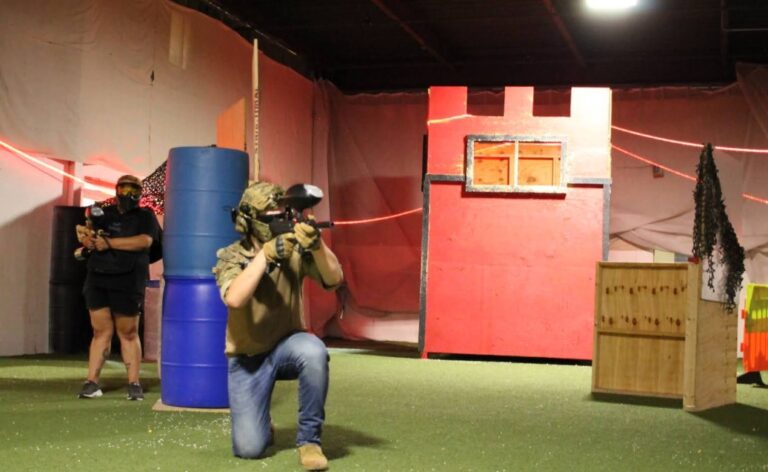
BattlegroundZ sits in Lincoln, Rhode Island, a short drive from Providence, inside a sprawling 50,000-square-foot indoor complex on Higginson Avenue.
The venue pairs two 20,000-square-foot arenas for paintball and airsoft with a 5,000-square-foot UV-lit Lazer Wars arena, plus gel blasters, archery tag, dart wars, dodgeball, and a full arcade. Paintball uses reusable silicone balls so players stay clean, airsoft features theatrical sound and lighting with new game modes each week, and all games run in ten-minute rounds with respawn rules.
Beyond the arenas, BattlegroundZ hosts birthday, bachelor, and corporate events with party hosts, private VIP rooms, and a 5,000-square-foot banquet room. The Mess Hall serves chef-created food, the Battle Bar pours adult beverages, and a 1,200-square-foot Pro Shop stocks gear and airsoft replicas. Safety briefings, chronograph checks, and ANSI-certified protection make it welcoming for both newcomers and seasoned players.
 Indoors
Paintball has exploded from a niche pastime into a global phenomenon that blends physical fitness, tactical thinking, and pure adrenaline. Whether you’re a curious newcomer, a seasoned marker‑maven, or a parent looking for a safe, team‑building activity, this comprehensive guide will walk you through everything you need to know. We’ll cover the core definition of paintball, the essential rules that keep the game fair and fun, popular game scenarios, the surprising benefits it offers, the diverse community of players, the scientific and industry perspective, and finally, where you can suit up for a round—both outdoors and indoors.
Paintball is a competitive sport in which participants use compressed‑air or CO₂‑powered markers (commonly called “paintball guns”) to fire small gelatin capsules—known as paintballs—at opposing players. Each paintball contains a liquid dye that bursts on impact, leaving a bright, easily visible mark. The primary objective is simple: eliminate opponents by hitting them with a paintball, or achieve mission‑based goals such as capturing a flag or defending a position.
| Component | Description |
|---|---|
| Marker | A lightweight, semi‑automatic or fully‑automatic device that propels paintballs using compressed gas. |
| Paintballs | 0.68‑inch (17.3 mm) spherical shells filled with non‑toxic, water‑based dye. |
| Protective Gear | Mask (mandatory), chest protectors, gloves, elbow/knee pads, and sometimes full‑body suits for high‑impact fields. |
| Field | An arena—ranging from dense woods to high‑tech indoor arenas—filled with obstacles and terrain that shape gameplay. |
| Ruleset | A agreed‑upon set of guidelines governing how hits are counted, respawn mechanics, and safety protocols. |
Paintball is distinguished from its cousins, airsoft and laser tag, by its tactile “splatter” feedback, which makes every hit instantly visible and adds a visceral element to the sport.
Although each venue may tweak the details, the following rules form the backbone of any paintball match. Understanding them is essential for safety, sportsmanship, and a smooth game flow.
The marker’s barrel is a lethal projectile when loaded. Players must keep their mask securely fastened from the moment they step onto the field until they leave the playing area.
A player is considered “out” when a paintball breaks open and leaves a visible mark on any part of the body or gear except for the mask (some fields use “balloon” marker to indicate a mark on the mask). If a paintball hits a piece of equipment (e.g., a chest protector) that’s visibly stained, the player must still exit.
Deliberately aiming for the head is discouraged and often prohibited in family‑friendly leagues. Some venues ban “head‑shots” altogether, requiring a “body‑only” rule to keep the sport safe for younger players.
Markers must be filled with the correct gas type (CO₂ or compressed air) at the venue’s pressure limits. Over‑pressurizing can cause marker malfunction and pose a danger to nearby players.
Most matches impose a cap on the number of paintballs each player can carry (e.g., 200 paintballs). Reload stations are typically positioned in safe zones; players must surrender their empty hoppe r before refilling.
Leaving the designated playing area is a violation. Most fields have “out‑of‑bounds” lines marked by rope or paint. Stepping over these lines results in an automatic “out” and may incur a time penalty.
Players must treat each other with respect. Verbal abuse, intentional physical contact (aside from marker impact), or equipment tampering can lead to ejection from the game and possibly a ban.
Most fields have a trained first‑aid responder on site. Any injury—no matter how minor—should be reported immediately. Players are required to sign a liability waiver acknowledging they understand the risks.
The heart of paintball is the scenario—an overarching narrative or objective that transforms a simple “eliminate everyone” skirmish into a story‑driven battle. Below are the most beloved scenarios across both casual and competitive play.
Two teams defend a flag while trying to seize the opponent’s flag and return it to their home base. Variations include multiple flags, “king of the hill” (the flag moves), and “one‑flag” (central flag that both teams contest).
One side (the “attackers”) must breach a fortified position within a set time limit, while the defending side holds a line of obstacles or a “base.” This scenario mirrors military operations and is a staple in tactical paintball leagues.
Every hit eliminates a player; the round ends when only one player/team remains. Games can be fast‑paced or extended depending on the number of players and the field size.
A small group of “survivors” must protect themselves against a larger horde of “zombies.” When a survivor is hit, they become a zombie, adding a dynamic shift in team balance as the round progresses.
Large‑scale events (often lasting several hours) feature elaborate narratives—e.g., rescuing hostages, searching for treasure, or surviving a post‑apocalyptic wasteland. Props, props, and role‑playing elements heighten immersion.
Quick, often humorous challenges like “paintball darts” (players throw paintballs at a target), “shoot‑the‑bridge” (eliminate opponents while crossing a narrow bridge), or “sniper vs. 30‑man army” where one player with a high‑precision marker faces a swarm.
Each scenario can be tweaked by adjusting time limits, respawn rules, and the layout of obstacles to keep the experience fresh.
Beyond the obvious thrill of dodging and firing, paintball delivers an unexpected suite of mental, physical, and social benefits.
Some hospitals and rehab centers employ paintball as an occupational therapy tool. The sport promotes confidence, improves balance, and offers a controlled environment to practice social interaction for individuals recovering from injuries or dealing with mental health challenges.
Paintball’s appeal cuts across age, gender, and socioeconomic lines. Below is a snapshot of the main demographics.
| Segment | Typical Profile | Motivations |
|---|---|---|
| Youth & Teens (12‑18) | School clubs, summer camps, birthday parties | Fun, social interaction, low‑cost adventure |
| College Students | Intramural leagues, fraternity/sorority events | Competition, team bonding, stress relief |
| Professionals (25‑45) | Corporate team‑building, hobbyist leagues | Leadership development, fitness, networking |
| Military & Law Enforcement | Tactical training units | Real‑world scenario rehearsal, unit cohesion |
| Women‑Only Groups | Dedicated leagues & events | Safe, supportive environment, empowerment |
| Seniors (55+) | “Gentle‑play” leagues, adaptive equipment | Socialization, light cardio, nostalgia |
| Special‑Needs Communities | Adaptive paintball programs | Confidence building, inclusive recreation |
The rise of inclusive leagues (e.g., “Women’s Paintball League”, “Veterans’ Paintball Initiative”) affirms that the sport is expanding to previously under‑represented groups.
A 2022 study in the Journal of Sports Medicine compared paintball to high‑intensity interval training (HIIT). Participants showed:
Dr. Maya Patel, a cognitive psychologist at Stanford, observed that paintball’s “shared stress environment” accelerates trust formation among strangers—an effect she calls the “Paintball Paradox.” Her findings suggest a brief, high‑stakes game can produce the same bonding outcomes as weeks of traditional team‑building workshops.
Overall, experts agree that paintball combines controlled risk, physical exertion, and cognitive challenge, making it a valuable tool for both recreation and applied training.
Finding the right arena can significantly shape your experience. Below is a practical guide to the two main categories of venues, plus tips for selecting a location that matches your skill level and scenario preferences.
| Feature | Typical Attributes | Ideal For |
|---|---|---|
| Terrain | Woods, hills, streams, abandoned structures, natural obstacles | Tactical gameplay, large‑scale scenarios |
| Size | 5–20 acres (or larger for “milsim” events) | Full‑contact attack/defence, CTF |
| Weather Dependency | Rain, heat, wind affect paintball flight | Players who enjoy natural conditions |
| Amenities | Parking, BBQ pits, camping sites, on‑site stores | Day‑long tournaments, weekend retreats |
| Examples | Paintball USA (Georgia, USA), Delta Force (UK), Red Zone (Australia) | Teams seeking immersive, realistic environments |
| Feature | Typical Attributes | Ideal For |
|---|---|---|
| Layout | Modular inflatable bunkers, PVC pipes, maze‑like corridors | Fast‑paced, high‑intensity matches |
| Size | 5,000–20,000 sq ft (often climate‑controlled) | Beginner leagues, corporate events |
| Consistency | No weather influence; paintball flight remains predictable | Training sessions, skill drills |
| Lighting & Effects | Black‑out rooms, neon lighting, sound systems | Night‑vision or “laser‑paintball” hybrids |
| Examples | World Class Paintball (Los Angeles), Battlegrounds (London), Paintball Xtreme (Tokyo) | Urban players, night‑time groups, event planners |
Paintball is far more than a weekend hobby; it’s a dynamic blend of sport, strategy, and social interaction that serves athletes, professionals, educators, and even researchers. By mastering the fundamentals—what paintball is, the core rules, common scenarios, and why it matters—you’ll be ready to step onto any field with confidence. Whether you prefer the mud‑splattered woods of an outdoor battleground or the high‑octane intensity of an indoor arena, the world of paintball welcomes you with open arms—and a fresh burst of color. So load your marker, secure that mask, and charge into the exhilarating chaos—because the next great story is waiting to be painted.


 100 Higginson Ave, Lincoln, RI 02865, United States