
 El Monte
 Log in
Log in
Log in

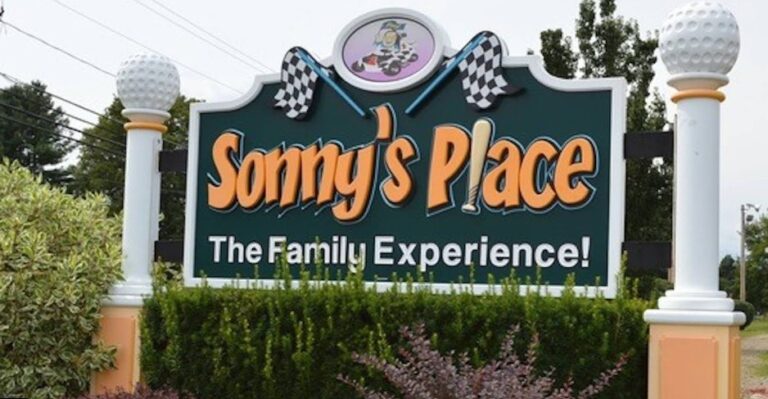
Sonny’s Place sits along Main Street in Somers, Connecticut, a family-owned amusement complex that opened in 2008 and has grown steadily ever since. The park features a two-story Zap Zone Laser Tag Arena by Lasertron with multiple game modes, outdoor go-karts, two mini-golf courses, a zipline, batting cages, a 7,000-square-foot arcade, climbing wall, bumper boats, and a soft indoor playground. Birthday parties come with private rooms and dedicated hosts, while the Sonny’s Pavilion accommodates groups of over 500 for corporate events, school trips, reunions, and social gatherings.
Beyond the attractions, the park offers several dining options including a smokehouse, bar, and ice cream counter, plus live music on summer weekends and special adult-only late-night events. The staff is known for being friendly and professional, and the park runs community appreciation programs for teachers, first responders, and military personnel. With family night bundles, date night specials, and seasonal events like character days and the North Pole Experience, Sonny’s Place functions as a genuine community gathering spot rather than just a collection of rides.
 Indoors
 Outdoors
In the rapidly expanding landscape of digital entertainment, few innovations have captured the public imagination quite like the free-roam virtual reality (VR) arena. Unlike home-based VR, which is often confined to the limited square footage of a living room and tethered by cables or restricted by “guardian boundaries,” a free-roam arena represents the pinnacle of physical-digital integration. It is a dedicated space—often spanning hundreds or thousands of square feet—designed to replicate the sensation of total presence. In these environments, the physical world and the digital simulation become one, allowing participants to walk, run, and interact naturally within a boundless-feeling virtual expanse.
At its core, a free-roam VR arena, often referred to as “Location-Based Entertainment” (LBE), is a facility engineered for uninhibited movement. Users are typically equipped with a lightweight, high-performance VR headset, a powerful backpack computer (or a wireless streaming system), and haptic gear that provides physical feedback.
What distinguishes these arenas from traditional arcades is the use of sophisticated motion-tracking technology. Infrared cameras mounted throughout the facility track the precise position of every player in real-time, allowing them to navigate an physical floor plan that mirrors the virtual world. When a player walks forward in the physical arena, they move forward in the game. This seamless translation of movement eliminates the “motion sickness” often associated with joystick-based movement in VR, as the inner ear’s vestibular system remains in sync with the visual input. It is the closest humanity has yet come to the “Holodeck” experience envisioned in science fiction.
The true power of free-roam VR lies in the narrative variety it offers. These scenarios are designed to transport users into worlds that would be impossible to build in the physical realm. The most popular genre is the cooperative shooter, where teams must coordinate to survive waves of zombies, rogue robots, or extraterrestrial threats. These scenarios emphasize communication and spatial awareness; players must physically lean around corners, duck behind virtual cover, and call out enemy positions to their teammates.
Beyond combat, developers are increasingly exploring puzzle-solving and exploration-based scenarios. Players might find themselves traversing an ancient, crumbling temple, solving intricate mechanical locks in a high-tech heist, or venturing into deep-sea stations to rescue stranded researchers. Some arenas even offer “escape room” style VR, where the environment is less about high-octane action and more about logic, environmental manipulation, and discovery. Each scenario is crafted to leverage the full scale of the arena, turning the floor into a living, breathing set piece.
The demographic for free-roam VR is remarkably diverse, extending well beyond the stereotypical “hardcore gamer.” Because the technology is intuitive—requiring only the ability to walk and point—it is accessible to almost anyone who can wear the equipment. Among the most enthusiastic participants are children and teenagers.
For younger players, VR arenas provide a unique form of “active screen time.” Unlike sedentary gaming, where children sit for hours, free-roam VR demands physical exertion. It encourages children to collaborate with friends, exercise critical thinking, and build confidence as they navigate daunting virtual challenges. Many facilities implement safety protocols tailored for kids, ensuring the equipment fits smaller frames and the content is age-appropriate. When schools or youth groups utilize these spaces, they often find that the shared experience fosters stronger social bonds and encourages team-oriented problem-solving, making it a powerful tool for developmental interaction.
The versatility of the free-roam arena has made it a premier destination for milestone events. Traditional parties often rely on passive entertainment, but a VR arena changes the dynamic, turning attendees from spectators into protagonists.
For birthday parties, the draw is clear: it is a high-impact, memorable experience that friends can talk about long after the headset is removed. Whether it is a group of teenagers celebrating a birthday or a group of young adults marking a graduation, the shared adrenaline rush of saving the world together creates a lasting connection.
Perhaps most significantly, the corporate sector has embraced free-roam VR as a sophisticated team-building tool. Traditional corporate retreats often struggle to break down hierarchies or foster genuine communication. In a VR arena, those barriers disappear. When a manager and a junior employee are both desperately trying to navigate a narrow virtual bridge or covering each other during a digital siege, the sense of hierarchy dissolves. The experience forces participants to rely on one another’s communication skills and leadership under pressure, providing an invaluable exercise in collaboration that translates directly back into the office environment.
Experts in human-computer interaction and psychology are paying close attention to the development of free-roam VR. Scientists often highlight the concept of “proprioceptive presence”—the sense that one’s body occupies a space. Research suggests that when our physical movements match our visual environment, the brain stops treating the display as an “image” and begins to process it as a “place.” This biological trick has profound implications for learning, therapy, and social interaction.
Industry analysts emphasize that while the hardware is currently the star of the show, the future of the medium lies in “asynchronous multi-user environments.” This means creating simulations that are so responsive that they feel truly alive, where AI entities react to the players’ physical presence rather than following a scripted path.
Many industry leaders view free-roam VR as the logical evolution of the “third place”—a social environment separate from home and work. As the technology becomes lighter (with lighter headsets) and more immersive (with advanced haptics and even scent or temperature triggers), experts predict these arenas will become staples of metropolitan life, akin to movie theaters or bowling alleys. The long-term vision is an “Omniverse” where these physical arenas serve as portals into massive, interconnected virtual landscapes, effectively blurring the lines between physical activity and digital escapism.
Ultimately, free-roam VR is not just a passing trend in gaming; it is an architectural and technological shift in how humans congregate and play. By marrying the limitations of physical anatomy with the infinite possibilities of digital architecture, these arenas offer an experience that is both grounded in reality and soaring in imagination. As the technology matures, it will continue to redefine our expectations of entertainment, proving that the future of digital experience is not found in a chair, but on our own two feet.


 349 Main Street, CT-190, Somers, CT 06071, United States