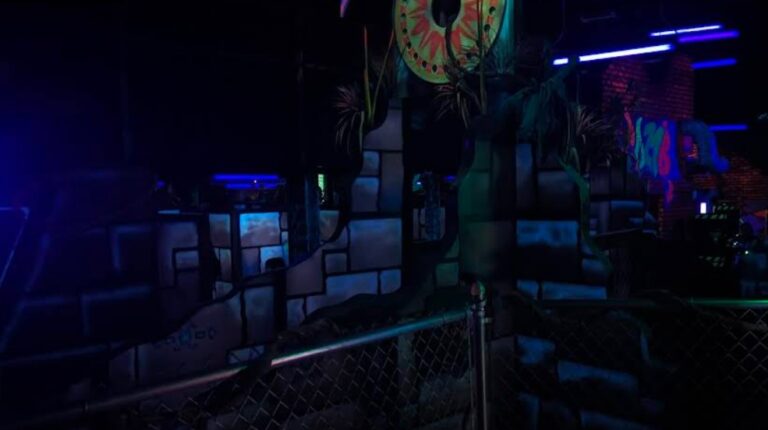
Mission Laser 757, located in Norfolk, VA, proclaims itself to offer the “757’s BEST Laser Tag Experience.” Mission Laser is an interactive Laser Tag experience. The 6,000 square foot multi-level arena is designed to immerse players in the game.
Participants can enjoy a round of Laser Tag in a multi-level arena filled with fog and music. Each game can accommodate up to 29 players for maximum action and fun with friends and family. They recommend closed-toe athletic shoes for participation.
The facility boasts a state-of-the-art Laser Blast game system, alongside new video games and newly renovated party rooms, all designed to provide visitors with a memorable experience. Even those who choose not to play can observe the action live from the observation area.
LaserTag is a high‑energy, team‑based sport that blends technology, strategy, and pure fun. Players wear lightweight vests equipped with infrared (IR) sensors and carry hand‑held “phasers” that emit invisible laser beams. When a beam strikes an opponent’s sensor, the hit is recorded, a sound or vibration alerts the player, and the score is logged instantly on a central computer or mobile app.
Unlike traditional paintball or airsoft, LaserTag is completely non‑lethal, requires no cleanup, and can be played in a wide variety of environments—from dimly lit arenas to sprawling outdoor forests. The game’s simplicity (point, aim, fire) hides a deep tactical layer: positioning, cover, movement, and communication all matter. Modern systems even incorporate augmented‑reality overlays, real‑time stats, and customizable game modes, turning each session into a unique narrative experience.
LaserTag Scenarios
The beauty of LaserTag lies in its adaptability. Here are some of the most popular—and inventive—scenarios you can run, whether you’re a casual group of friends or a professional event planner.
Scenario
Description
Ideal Setting
Free‑For‑All (FFA)
Every player for themselves; the highest score wins.
Small to medium arenas, indoor or outdoor
Team Deathmatch
Two (or more) squads battle for dominance; the first to reach a point threshold wins.
Classic arena or indoor warehouse
Capture the Flag
Teams must infiltrate the enemy base, steal a “flag” (sensor), and return it safely.
Larger maps with distinct zones
Zombie Apocalypse
One or two “infected” players chase the rest; when hit, survivors become zombies.
Dark, maze‑like environments
Mission‑Based Ops
Players receive objectives (e.g., “disable the enemy communications array”) and earn bonus points for completion.
Custom‑built arenas with props
LaserTag Escape Room
Combine puzzle solving with combat; teams must solve riddles to unlock new zones while fending off opponents.
Indoor venue with modular walls
Corporate “War Games”
Teams earn points for completing business‑related challenges (e.g., “close the deal” sensor) while sabotaging rivals.
Large indoor facilities or outdoor fields
Themed Adventures
Fantasy (dragons, knights), sci‑fi (space battles), or historical (WWII skirmish) themes with special props and storylines.
Any venue that can be dressed up
Each scenario can be tweaked on‑the‑fly with real‑time scoring adjustments, “power‑ups” (extra lives, speed boosts), and environmental effects (fog machines, strobe lights) to keep the adrenaline flowing.
LaserTag Benefits
Beyond the immediate thrill, LaserTag delivers a surprising array of physical, mental, and social advantages.
1. Physical Fitness
Cardiovascular Boost: A typical 15‑minute round can raise heart rate to 140‑160 BPM, comparable to moderate jogging.
Full‑Body Movement: Players duck, weave, sprint, and climb, engaging core, legs, and upper body muscles.
Low Injury Risk: No hard projectiles means minimal chance of bruises or cuts.
2. Cognitive Development
Strategic Thinking: Rapid decision‑making, resource allocation, and situational awareness are exercised every second.
Spatial Awareness: Navigating three‑dimensional terrain sharpens perception and mental mapping.
Problem Solving: Mission‑based scenarios require teams to analyze data and improvise solutions under pressure.
3. Social & Emotional Growth
Teamwork & Communication: Success depends on clear, concise verbal cues and collaborative planning.
Confidence Building: Hitting targets and earning points reinforces self‑efficacy, especially for shy or introverted participants.
Conflict Resolution: The game’s competitive nature offers a safe arena for learning to handle wins and losses gracefully.
4. Technology Literacy
Familiarity with Sensors & Data: Players see how real‑time data streams work, a subtle introduction to IoT concepts.
App Integration: Scoring apps teach basic navigation of dashboards, statistics, and leaderboards.
5. Versatility & Accessibility
Inclusive Design: Adjustable difficulty levels allow beginners, children, seniors, and even people with limited mobility to join.
No Mess, No Recovery Time: Unlike paintball, there’s no clean‑up, making it ideal for schools, offices, and family venues.
Scientists and Industry Experts’ View on LaserTag
“LaserTag provides a controlled, repeatable environment for studying group dynamics, decision‑making under stress, and physical‑cognitive interaction.” – Dr. Maya Patel, Cognitive Neuroscientist, University of Washington
Research Highlights
Field
Insight
Human Factors & Ergonomics
Studies show that the latency of IR sensors (< 30 ms) is low enough to mimic real‑world reaction times, making LaserTag a viable surrogate for tactical training.
Physical Therapy
Rehab clinics are piloting LaserTag to rehabilitate gait and balance in post‑stroke patients, reporting a 25 % improvement in mobility after six weeks.
Education Technology
Researchers at the Institute of Interactive Learning found that integrating LaserTag missions into STEM curricula increased student engagement by 42 % and boosted retention of physics concepts (e.g., angles, velocity).
Psychology
A 2022 meta‑analysis indicated that team‑based LaserTag reduced cortisol levels (stress hormone) by an average of 15 % compared to passive recreational activities.
Industry (Gaming & Entertainment)
Market analyst Gartner predicts the global immersive multiplayer market—including LaserTag arenas, AR/VR experiences, and e‑sports—to exceed $12 billion by 2030, with LaserTag accounting for a growing 8‑10 % slice.
Expert Recommendations
Safety First: Ensure all equipment meets CE/UL certifications; regular maintenance of sensors prevents false hits.
Scenario Design: Mix cognitive tasks with physical challenges to maximize neuro‑physical benefits.
Data Privacy: When using scoring apps that collect biometric data, comply with GDPR/CCPA regulations.
Inclusive Programming: Offer adaptive controllers (e.g., larger trigger grips, voice‑activated phasers) for players with disabilities.
Who Plays LaserTag? LaserTag for Kids
Demographic Snapshot
Age Range
Typical Participation
Popular Game Modes
5–8
School field trips, birthday parties
Free‑For‑All, “Space Invaders” (simple point shooting)
9–12
After‑school clubs, youth leagues
Capture the Flag, Zombie Apocalypse (team‑based)
13–17
Middle/high school tournaments, e‑sports qualifiers
All scenarios, especially themed adventures and war games
Why Kids Love It
Immediate Feedback: Lights, sounds, and score pop‑ups give instant gratification.
Safe Competition: No pain or mess, yet the thrill of “combat” is intact.
Imagination Boost: Thematic storylines let kids become superheroes, astronauts, or knights.
Social Glue: Friends cooperate, negotiate roles (sniper, scout, medic), and celebrate victories together.
Parent & Educator Tips
Check Age‑Rating: Some systems have “low‑power” modes for younger children.
Set Clear Rules: Emphasize “no shooting the head” (sensor placement) and respect personal space.
Combine Learning: Use a “Science Quest” scenario where players must locate “energy cores” to learn about renewable energy sources.
Encourage Balance: Pair LaserTag sessions with a calm cool‑down period—stretching or a short debrief—to solidify teamwork lessons.
LaserTag for a Birthday Party, Graduation, Corporate Party
LaserTag adapts seamlessly to celebrations of any size or theme. Below are tailored ideas and logistical considerations for three common event types.
1. Birthday Parties
Theme Integration: Superhero capes, pirate eye‑patches, or princess tiaras can be handed out alongside the phasers.
Mini‑Tournament Structure: Three 10‑minute rounds, rotating teams every round to ensure everyone plays with each friend.
Awards & Swag: Medal ribbons, custom‑printed “laser‑shooter” t‑shirts, and a photo booth with neon backdrops.
2. Graduation Celebrations
Class‑Versus‑Class Challenge: Seniors vs. underclassmen in a grand “final showdown”—a symbolic passing of the torch.
Memory Quest Mode: Hidden sensors hold “memories” (photos, quotes) that players must collect, turning the arena into a living yearbook.
Catering Considerations: Schedule a short intermission for food; opt for low‑mess finger foods to keep equipment clean.
3. Corporate Parties & Team‑Building
Strategic Objectives: Embed company values into missions (e.g., “innovation” sensor yields bonus points when “hacked”).
Leadership Rotation: Rotate “team captain” roles each round to develop different leadership styles.
Performance Metrics: Use the scoring software to generate post‑event analytics—communication score, response time, and “team cohesion index.”
Hybrid Formats: Combine indoor arena play with an outdoor “field ops” segment for larger groups, encouraging adaptability to changing environments.
Logistical Checklist for Any Event
Item
Details
Venue Capacity
Verify maximum occupancy and ensure emergency exits are clearly marked.
Equipment Rental
Confirm number of vests/phasers, battery life, and spare sensors.
Safety Briefing
5‑minute pre‑game talk on rules, equipment handling, and emergency procedures.
Game Master (GM)
Designate a trained staff member to manage scenarios, track scores, and handle disputes.
Insurance
Many venues require liability coverage for group activities; check contracts.
Accessibility
Provide ramps, adjustable vests, and alternative controllers if needed.
Post‑Game Debrief
Short discussion on highlights, lessons learned, and award ceremony.
Where to Play LaserTag? Outdoor and Indoor Venues
Indoor Arenas
Venue Type
Pros
Cons
Typical Price (per hour)
Dedicated LaserTag Centers
Professionally designed mazes, high‑tech lighting, on‑site staff.
May be crowded on weekends.
$25‑$45 per group (up to 10 players).
Bowling Alleys / Trampoline Parks
Multi‑use space, easy to book for parties.
Layout may be less immersive.
$15‑$30 per hour.
Corporate Event Spaces
Customizable lighting, can combine with meetings.
Requires external equipment rental.
$35‑$60 per hour (plus equipment).
Schools / Universities
Affordable for student groups; educational tie‑ins.
Limited operating hours.
Often free or subsidized.
Key Features to Look For
Adjustable Lighting: Ability to dim or color‑change lights to suit different scenarios.
Sound Isolation: Reduces external noise and enhances immersion.
Modular Walls/Props: Allows scenario customization without permanent construction.
Scoreboard Integration: Live leaderboards visible to spectators.
Outdoor Fields
Venue Type
Pros
Cons
Typical Price (per hour)
Forest or Park Courses
Natural cover, large area for expansive games.
Weather‑dependent; requires portable power.
$20‑$40 per group (up to 20 players).
Urban “LaserTag Streets”
Utilizes city blocks, building façades for high‑tech chase.
Requires permits and safety barriers.
$30‑$55 per hour (including staff).
Military‑Style Training Grounds
Realistic terrain, obstacles, and longer range sensors.
Higher cost, stricter safety regs.
$50‑$80 per hour.
University Campus Grounds
Large open spaces, easy to split into multiple zones.
May need coordination with campus security.
Often free with campus affiliation.
Outdoor Essentials
Weather‑Proof Gear: Waterproof vest shells and UV‑resistant phasers.
Power Solutions: Portable generators or solar chargers for sensors and lighting.
Boundary Markers: Flags or tape to clearly delineate play zones.
First‑Aid Kit & Safety Personnel: Essential for any outdoor activity with vigorous movement.
Choosing the Right Venue
Group Size & Age: Small children thrive in compact indoor arenas; teens and adults often prefer larger outdoor fields.
Scenario Complexity: If you need intricate props and lighting, indoor venues win. For large‑scale “capture the flag” or “zombie hunt,” outdoor spaces excel.
Budget & Logistics: Indoor centers often bundle equipment and staff, reducing organizational overhead. Outdoor sites may require DIY setup but can be more cost‑effective for large groups.
Location Accessibility: Proximity to public transport and parking can be a deciding factor for corporate events.
LaserTag is far more than a weekend pastime; it’s a multifaceted platform that blends physical activity, cognitive challenge, and social interaction in a safe, adaptable package. Whether you’re a parent planning a kid’s birthday, a graduation committee seeking a memorable send‑off, or a corporate HR leader aiming to strengthen teamwork, LaserTag offers customizable scenarios that can be tailored to any audience.
The growing interest from scientists, educators, and industry innovators underscores its potential as a learning tool, therapeutic aid, and entertainment staple. As technology continues to evolve—think AI‑driven dynamic missions, mixed‑reality overlays, and biometric feedback loops—LaserTag is poised to become an even richer experience for the next generation of players.
So, gather your crew, pick a scenario, and step into the arena. The laser is poised, the sensors are waiting, and the adventure is just one “pew‑pew” away.

 El Monte
 Log in

 Indoors


 5671 Raby Rd Unit A, Norfolk, VA 23502, United States