
 El Monte
 Log in
Log in
Log in

Main Event Indoor Laser Tag arena is located in Lubbock, TX.
Main Event is a huge entertainment hub where you can spend your weekend or throw a birthday party. These laser-tag battles take place in a multi-story arena with fantasy-like decorations, neon lights, and laborious obstacles. Climb up the towers and rain fire on unsuspecting enemies.
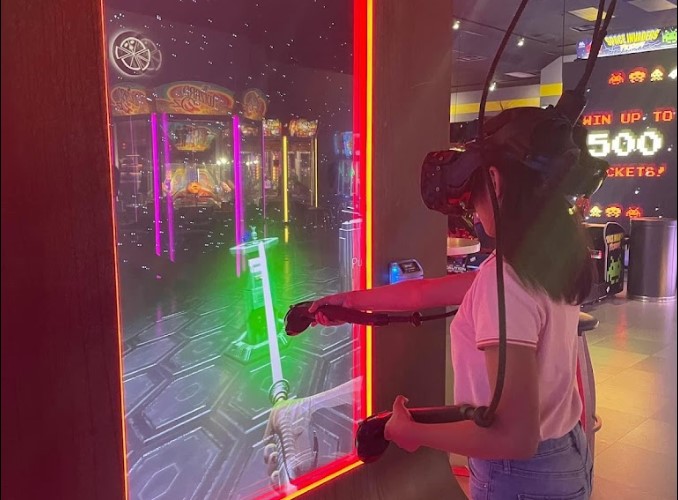
There is also a large recreation area with snacks and drinks to chill after the game. There’s also bowling, pool, VR, mini-golf, a story room, and a ropes course – all available at one single place!
 Indoors
Laser tag is a fast‑paced, team‑oriented game that uses infrared (IR) technology to simulate combat without any physical projectiles. Players wear a lightweight vest or harness that houses an IR sensor and a handheld “phaser” that emits a modulated infrared beam. When a phaser’s beam strikes a sensor, a micro‑processor records the hit, deducts points or health, and often triggers a sound or visual cue on the vest. The equipment is battery‑powered, wireless, and designed for durability, allowing participants to run, duck, and hide in a variety of environments.
Unlike traditional paintball or air‑soft, laser tag produces no mess, eliminates the risk of bruises, and can be set up in almost any indoor or outdoor space. Modern systems also integrate Bluetooth or Wi‑Fi connectivity, enabling real‑time scoring displays, customizable game rules, and even augmented‑reality overlays that enrich the experience.
A major appeal of laser tag lies in its flexibility. Game designers can craft countless scenarios, each with its own objectives, narrative, and level of complexity. Some of the most popular formats include:
| Scenario | Core Objective | Typical Setting |
|---|---|---|
| Team Deathmatch | Eliminate as many opponents as possible within a time limit. | Open arena with multiple levels and cover. |
| Capture the Flag | Retrieve the enemy’s flag and bring it back to your base while defending your own. | Symmetrical maps with distinct zones. |
| Zombie Survival | One team starts as “infected” and tries to tag survivors; survivors must avoid being turned. | Darkened, maze‑like layouts with ambient lighting. |
| Mission‑Based Ops | Complete specific tasks such as “defuse the bomb” or “secure the data core.” | Themed environments (space station, jungle ruin, urban warehouse). |
| Free‑For‑All | Every player for themselves; highest score wins. | Smaller arenas that encourage constant movement. |
| Scenario‑Driven Storylines | Players follow a scripted plot, receiving audio cues or mission briefings as the game unfolds. | Custom‑built sets with props, sound effects, and lighting. |
The scenario can be altered on the fly by adjusting variables such as hit points, respawn times, or the number of lives. Some venues also incorporate laser‑tagged obstacles that act as “cover” or “hazards,” adding strategic depth. The ability to blend competitive sport with immersive storytelling keeps the activity fresh for repeat players.
Beyond entertainment, laser tag delivers measurable physical, cognitive, and social advantages.
Cardiovascular Exercise – A typical 15‑minute bout can raise heart rate to 130–150 beats per minute, comparable to a brisk jog. The constant sprint‑duck‑dodge cycle strengthens leg muscles and improves overall stamina.
Hand‑Eye Coordination – Players must quickly align the phaser with moving targets, sharpening reflexes and fine motor control. Studies show that repeated IR‑based games enhance reaction time by up to 12 % after several sessions.
Strategic Thinking – Scenario‑based play forces participants to evaluate terrain, allocate resources, and anticipate opponents’ moves. This promotes problem‑solving skills and spatial awareness.
Teamwork and Communication – Most formats require coordinated tactics, encouraging clear verbal cues and role assignment. In corporate settings, teams often report higher levels of trust and collaboration after a single laser‑tag session.
Stress Relief – The immersive, high‑energy environment triggers endorphin release, providing a healthy outlet for pent‑up energy. Because the activity is non‑violent and non‑painful, it is suitable for a wide age range.
Inclusive Accessibility – The lack of heavy equipment, minimal protective gear, and low impact on joints make laser tag ideal for participants with varying fitness levels, including seniors and individuals with mild physical limitations.
Collectively, these benefits position laser tag as a valuable tool for schools, fitness programs, and corporate wellness initiatives.
Research into laser‑tag‑related technology and its effects on participants has been gaining traction in recent years. Physiologists from several universities have measured the metabolic demand of a standard 30‑minute match, confirming that the activity meets moderate‑intensity exercise guidelines set by the World Health Organization. Their findings indicate that regular laser‑tag participation can improve VO₂ max and aid in weight management when combined with a balanced diet.
Cognitive psychologists have explored the impact of the fast decision‑making required in laser tag. In controlled experiments, subjects who engaged in weekly laser‑tag sessions demonstrated improved working memory and faster visual processing speeds compared to a control group engaged in passive video‑gaming. The researchers attribute these gains to the blend of physical motion and real‑time strategic planning.
From an industry standpoint, experts emphasize the rapid evolution of laser‑tag hardware. The integration of lidar‑based sensors, haptic feedback, and AI‑driven opponent bots is expanding the possibilities for solo play and hybrid AR experiences. Moreover, data analytics platforms now allow venues to track player performance over time, providing personalized coaching insights and fostering a competitive league ecosystem.
Safety is another focal point. Occupational health specialists have evaluated the infrared emissions from modern phasers and confirmed that they fall well below the threshold for retinal damage. Unlike paintball, laser tag generates no airborne particulates, making it a cleaner alternative for indoor venues with strict air‑quality standards.
Overall, the consensus among scientists and industry leaders is that laser tag represents a low‑risk, high‑reward activity that bridges the gap between recreational gaming and genuine physical exercise.
Laser tag’s appeal spans generations, but its popularity among children is especially notable. Kids aged 6 to 14 constitute the largest demographic at most family‑oriented arenas. The reasons are multifold:
Parents also appreciate the constructive outlet laser tag provides after school, helping to burn excess energy in a controlled environment. Many schools incorporate laser‑tag sessions into physical‑education curricula, recognizing its capacity to engage otherwise reluctant participants.
Because laser tag can be tailored to any celebration, it has become a go‑to option for a broad spectrum of events.
For children’s birthdays, venues often offer customizable packages that include themed décor, personalized scoreboards, and a “battle‑royale” finale where the top scorer receives a trophy. Food service can be coordinated on‑site, and party hosts can add interactive elements like scavenger hunts that lead to hidden power‑ups.
High‑school or college graduates looking for a memorable send‑off can book late‑night sessions that blend competitive play with a social lounge area for post‑game refreshments. Some arenas provide “memory‑lane” lighting that projects photos of the graduating class onto the walls, creating a nostalgic backdrop while friends compete.
Companies increasingly turn to laser tag for team‑building retreats. Game modes such as “Mission Critical” simulate problem‑solving under pressure, while “Leadership Capture” assigns rotating captains to encourage delegation and decision‑making. The rapid de‑brief that follows each round allows facilitators to discuss communication patterns, conflict resolution, and leadership styles in a low‑stakes environment.
In each case, the core advantage is the blend of physical activity, competition, and collaborative storytelling, which transforms a simple gathering into an immersive experience that participants remember long after the event ends.
Choosing the right venue depends on the desired atmosphere, group size, and budget. Both indoor and outdoor facilities have distinct characteristics.
When selecting a venue, organizers should assess safety protocols, equipment maintenance, and staff expertise. Reputable facilities keep their gear calibrated, enforce age‑appropriate rules, and provide trained referees to oversee gameplay. Additionally, participants with visual impairments or other special needs should verify that the venue offers accommodations such as high‑contrast sensors or adjustable game speeds.
Laser tag has evolved from a niche hobby into a versatile, widely accessible activity that blends physical exertion, strategic thinking, and immersive storytelling. Its adaptable scenarios, proven health benefits, and endorsement by scientific and industry experts make it a compelling option for people of all ages. Whether children are celebrating a birthday, graduates are marking a milestone, or corporations are fostering teamwork, laser tag delivers a memorable experience that transcends the traditional boundaries of sport and game. With a growing network of indoor and outdoor venues equipped with cutting‑edge technology, the future of laser tag points toward even richer interactions—potentially integrating augmented reality, AI opponents, and advanced analytics—to keep players engaged for years to come.


 6010 Marsha Sharp Fwy W, Lubbock, TX 79407, United States