El Monte
 Log in
Log in
Log in

Urban Air Trampoline and Adventure Indoor Park is located in Midland, TX.
The Urban Air Trampoline and Adventure Park is located in Midland, TX. It offers a wide array of activities for all ages, including trampolines, ropes course, climbing walls, and a Warrior Course. In addition, there are attractions like a virtual reality attraction and a laser tag arena. Perfect for birthday parties, group events and fun with family and friends. The park prioritizes safety and cleanliness, with specialized COVID-19 protocols in place.
 Indoors
Main Event Indoor Laser Tag arena is located in Lubbock, TX.
Main Event is a huge entertainment hub where you can spend your weekend or throw a birthday party. These laser-tag battles take place in a multi-story arena with fantasy-like decorations, neon lights, and laborious obstacles. Climb up the towers and rain fire on unsuspecting enemies.
There is also a large recreation area with snacks and drinks to chill after the game. There’s also bowling, pool, VR, mini-golf, a story room, and a ropes course – all available at one single place!
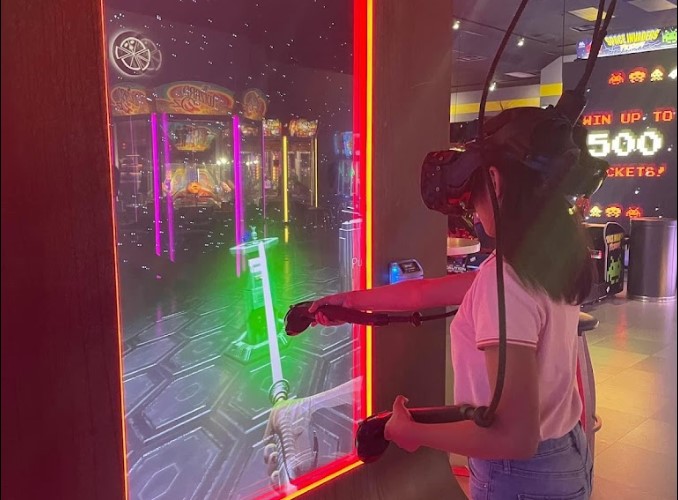
IndoorsFree‑roam virtual‑reality (VR) arenas are dedicated physical spaces in which participants can move unhindered while wearing head‑mounted displays (HMDs). Unlike seated or tabletop setups, the arena is equipped with a network of motion‑tracking sensors, often a combination of infrared cameras, lidar scanners, or inside‑out tracking built into the headset. These sensors map the user’s position and orientation in real time, allowing the virtual environment to react instantly to every step, turn, and gesture.
The result is an immersive playground where the boundary between the digital and the physical blurs. Users can duck under virtual obstacles, sprint across simulated landscapes, or cooperate with teammates in a three‑dimensional game world that is anchored to a safe, obstacle‑free real‑world floor. The arena itself is typically padded, with soft walls, safety nets, or clear markings that keep participants within the tracked volume and protect them from collisions.
Because the hardware can support multiple users simultaneously, many free‑roam venues operate as multi‑player hubs. Each participant’s movements are independently captured and merged into a shared virtual space, enabling collaborative gameplay, competitive sport, or narrative experiences that feel as tangible as a live‑action theatre performance.
The flexibility of an open‑space tracking system makes it possible to design a broad spectrum of scenarios.
Adventure and Exploration – Users can wander through hyper‑realistic recreations of historic sites, alien planets, or fantastical kingdoms. The sense of scale is amplified when a user can physically walk a kilometer in the virtual world without ever leaving the arena.
Action and Combat – Laser‑tag‑style shooters, sword‑fighting duels, and futuristic mech battles are popular because the physicality of dodging, ducking, and lunging adds a visceral layer of excitement that conventional screen‑based games cannot replicate.
Puzzle and Collaboration – Teams can solve spatial riddles that require moving objects, stacking virtual blocks, or coordinating movements in sync with one another. The shared physical space encourages communication and teamwork.
Training Simulations – Industries such as aviation, emergency response, and manufacturing use free‑roam setups to rehearse procedures in a risk‑free environment. Trainees can practice navigating confined spaces, handling equipment, or reacting to dynamic hazards while their actions are recorded for later analysis.
Creative Workshops – Artists and designers can sculpt three‑dimensional models with their hands, paint on virtual canvases that surround them, or choreograph performances that blend motion capture with visual effects.
Because the arena can be reconfigured quickly—by adding modular barriers, changing lighting, or swapping software modules—operators can switch from a family‑friendly maze to a high‑intensity esports competition in a matter of minutes.
The audience for free‑roam VR is remarkably diverse.
Casual Gamers – People who enjoy arcade‑style entertainment often visit arenas for short, high‑energy sessions. The novelty of moving through a virtual world without being tethered to a chair makes the experience a popular weekend outing.
Enthusiast Communities – Dedicated VR hobbyists seek out arenas to test the limits of new hardware, participate in organized leagues, and share tips on movement optimization. For them, the arena is a social hub where emerging trends are tried and refined.
Educational Groups – Schools, museums, and science centers incorporate free‑roam experiences into curricula to illustrate concepts in physics, biology, or history. The immersive format helps students retain information by placing them inside the subject matter.
Corporate Teams – Companies use the arena for team‑building exercises, leadership training, and product demonstrations. The physical collaboration required in many scenarios translates into improved communication and problem‑solving skills in the workplace.
Families and Children – Parent‑child outings and birthday celebrations are increasingly hosted in VR arenas, where age‑appropriate games provide both entertainment and gentle physical activity.
Researchers and Developers – Academic labs and commercial studios rent arena time to prototype new interactions, study human motion, or collect data on user behavior in unrestricted virtual spaces.
The inclusive design of most arenas—featuring adjustable headset straps, wheelchair‑friendly pathways, and a range of difficulty settings—ensures that participants of varying ages, abilities, and experience levels can take part.
Children are among the fastest‑growing segments of the free‑roam market, and arena operators have responded with kid‑centric content and safety protocols.
Game designers craft experiences that emphasize bright colors, whimsical narratives, and gentle challenges. For example, a “Jungle Safari” adventure invites youngsters to explore a lush rainforest, collect virtual animal tokens, and solve simple riddles that reinforce basic math or spelling skills. The physical activity inherent in walking and reaching helps counteract sedentary screen time, offering a playful form of exercise.
Safety measures are particularly stringent for younger users. Headsets are fitted with soft, adjustable padding, and the tracking volume is reduced to a smaller, clearly marked area to minimize the risk of collision. Staff members supervise every session, performing quick equipment checks and monitoring participants’ comfort levels. Additionally, many arenas provide “soft‑start” tutorials that teach children how to move safely while wearing the headset, ensuring that the novelty of the technology does not compromise well‑being.
The educational potential of VR for kids extends beyond entertainment. Immersive field trips to ancient ruins, marine ecosystems, or space stations give students a first‑hand perspective that textbooks cannot match. By blending storytelling with interactive exploration, free‑roam VR can ignite curiosity and foster a deeper understanding of complex subjects.
The adaptability of free‑roam arenas makes them ideal venues for a wide range of celebrations and corporate gatherings.
Parents increasingly choose VR arenas as an alternative to traditional party locations. Packages typically include a private time slot, a selection of themed games, and a party host who guides the group through the experience. Children can compete in timed obstacle courses, team up for cooperative quests, or engage in friendly duels, all while enjoying the thrill of movement in a safe, supervised environment. Customizable avatars let each guest express their personality, and post‑session photo booths capture memorable moments against virtual backdrops.
Universities and schools have experimented with using free‑roam VR to mark graduation milestones. A common approach is to create a virtual campus where graduates walk through iconic landmarks, reliving favorite memories before receiving a digital diploma in a spectacular, fireworks‑filled finale. The immersive format adds an emotional layer to the ceremony, allowing participants who are unable to attend in person—such as distant family members—to experience the event through a shared virtual space.
Corporate clients often book arenas for product launches, client entertainment, or internal celebrations. The venue can be branded with custom visuals, allowing companies to showcase logos, product prototypes, or marketing messages within the virtual environment. Team‑building modules are designed to strengthen collaboration: participants might work together to disarm a virtual bomb, navigate a maze while sharing limited information, or compete in a virtual sport that requires strategic coordination. The physical exertion and shared laughter generated during these activities have been shown to improve morale and strengthen interdepartmental bonds.
Because the arena can be reconfigured quickly, event planners can schedule multiple experiences in a single day—morning workshops, afternoon celebrations, and evening gala events—maximizing the utility of the space and providing a seamless flow of entertainment.
Researchers across several disciplines recognize free‑roam VR as a powerful tool for both scientific inquiry and commercial innovation.
In the field of human‑computer interaction, scholars point out that unrestricted movement offers a more natural interface compared with seated controllers. By analyzing gait, reach, and spatial awareness within a controlled yet immersive environment, scientists can gather high‑resolution data on motor learning, perception, and decision‑making. This information is valuable for designing assistive technologies, refining ergonomics, and improving rehabilitation protocols for patients recovering from stroke or traumatic injuries.
Neuroscientists appreciate that free‑roam setups stimulate multiple sensory modalities simultaneously—visual, vestibular, proprioceptive—thereby providing a richer stimulus for studying brain activity. Functional imaging studies performed alongside arena sessions have revealed distinct activation patterns when participants navigate real‑world‑sized virtual spaces, offering insights into spatial memory formation and navigation strategies.
From an industry standpoint, developers stress that free‑roam environments push the boundaries of content creation. The need for seamless, low‑latency tracking drives advances in wireless streaming, edge computing, and AI‑based occlusion handling. Moreover, the demand for compelling multi‑player experiences accelerates the evolution of networking protocols that can support dozens of users without compromising visual fidelity.
Economists and market analysts note that the rise of free‑roam VR arenas contributes to a broader ecosystem of location‑based entertainment. The model generates recurring revenue through session fees, event bookings, and corporate contracts, while also stimulating ancillary markets such as hardware manufacturing, software licensing, and training services.
Overall, the consensus among experts is that free‑roam VR is more than a novelty; it is an emerging platform that bridges entertainment, education, research, and business. Its capacity to blend physical movement with digital immersion positions it as a pivotal technology for the next decade of human‑centered innovation.
Free‑roam VR arenas represent a convergence of cutting‑edge tracking technology, imaginative content design, and versatile space utilization. By liberating users from the constraints of seated gameplay, these venues unlock new possibilities for adventure, education, and social interaction. The range of scenarios—from high‑octane combat to collaborative puzzles—caters to a broad audience that includes casual gamers, families, corporate teams, and scientific researchers.
For children, the combination of safe physical activity and immersive storytelling offers a compelling alternative to passive screen time, while for adults the same environments provide memorable venues for celebrations, milestones, and professional development. The endorsement of scientists and industry specialists underscores the platform’s value as a research tool and a catalyst for technological progress.
As hardware becomes more lightweight, tracking more precise, and content pipelines more efficient, free‑roam VR arenas are poised to become a staple of modern entertainment and learning. The next generation of experiences will likely blur the line even further between the virtual and the physical, inviting anyone who steps into an arena to explore worlds that are limited only by imagination.


 4706 N Midkiff Rd Suite 1, Midland, TX 79705, United States