
 El Monte
 Log in
Log in
Log in

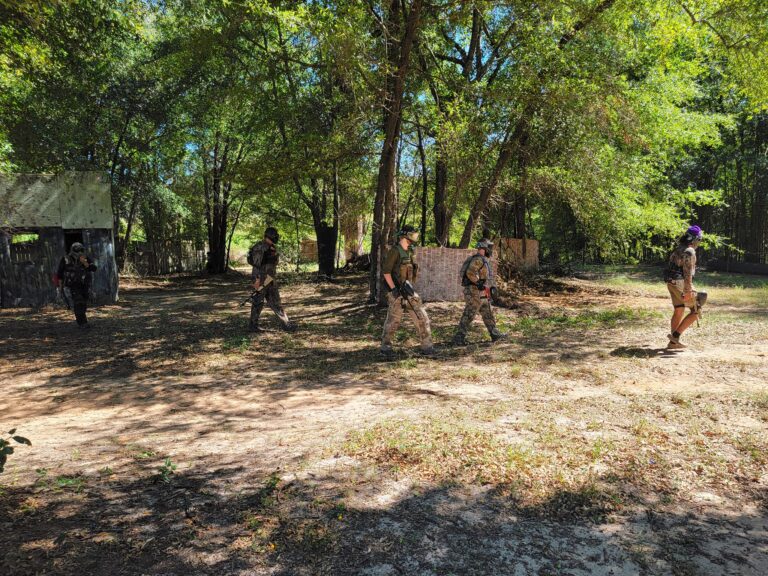
Big Indian Paintball & Airsoft is located in Perry, Georgia, just off Valley Drive, set on an expansive 82-acre property that blends open fields, dense woodland, and a full-scale abandoned town.
The club offers paintball, airsoft, gelly ball, junior league (50-caliber), and NERF play across a 12-acre urban town field, wooded trails, a two-story castle, and two regulation PSP X-ball fields with lights for night games. Walk-on players are welcome without a reservation, and rental packages include markers, masks, and gear. The staff designs mission-based scenarios for each field, and the property includes five large bases and multiple smaller outposts for tactical variety.
Beyond the games, the facility features a covered observation deck, a pavilion with grills and picnic tables, bleachers for tournament viewing, clean restrooms with hot water, and camping space during events. The on-site pro shop sells markers, masks, tanks, and accessories, while the office offers drinks, snacks, and merchandise. The club is a popular choice for birthday parties, corporate team-building, family reunions, and casual group outings.
 Outdoors
Paintball is an exciting and thrilling game that is quickly gaining popularity in Macon, Georgia. Paintball allows you to test your skills against other competitors in a fast-paced and competitive environment. With various locations in Macon, there are plenty of places to choose from to have a great time playing paintball.

Paintball is a fast‑paced, team‑oriented sport in which participants—known as players or “markers”—use air‑propelled pistols to fire gelatin capsules filled with non‑toxic, water‑based paint. When a capsule bursts on contact, it leaves a brightly colored splatter that instantly marks the target as “hit.” The basic premise is simple: avoid being hit while attempting to eliminate opponents or achieve a specific objective. What makes paintball compelling is the combination of tactical thinking, physical agility, and the adrenaline rush of sudden, high‑intensity action.
Modern paintball markers have evolved from rudimentary pump‑action devices into sophisticated, semi‑automatic or fully automatic machines that can fire up to 15 rounds per second. Despite this technological leap, the core experience remains rooted in the same principles that defined the sport’s humble beginnings in the early 1980s: quick reflexes, strategic positioning, and a playful sense of competition.
While individual fields may adapt rules to fit their terrain or the particular game mode, a set of universally recognized guidelines governs most organized paintball matches.
Safety Gear Is Mandatory – Every player must wear a full‑face mask that meets industry safety standards, along with protective clothing such as padded vests, gloves, and sturdy footwear. The mask shields the eyes and face from the high‑velocity paint capsules, which can cause serious injury if struck directly.
Barrel Blocking – Before entering a field, players must block the barrel of their marker with a proper barrel plug or tape. This practice prevents accidental discharge while players are moving between the parking area and the playing arena.
Elimination Protocol – A player is considered eliminated when a solid paint hit is visible on any part of the body or equipment. Some fields also accept “soft” hits, where the paint lands on clothing but does not penetrate, while others require a clear mark on exposed skin. Once eliminated, the player must raise a hand, step out of the active area, and remain there until the round ends.
No Physical Contact – Paintball is a non‑contact sport. Pushing, shoving, tackling, or any form of physical aggression is strictly prohibited and can lead to immediate disqualification.
The “No‑Shoot” Zones – Certain areas, such as spectator zones, the referee’s table, and designated safe zones, are off‑limits for shooting. Violating these zones can result in penalties ranging from warnings to loss of points.
Respect for the Field – Players must avoid damaging property, including trees, fences, and obstacles. The use of “fast‑draw” or “quick‑draw” weapons that can fire multiple paintballs in an uncontrolled burst is often restricted in indoor or wooden‑structure venues.
Time Limits – Most games are timed, typically ranging from 5 to 15 minutes per round. The clock stops when a winning condition is met, such as capturing a flag, eliminating the opposing team, or completing an objective.
These rules are enforced by field officials who monitor gameplay, mediate disputes, and ensure that safety standards are upheld throughout each match.
The versatility of paintball lies in its ability to accommodate a wide array of game scenarios, each designed to test different aspects of teamwork, strategy, and individual skill. Below are some of the most popular formats.
Two opposing teams each protect a flag placed at their base while attempting to infiltrate the opponent’s territory to capture the enemy flag and bring it back to their own side. The scenario emphasizes stealth, coordinated assaults, and rapid extraction.
The simplest and most common format, elimination pits two teams against each other until one side has no remaining active players. This mode highlights pure shooting accuracy, defensive positioning, and effective use of cover.
Inspired by military simulations, these scenarios assign specific tasks such as defusing a “bomb,” rescuing a “hostage,” or securing a series of checkpoints. Players must balance aggression with caution, as focusing solely on offense can leave objectives vulnerable.
Complex, narrative‑driven games can last several hours and involve dozens of objectives, role‑playing elements, and evolving storylines. Players may be assigned unique roles—sniper, medic, demolitions expert—each with distinct responsibilities and equipment.
Played on a compact, inflatable field with symmetrical obstacles, speedball emphasizes fast reflexes and rapid decision‑making. The high‑visibility environment and quick rounds make it ideal for tournaments and televised events.
Each scenario can be tweaked with variable win conditions, limited ammunition, or specialized equipment to keep the gameplay fresh and challenging for seasoned veterans and newcomers alike.
Beyond the obvious entertainment factor, paintball offers a suite of tangible benefits that extend into physical health, mental acuity, and social development.
Running between bunkers, ducking under obstacles, and maneuvering through uneven terrain provides a high‑intensity cardiovascular workout. Players frequently experience improved stamina, agility, and core strength, comparable to the benefits of interval training.
Success in paintball hinges on planning, quick assessment of changing situations, and effective communication. Players learn to read terrain, anticipate opponent movements, and adjust tactics on the fly—skills that translate well to business strategy, project management, and everyday problem solving.
Cooperative objectives require clear, concise communication and trust among teammates. Regular participation in paintball builds camaraderie, strengthens leadership abilities, and reinforces the importance of each member’s contribution to a shared goal.
The exhilarating rush of a fast‑paced match releases endorphins, offering an outlet for stress and pent‑up energy. The controlled, competitive environment also provides a healthy avenue for channeling aggression, making it a popular choice for corporate team‑building events.
Aiming and firing a marker while moving at speed fine‑tunes hand‑eye coordination and reaction time. These improvements can benefit athletes, gamers, and anyone whose daily activities rely on precise motor skills.
Collectively, these advantages demonstrate that paintball functions not only as a recreational pastime but also as a multifaceted development tool.
The demographic landscape of paintball is remarkably diverse, reflecting its broad appeal across age groups, professions, and cultural backgrounds.
The sport’s inclusive nature—thanks to adjustable difficulty levels, varied game formats, and adaptive equipment—ensures that individuals of nearly any skill set can find a niche within the paintball world.
The intersection of paintball with scientific research and industry analysis has produced a nuanced perspective on the sport’s impact and potential.
Biomedical studies have examined the incidence of injuries in paintball, concluding that when field safety protocols are strictly observed, the overall injury rate is comparable to that of other high‑energy recreational activities such as skateboarding or lacrosse. Researchers highlight the importance of proper mask fit, barrel blocking, and regulated marker velocity—typically limited to 300 feet per second—to mitigate risks.
Psychologists have investigated the cognitive effects of competitive paintball, noting improvements in situational awareness, stress management, and rapid decision‑making. A recurring finding is that participants often experience heightened self‑efficacy after completing challenging scenarios, which can translate into improved performance in work and academic settings.
Industry analysts observe that the global paintball market has sustained steady growth, driven by expanding indoor facilities in urban areas and the rising popularity of e‑sports adaptations that blend virtual reality with physical gameplay. The emergence of eco‑friendly paintball ammunition—biodegradable shells and non‑toxic paint formulations—has also opened new avenues for environmentally conscious consumers.
Engineers within the paintball equipment sector are experimenting with lighter composite marker bodies, programmable firing modes, and integrated telemetry that tracks shot count, velocity, and player movement. These advancements aim to enhance performance while maintaining safety standards, positioning paintball as a testing ground for broader advancements in pneumatic and sensor technologies.
Overall, the consensus among experts is that paintball, when managed responsibly, offers considerable benefits without imposing undue health hazards, and it continues to evolve as both a sport and a platform for technological experimentation.
Choosing the right venue is pivotal to shaping a memorable paintball experience. Both outdoor and indoor fields cater to distinct preferences, terrain types, and logistical considerations.
Outdoor venues capitalize on natural landscapes—forests, fields, abandoned structures, and rugged hills—to create immersive environments. Players can expect sprawling courses that incorporate varied elevation, dense foliage, and long sightlines, fostering a blend of stealth and long‑range tactics. Many outdoor locations offer themed scenarios such as “military invasion” or “zombie apocalypse,” leveraging the expansive space to build elaborate set pieces.
Advantages of outdoor play include:
Potential drawbacks involve dependence on weather, travel distance for urban dwellers, and the need for comprehensive safety measures due to uneven ground.
Indoor paintball arenas—often referred to as “speedball” fields—feature inflatable or modular structures arranged in symmetrical patterns. These arenas are climate‑controlled, ensuring consistent playing conditions year‑round. The compact layout encourages rapid engagements, quick reflexes, and high scoring.
Key benefits of indoor play are:
Limitations include reduced tactical depth due to the uniform environment, and a higher emphasis on reflexes over strategic navigation.
Some operators blend the two concepts, offering “urban” indoor fields that mimic city streets, complete with barricades, staircases, and simulated building interiors. Others provide “semi‑outdoor” spaces—large warehouses with natural lighting and partial exposure to the elements—offering a middle ground between traditional outdoor immersion and indoor convenience.
When selecting a venue, prospective players should consider factors such as desired game style, group size, budget, and proximity. Many fields provide rental equipment, coaching, and scenario planning services, allowing newcomers to dive in with minimal preparation.
Paintball stands at the crossroads of sport, strategy, and social interaction. Its simple premise—shooting colored capsules at opponents—belies the depth of skill, teamwork, and mental agility required to excel. From the fundamental safety regulations that keep participants protected, to the myriad game scenarios that cater to every taste, the sport offers an adaptable framework that can be tailored for recreation, professional training, or competitive tournaments.
Beyond the thrill of the match, paintball delivers concrete health benefits, fosters strategic thinking, and builds strong interpersonal bonds. Its appeal cuts across age groups and professions, attracting everyone from teenagers seeking an adrenaline rush to seasoned veterans sharpening tactical acumen. Scientific studies affirm its safety when guidelines are followed, while industry analysts note a vibrant, growing market fueled by innovation and environmental consciousness.
Whether players choose the expansive, unpredictable wilderness of an outdoor field or the controlled, fast‑paced arena of an indoor speedball venue, paintball provides an engaging outlet for physical activity, mental challenge, and community building. As technology continues to evolve and new formats emerge, paintball is poised to remain a dynamic and accessible sport for years to come.


 301 Valley Dr, Perry, GA 31069, United States