El Monte
 Log in
Log in
Log in

Charleston Fun Park sits in the Mount Pleasant area of South Carolina, along busy Highway 17, a short drive from downtown Charleston. It’s a family entertainment venue that blends outdoor attractions with a large indoor arcade and gaming space, making it a year-round destination for locals and visitors alike.
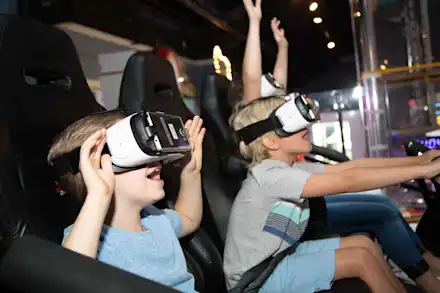
The park offers high-speed go-karts on a professional track, two themed 18-hole mini-golf courses under Spanish moss, bumper cars, a motion theater, mini-bowling, and a new gem and fossil mining sluice. Inside, an arcade with more than 50 games and the unique OMNI VR Battle Arena—a 360-degree virtual reality experience with full-motion treadmills—provide tactical, high-energy gaming for groups of all sizes.
Birthday packages range from a simple reserved table with pizza and arcade play to a top-tier option with 1.5 hours of unlimited go-karts, mini-golf, and arcade games, plus add-ons like NERF shooting, piñata fun, and slime-making. The event team handles corporate events, school groups, holiday parties, and family reunions with catering from pizza to BBQ. An on-site snack bar, an outdoor patio with beer and wine for adults, and seasonal community events round out the experience.
 Indoors
 Outdoors
Stars and Strikes Family Entertainment Center sits in the Oakbrook area of Summerville, South Carolina, on Ladson Road just off the highways that connect the greater Charleston region.
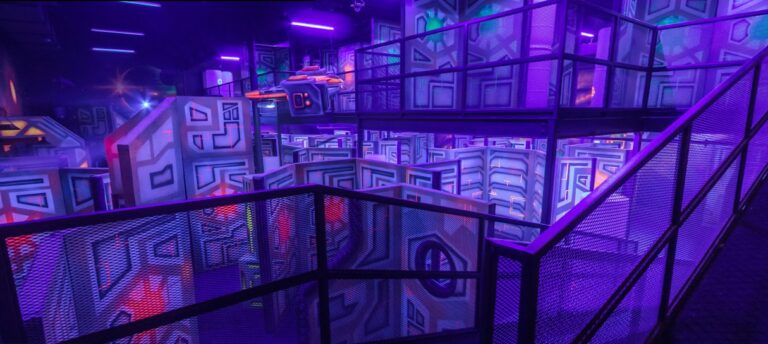
The 55,000-square-foot complex centers on a two-story laser tag arena packed with ramps, glowing hideouts, fog, and music, alongside 24 bowling lanes (eight VIP lanes in the Main St Lounge), a 7,300-square-foot arcade with a prize store, bumper cars, virtual reality, and an on-site Escapology escape room. Kids’ birthday packages come with dedicated party hosts, while adult parties, corporate events, and team-building outings are all welcome in private rooms, including an upscale corporate event room seating 150-plus with a full private bar.
The 7/10 Grille serves chef-inspired cuisine from burgers to seafood, with a full-service bar and big-screen TVs for sports viewing. Seating is spread throughout so parents can watch their kids while dining. Regular specials—happy hour bowling, discounted game days, and food-and-arcade combos—make it easy to enjoy everything without overspending, and the attentive staff keeps the space clean, welcoming, and well-maintained.
IndoorsThe landscape of entertainment has undergone a radical transformation over the last decade, moving from passive observation to active participation. While traditional video games allowed players to control characters on a screen, and early virtual reality (VR) offered a glimpse into digital worlds from the safety of a swivel chair, a new frontier has emerged. Free-roam VR arenas represent the pinnacle of this evolution, blending physical movement with digital landscapes to create an experience that challenges the boundaries of reality. These facilities offer a level of presence and agency that was once the stuff of science fiction, turning players into the protagonists of their own high-stakes adventures.
A free-roam VR arena is a dedicated physical space, often ranging from 1,000 to 5,000 square feet, where participants can move naturally without being tethered to a computer by wires or cables. Unlike traditional “stationary” VR, where the user stands in a small square or sits down, free-roam VR utilizes advanced tracking technology to map a player’s real-world movements directly into the virtual environment. If a player takes five steps forward in the physical arena, their digital avatar takes five steps forward in the virtual world.
The technology behind these arenas relies on sophisticated motion-capture systems or inside-out tracking cameras. Players are typically equipped with high-performance VR headsets and, in some setups, haptic vests that provide tactile feedback, allowing them to “feel” the environment. The absence of cables—traditionally managed via wireless streaming or backpack PCs—removes the “tripping hazard” and allows for a 360-degree range of motion. This freedom is the fundamental component of “immersion,” as it eliminates the cognitive dissonance that occurs when a person’s visual field moves while their body remains still. In a free-roam arena, the physical and digital boundaries align, creating a seamless sense of presence.
The versatility of free-roam VR is best demonstrated through the diversity of “scenarios” or game modules available to players. These are not merely games; they are curated digital realities designed to maximize the use of the physical space. One of the most popular genres is the cooperative tactical shooter. In these scenarios, teams of players must navigate a post-apocalyptic city or a derelict space station, working together to fend off waves of digital adversaries. The free-roam aspect adds a layer of physical strategy, as players must physically duck behind virtual cover, peek around corners, and move in formation.
Beyond combat, free-roam VR has mastered the art of the “virtual escape room.” In these scenarios, the focus shifts from reflexes to logic and environmental interaction. Players might find themselves inside an ancient Egyptian tomb or a high-tech laboratory, where they must move through the room to pick up digital artifacts, solve spatial puzzles, and manipulate the environment to progress. There are also “exploration” scenarios, which are often less intense and more focused on the awe of the digital surroundings—such as walking through a fantasy forest or exploring the depths of the ocean. The common thread across all these scenarios is the “one-to-one” movement ratio, which ensures that every physical action has a direct, logical consequence in the virtual space.
While one might assume that free-roam VR is reserved for tech-savvy young adults, the demographic for these arenas is surprisingly broad. The intuitive nature of “walking to move” makes the technology accessible to people who have never touched a traditional game controller. One of the fastest-growing segments in the industry is the youth market. Many facilities offer specialized VR experiences for kids, typically aged eight and up, designed with age-appropriate themes and simplified mechanics.
For children, free-roam VR offers a unique blend of physical activity and cognitive engagement. Unlike traditional gaming, which is often sedentary, a session in a VR arena involves constant movement, stretching, and walking. This makes it an attractive option for parents looking to combine technology with physical exercise. Furthermore, many scenarios for children focus on collaborative problem-solving and teamwork, helping to develop social skills in a controlled, safe environment. Safety is a paramount concern in these arenas; “chaperone systems” are built into the software to display virtual walls if a player gets too close to the physical boundaries of the room, ensuring that children (and adults) can play without the risk of colliding with the actual walls of the facility.
The social architecture of free-roam VR makes it an ideal venue for group events. Unlike traditional movie theaters or bowling alleys, VR arenas provide a shared, high-intensity experience that serves as a powerful “social glue.” For birthday parties, especially for teenagers and pre-teens, the novelty of the technology provides a “wow factor” that is difficult to replicate with other forms of entertainment. It allows the group to enter a shared fantasy world where they are the stars of the show, creating lasting memories.
Graduation parties also benefit from the high-energy nature of free-roam VR. As students look to celebrate a major milestone, the adrenaline-pumping nature of a 30-minute VR mission provides a perfect outlet for celebration. It allows graduates to bond one last time over a shared challenge, whether they are defending a base or solving an intricate puzzle.
Perhaps the most significant professional application is the corporate party or team-building event. Organizations are increasingly moving away from traditional “ice-breakers” in favor of immersive experiences. In a free-roam VR scenario, departmental hierarchies often disappear as team members are forced to communicate clearly and trust one another to succeed in the game. It reveals a lot about leadership styles, communication under pressure, and collaborative efficiency. After the session, teams often engage in a “debrief,” discussing their performance in the virtual world, which can lead to genuine insights into their real-world professional dynamics.
From a scientific and technological perspective, free-roam VR is viewed as more than just entertainment; it is considered a significant milestone in “spatial computing.” Neuroscientists have taken a particular interest in how the brain processes these environments. Research into “proprioception”—the body’s ability to perceive its position in space—suggests that free-roam VR is significantly better at tricking the brain into a state of “presence” than seated VR. When the vestibular system (balance) and the visual system are in alignment, the likelihood of motion sickness is drastically reduced, which has long been the primary hurdle for mainstream VR adoption.
Industry experts also see free-roam arenas as a testing ground for broader applications. Engineers and urban planners are studying how people interact with virtual architecture in these spaces to better design physical cities. In the medical field, the principles of free-roam VR are being applied to physical therapy and rehabilitation, allowing patients to practice movement in controlled, engaging digital environments. Experts suggest that as hardware becomes lighter and haptic technology more refined, the line between these “arenas” and everyday life will continue to blur, eventually leading to a world where “mixed reality” is as common as the smartphone. For now, however, the arena remains the gold standard for immersion, providing a glimpse into a future where the only limit to where we can go is the size of the room and the reach of our imagination.


 3255 N Hwy 17, Mt Pleasant, SC 29466, United States