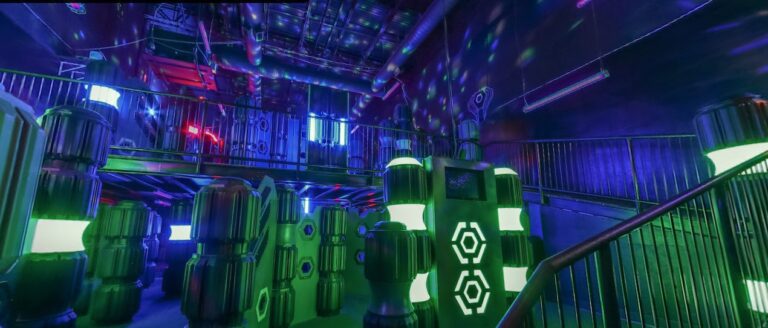
El Monte
 Log in
Log in
Log in

Another World VR is located in a convenient commercial area of Lawrenceville, Georgia, just off West Pike Street.
This free-roam virtual reality arena offers over two dozen games spanning tactical shooters, horror adventures, sci-fi expeditions, escape rooms, and family-friendly competitions. Groups of up to 20 players can move freely through detailed virtual environments — from haunted mansions and alien space stations to ancient pyramids and zombie-infested bunkers. The arena features 360-degree movement, pro-grade VR gear, and a split-zone mode that allows two different groups to play simultaneously. Knowledgeable staff handle all setup and guidance, making the experience accessible even for first-time VR users.
Beyond gaming, the venue offers a comfortable lounge area where guests can bring their own food and drinks (alcohol excluded). PlayStation rental and monthly subscription plans are also available. The private arena setup makes it a natural choice for birthday parties, corporate team-building events, date nights, and family outings. The staff assists with game selection, safety briefings, and even captures photos and videos of your group in action.
 Indoors
Stars and Strikes Family Entertainment Center is located in Columbus, Georgia, off Veterans Parkway, not far from the National Infantry Museum and the Chattahoochee River area.
This 55,000-square-foot entertainment hub features 24 bowling lanes (including 8 VIP lanes with SPARK augmented reality), a two-story laser tag arena, a 7,000-square-foot arcade with a prize redemption center, bumper cars, axe throwing, virtual reality experiences, and an escape room. The on-site 7/10 Grille serves chef-inspired food and drinks, and the facility offers multiple private party rooms for birthdays, corporate events, and group gatherings.
Beyond the main attractions, Stars and Strikes provides dedicated party hosts for celebrations, an upscale corporate lounge with a private bar that seats up to 100 guests, and a full-service bar with big-screen sports viewing. The center is designed for all ages and occasions — from kids’ birthday parties and school events to team-building outings and fundraisers — with staff trained to handle every detail so guests can focus on having fun.
IndoorsUrban Air Trampoline and Adventure Park is located in the Bradley Park area of Columbus, GA.
The park offers a wide range of indoor attractions including The APEX Trampolines, a Slam Dunk Zone, a Warrior Course, climbing walls, a Ropes Course, a Leap of Faith, a Tubes Playground, and a Tumble Track. For those seeking something different, there is a two-level laser tag arena, Virtual Reality experiences, Spin and Flip Zone bumper cars, and an indoor Sky Rider zipline. The park is suitable for children and adults of all ages, with height requirements posted at each attraction.
Beyond open play, Urban Air Columbus specializes in birthday parties with dedicated hosts, table seating, and cleanup services. The venue also accommodates school field trips, corporate team-building events, youth sports celebrations, and private park rentals. The Urban Café serves pizza and snacks, and party rooms are available for group gatherings. Membership plans are offered for frequent visitors, providing unlimited play and additional perks like food discounts and free socks.
Indoors
In recent years, the virtual reality (VR) industry has seen tremendous growth across the world. From gaming to educational materials, many industries have embraced the use of VR – and Columbus, GA is no exception.
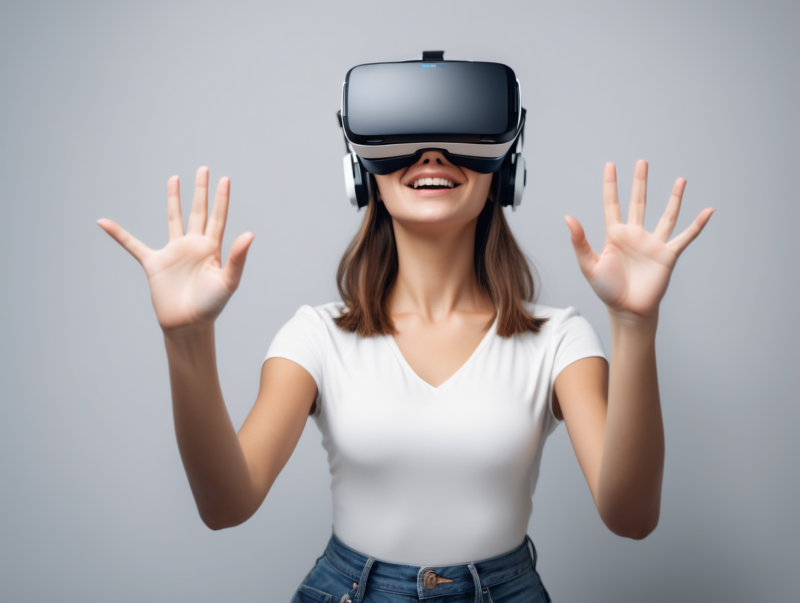
Free‑roam virtual‑reality (VR) arenas are dedicated physical spaces in which participants can move freely while wearing a head‑mounted display (HMD). Unlike seated or tethered setups that constrain the user to a small play area, free‑roam arenas blend real‑world tracking systems with immersive digital content, allowing users to walk, run, crouch, and even climb within a safely bounded environment. The space is typically outfitted with a network of infrared cameras, lidar sensors, or ultra‑wide‑angle optical trackers that continuously map the location of each headset and any handheld controllers. The data stream is processed in real time, translating the wearer’s physical motions into corresponding actions inside the virtual world.
Because the arena itself is a physical construct, safety measures such as padded walls, floor cushioning, and clear visual markers are integral to the design. This combination of hardware, software, and architectural planning creates a playground where the line between the player’s body and their avatar blurs, opening up experiences that would be impossible in a conventional living‑room setup.
The versatility of free‑roam arenas stems from the breadth of scenarios that can be rendered within them. Some of the most popular include:
Adventure Quest Games – Players embark on treasure‑hunt style missions, navigating labyrinthine corridors, solving puzzles, and battling virtual foes. The physical layout of the arena can be reconfigured with modular walls to match the narrative’s geography.
Simulation Training – Emergency responders, pilots, and industrial workers can rehearse high‑stakes procedures in a risk‑free environment. The ability to physically walk through a burning building or a malfunctioning factory line adds a tactile dimension that screen‑based simulators lack.
Sports and Fitness – From virtual dodgeball and laser tag to cardio‑focused rhythm games, free‑roam arenas turn exercise into an interactive spectacle. The system records metrics such as distance traveled, heart rate, and reaction time, enabling personalized fitness coaching.
Exploratory Experiences – Museums, historical reconstructions, and planetary rovers can be brought to life. Participants stroll through a recreation of ancient Rome or glide across the surface of Mars, all while remaining safely on the arena floor.
Creative Sandbox Play – Users can sculpt 3D objects, paint with light, or compose music by moving through space. Because the arena tracks full-body motion, creators can “draw” with their hands in mid‑air, producing artwork that would be impossible to render with a gamepad alone.
These scenarios illustrate how free‑roam VR transforms a static room into a dynamic stage, where the only limit is the imagination of developers and the physical dimensions of the venue.
Free‑roam VR appeals to a surprisingly wide demographic, largely because the technology accommodates varying skill levels and physical abilities.
Casual Gamers – Individuals who enjoy occasional immersive entertainment gravitate toward free‑roam venues for their novelty factor. The “no‑controller” feel reduces the learning curve, making the experience accessible to those who might be intimidated by complex console setups.
Hardcore Enthusiasts – A segment of the VR community seeks the most immersive experiences available. For them, free‑roam arenas provide a level of presence that surpasses home‑based systems, allowing deep engagement with competitive multiplayer titles and demanding narrative adventures.
Families – Parents often bring children to free‑roam locations because the environment is supervised, padded, and designed for safe group play. The shared experience encourages teamwork and communication across age groups.
Corporate Teams – Companies use free‑roam VR for team‑building exercises, leadership training, and product prototyping. The collaborative nature of the space fosters communication skills and problem‑solving in a low‑risk setting.
Researchers and Educators – Academic institutions leverage free‑roam arenas to study human perception, spatial cognition, and motor learning. The ability to record precise motion data while participants remain immersed makes the arena a valuable research tool.
The common thread among these users is a desire for immersion that feels both visceral and safe. Free‑roam arenas strike a balance that few other entertainment mediums can match.
Designing a free‑roam experience for children requires a careful blend of safety, simplicity, and wonder. Operators typically implement the following adaptations:
Reduced Tracking Zones – Play areas are limited to smaller footprints, often no larger than 15 × 15 feet, to keep children within a clearly defined perimeter. The tracking system automatically pauses the game if a participant approaches the boundary.
Soft‑Surface Flooring – Foam‑filled tiles or rubberized mats cushion falls and minimize the risk of injury during rapid movements or accidental collisions.
Age‑Appropriate Content – Game narratives avoid horror themes, instead focusing on bright, exploratory adventures such as “Underwater Treasure Hunt” or “Space Explorer.” Controls are simplified, with large virtual objects that can be grabbed easily.
Parental Supervision Interfaces – Staff or parents can monitor a child’s session via a live feed on a tablet, ensuring that the child remains calm and engaged. Some venues also offer “buddy” modes where an adult accompanies the child inside the arena.
Sanitation Protocols – Headsets and controllers are cleaned between sessions using UV‑light cabinets or anti‑microbial wipes, a practice that reassures parents about hygiene.
These considerations make free‑roam VR a safe yet thrilling option for birthday parties, school field trips, and after‑school clubs. The physical activity component also addresses growing concerns about sedentary screen time, encouraging kids to move, stretch, and interact with peers in a controlled virtual world.
When it comes to celebrating milestones, free‑roam VR offers a fresh alternative to traditional venues. Each type of event can be customized to match its unique tone and objectives.
A birthday celebration can be turned into an epic quest. Organizers select a themed scenario—pirate treasure chase, superhero training camp, or magical forest quest—and the venue decorates the arena accordingly. Guests receive personalized avatars, and the game’s difficulty scales automatically so both younger children and teenagers can enjoy the same storyline. The immersive nature of the experience creates lasting memories, and the built‑in photo capture function allows families to retrieve 360° snapshots of each participant in their virtual costumes.
Graduation marks a transition, and a free‑roam VR ceremony can symbolically reflect that passage. A custom experience might guide graduates through a virtual “hall of achievements,” where each milestone—internships, research projects, extracurriculars—is represented by interactive stations. The final segment could involve a shared virtual fireworks display, projected onto the real arena ceiling, providing a collective moment of celebration while adhering to social‑distancing guidelines if needed.
Corporate events benefit from the collaborative mechanics embedded in many free‑roam titles. Companies can commission bespoke scenarios that incorporate branding elements, product prototypes, or corporate values. For instance, a sustainability firm might create a “Clean‑the‑Ocean” mission where teams compete to collect virtual pollutants, reinforcing environmental awareness while fostering teamwork. Additionally, post‑game debrief sessions allow facilitators to translate in‑game observations into actionable insights about communication patterns, leadership dynamics, and problem‑solving strategies.
Across all these occasions, the venue staff handle logistics such as ticketing, equipment sanitization, and real‑time technical support, allowing hosts to focus on the celebratory aspects of the event.
The academic and industrial communities have taken a keen interest in free‑roam VR, recognizing its potential to advance both technology and human‑centered research.
Human‑Computer Interaction (HCI) Researchers cite free‑roam arenas as ideal testbeds for evaluating spatial interfaces. By capturing precise six‑degree‑of‑freedom (6DoF) motion data, scientists can study how users perceive depth, scale, and latency when visual feedback is fully synchronized with bodily movement. Findings from these studies influence the design of future AR/VR headsets, haptic gloves, and motion‑capture algorithms.
Neuroscientists are intrigued by the arena’s capacity to stimulate realistic sensory experiences. Experiments that combine free‑roam VR with EEG or functional near‑infrared spectroscopy have revealed how immersive environments engage the brain’s navigation circuits, offering insights relevant to treating vestibular disorders and age‑related spatial decline.
Industrial Engineers focus on the scalability of free‑roam systems. They analyze the trade‑offs between sensor density, processing latency, and arena size, aiming to reduce deployment costs while maintaining sub‑20‑millisecond end‑to‑end tracking—a threshold considered essential for preserving motion‑to‑photon fidelity.
Healthcare Practitioners explore therapeutic applications. Physical rehabilitation programs employ free‑roam VR to motivate patients recovering from stroke or orthopedic surgery, leveraging gamified movement tasks that encourage range‑of‑motion exercises in a low‑stress environment.
Economists observe the emerging market dynamics. The global free‑roam VR sector is projected to surpass $2 billion within the next five years, driven by demand from entertainment, education, and corporate training. Investment trends indicate a rise in modular arena kits that can be installed in shopping malls, cruise ships, and university campuses, democratizing access to high‑quality immersive experiences.
Collectively, these perspectives underscore free‑roam VR’s role as more than a novelty. It is a multidisciplinary platform that bridges entertainment, education, research, and commercial innovation, promising to reshape how people interact with digital content and with each other.
As sensor technology becomes more compact and networking bandwidth expands, free‑roam VR arenas are poised to become even more immersive and adaptable. Future iterations may incorporate full‑body haptic suits, scent dispensers, and AI‑driven narrative engines that respond dynamically to each participant’s choices. For now, the existing ecosystems already offer a compelling blend of safety, freedom of movement, and richly crafted virtual worlds—making free‑roam VR a cornerstone of modern experiential entertainment and a fertile ground for scientific discovery.


 575 W Pike St Ste 23, Lawrenceville, GA 30046, United States