El Monte
 Log in
Log in
Log in

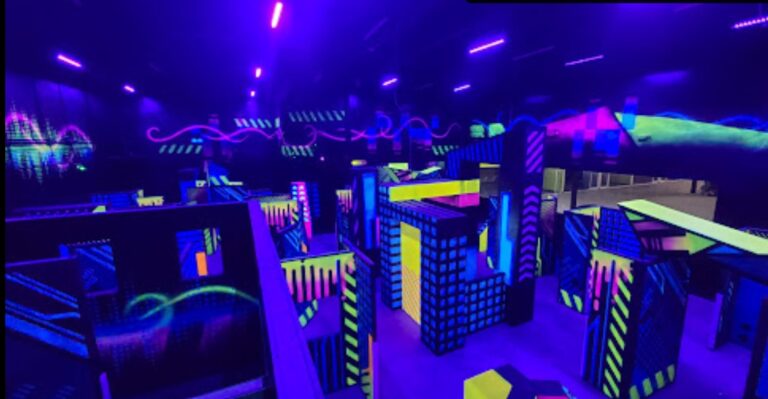
Urban Air Adventure Park is located on Bank Street in Waterbury, Connecticut.
The park features a wide range of indoor attractions including trampoline zones, a ropes course, a zipline (Sky Rider), laser tag, bumper cars, climbing walls, a warrior obstacle course, a tubes playground, and a dedicated area for children under 7. Birthday party packages include a host, reserved space, all-day play, and setup/cleanup services. The park also accommodates school field trips, team-building events, and youth group outings.
The on-site Urban Café serves pizza, snacks, and drinks for refueling. Private rooms with HDTV are available for parties. Memberships are offered for frequent visitors, providing unlimited play and discounts on food and guest passes. The staff handles party coordination and safety briefings, and an online waiver system streamlines check-in.
 Indoors
The Cave is located in the Stony Hill area of Bethel, Connecticut.
The venue is a three-level indoor glow-in-the-dark entertainment center. Its main attractions include a two-level laser tag arena (3,000 sq. ft., up to 24 players, 30+ game modes), 18 holes of glow mini-golf, a high ropes course suspended above the golf course, bumper cars, six lanes of mini-bowling, and four virtual reality rides (Starship Adventure, Infinite Battle, 360 Coaster, VR Racing). Individual attraction prices range from $6 to $14, with combo passes available for $45–$65 on weekends.
Additional offerings include a six-lane axe throwing lounge (30- and 45-minute sessions from $25), a private karaoke recording studio with a green screen ($10 per person for 20 minutes), and two floors of ticketless arcade games. The venue specializes in birthday parties (starting at $450 for up to 12 guests), corporate events, team-building, and adult parties. A lounge area is available on the lower level, and the venue reimburses delivery fees for food ordered from local restaurants. An in-house cafe and bar are planned for later in 2025.
IndoorsXperiment Virtual Reality is located in the Stop & Shop Plaza at 89 Washington Avenue in North Haven, Connecticut.
The venue offers a broad range of immersive virtual reality experiences, including room-scale VR with over 80 games, a wireless Free-Roam arena for 2–4 players, VR escape rooms, and racing simulators. Guests can choose from action shooters, family-friendly adventures, sports games, and educational content. The facility is well-suited for birthday parties, corporate team building, school field trips, and private events, with party packages that include VR time, a private party room, pizza, and drinks.
In addition to on-site gaming, Xperiment VR provides a Mobile VR service that brings the experience to schools, camps, and community events. The venue features a lounge area with live gameplay displays, a private party room for celebrations, and a staff known for being friendly and helpful with first-time users. Hygiene protocols include sanitizing all equipment between uses, and the space is ADA compliant with seated options available.
IndoorsLaser Planet Plus is located in the East End of Waterbury, Connecticut, tucked away in the rear of the Sunbeam Plaza on East Main Street.
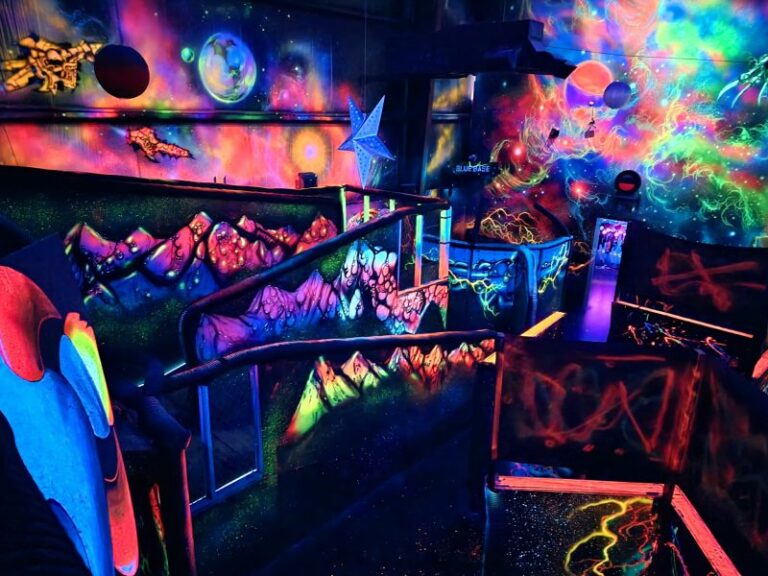
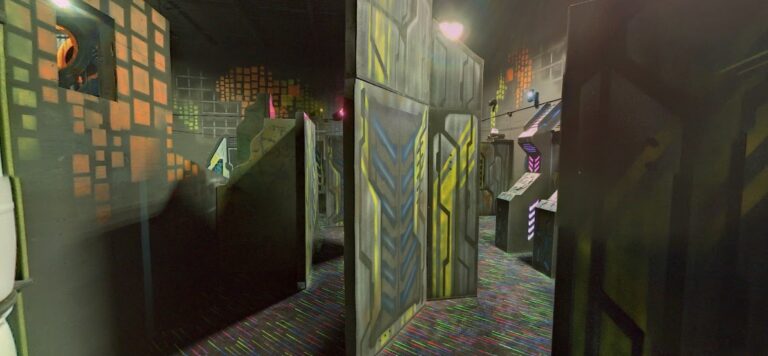
The venue is home to New England’s largest multi-level laser tag arena — a space-themed cosmic maze with fluorescent graffiti, neon lighting, and immersive sound effects. Players can engage in tactical laser tag battles with multiple levels, hiding spots, and sniper positions. Beyond laser tag, the facility offers UFO bumper cars that glide like flying discs, virtual reality games, and a classic arcade with prize redemption. Walk-in pricing is available for individuals, and the arena accommodates up to 25 players per game.
For group celebrations, Laser Planet Plus provides private party rooms with two party packages: a standard Laser Tag Party and a premium “Out of This World” package that includes bumper car rides, a t-shirt for the guest of honor, and goodie bags. The venue also offers private event rentals for corporate team-building, youth sports teams, scout groups, and school celebrations. Add-ons include pizza, arcade cards, activity tickets, and goodie bags. The atmosphere is casual and energetic, suitable for ages five and up.
IndoorsUrban Air Trampoline and Adventure Indoor Park is located in Orange, CT.
Urban Air in Orange is far from a simple trampoline park. Under one roof, visitors will find over twenty different attractions that range from high-flying adventures to competitive games. The park features indoor go-kart tracks, a Sky Rider indoor zip line, a multi-level ropes course, climbing walls of varying difficulty, and a dedicated Warrior Course inspired by ninja obstacle competitions. For those who enjoy tactical play, there is a laser tag arena where groups can gear up and face off in a glow-in-the-dark battle.
The trampoline areas are equally impressive, with the APEX trampolines that extend to the walls, a ProZone Performance Trampoline section for acrobats and daredevils, a Slam Dunk Zone for basketball fans, and a Runway tumble track. Younger visitors (ages 7 and under) have their own dedicated Kid’s Area, ensuring safe and age-appropriate fun. Other notable attractions include the Spin Zone Bumper Cars, a Battle Beam (balance beam with foam swords), a Drop Zone leap of faith onto an airbag, a Trapeze, and a Tubes Playground that doubles as an obstacle course.
IndoorsIn the rapidly evolving landscape of immersive entertainment, free‑roam virtual reality (VR) arenas have emerged as a distinctive hybrid between theme‑park attractions and high‑tech gaming centers. Unlike the cramped, seated experiences that dominate most consumer‑grade headsets, free‑roam venues allow participants to move unhindered across a physical space while their digital avatars mirror every step, turn, and gesture. The result is a physical‑digital playground where the boundaries of imagination are enforced only by the size of the room and the creativity of the designers.
At its core, a free‑roam VR arena consists of three intertwined components: a tracked physical environment, a fleet of wireless VR headsets, and a bespoke software engine capable of stitching together the real‑world layout with an equally expansive virtual world.
Tracked Physical Space – The arena is typically mapped with an array of infrared cameras, lidar sensors, or ultra‑wide‑angle optical trackers. These devices constantly triangulate the position of each headset and any handheld controllers, ensuring that the system knows exactly where a player is in three‑dimensional space. The tracking infrastructure is calibrated to millimeter precision, which not only prevents users from colliding with walls or obstacles but also enables seamless interaction with virtual objects that appear to occupy real locations.
Wireless Headsets and Controllers – Modern free‑roam setups rely on standalone headsets that combine high‑resolution displays, inside‑out tracking, and powerful onboard processors. The absence of tethered cables is essential; it preserves the sense of freedom and eliminates tripping hazards. Hand controllers, sometimes augmented with haptic feedback or finger‑tracking modules, let participants grasp, swing, or throw virtual items as naturally as they would in the real world.
Dynamic Software Engine – The digital realm is built on a game engine capable of real‑time spatial mapping. As the physical arena’s dimensions are fed into the engine, designers can overlay a fantastical landscape—whether it be a medieval castle, an alien planet, or an abstract puzzle environment—directly onto the real floor plan. The software also handles player collision detection, physics simulation, and dynamic lighting, all while maintaining a low latency loop that prevents motion sickness.
Together, these elements transform a simple warehouse or repurposed gymnasium into a portal to any imagined setting, allowing multiple participants to share the same immersive experience without the need for individual booths or isolated stations.
The design flexibility of free‑roam arenas has inspired a broad spectrum of scenarios, each tailored to different audiences, objectives, and durations. Below are some of the most prevalent categories:
Narrative‑driven experiences place participants in the role of heroes on a quest. Players might explore an ancient tomb, solve riddles to unlock a hidden chamber, and battle holographic guardians that materialize on their visor. Because the arena physically constrains movement, designers can craft “rooms” that correspond to distinct story beats—an overgrown jungle clearing that leads to a towering temple, for example. The tactile nature of the adventure—climbing a ladder, ducking under a laser grid, or physically shielding oneself from a virtual explosion—creates a visceral connection to the plot that seated VR experiences often lack.
Team‑based shooters, capture‑the‑flag games, and arena‑style combat thrive in free‑roam settings. By dividing the space into zones with distinct strategic value—high ground platforms, narrow corridors, or hidden alcoves—players must constantly adapt their tactics, moving in real space while tracking opponents’ avatars on their visors. The added physicality amplifies adrenaline: sprinting to avoid a virtual projectile or ducking behind a real pillar feels dramatically more intense than pressing a button on a controller.
Inspired by escape‑room concepts, cooperative puzzle experiences require groups to communicate, collaborate, and manipulate virtual mechanisms in order to progress. Imagine a scenario where participants must align a series of floating holographic crystals by physically moving around the room, arranging themselves in a specific formation, and using hand gestures to rotate each crystal. The requirement for spatial coordination encourages teamwork and often leads to moments of genuine “aha!” when a solution clicks into place.
Free‑roam arenas have also found a niche in experiential learning. For example, a simulated archaeological dig lets students walk through a reconstructed ancient settlement, uncover virtual artifacts, and examine them up close using hand gestures. Because the environment can be scaled to match the size of the classroom, educators can supervise multiple small groups simultaneously, each observing a different facet of the dig without crowding.
Certain operators have blended gamified workouts with free‑roam VR, creating experiences where participants must physically dodge obstacles, swing a virtual sword, or perform aerial maneuvers to complete challenges. The open space eliminates the need for external treadmill hardware, and the immersive visuals provide a distraction from fatigue, turning exercise into an adventure.
The audience for free‑roam VR is surprisingly diverse, reflecting the medium’s ability to adapt to different age groups, skill levels, and social contexts.
Younger participants are drawn to the tactile nature of free‑roam experiences. The ability to physically run, jump, and interact with virtual objects satisfies a natural desire for active play. Parents often appreciate the controlled environment—tracking systems keep children within safe boundaries, and the content can be curated for age‑appropriate themes, ranging from whimsical fairy‑tale forests to cartoonish space stations.
Adolescents and college‑age individuals gravitate toward the competitive and social aspects. Free‑roam battle arenas and collaborative puzzle rooms offer opportunities for friendly rivalry and teamwork. Many operators host league nights or tournament brackets, turning the arena into a recurring hangout spot for local gaming communities.
Businesses increasingly view free‑roam VR as a novel platform for team‑building and corporate events. The immersive setting forces participants out of their comfort zones, encouraging communication and problem‑solving under pressure. Companies can customize scenarios to align with brand values or training objectives, such as a simulated product launch or a crisis‑management exercise that requires rapid coordination.
Birthday parties, graduation celebrations, and even wedding receptions have begun to incorporate free‑roam VR as a headline attraction. Event organizers appreciate the flexibility: the arena can be re‑skinned with themed overlays—pirate ships for a birthday, futuristic neon streets for a graduation party, or a sleek, branded environment for a corporate celebration—while still delivering a shared, memorable experience for guests.
When it comes to children, safety is the foremost concern. Free‑roam arenas address this through several layers of protection:
Physical Boundaries: Invisible “virtual walls” appear on the headset if a player approaches the arena’s edge, prompting them to turn away. The real‑world walls are also padded or equipped with foam padding to mitigate accidental impacts.
Age‑Appropriate Content Filters: Operators maintain libraries of scenarios classified by age rating, ensuring that younger children are not exposed to intense horror or violent themes.
Supervised Sessions: Staff members monitor each session from a control room, watching real‑time feeds of the arena’s cameras and headset data. If a participant appears disoriented, the staff can pause the experience and guide them to a calm‑down area.
Beyond safety, free‑roam VR offers unique educational benefits for children. The immersive nature encourages active learning, as concepts can be demonstrated in three dimensions. A science‑themed adventure might let kids walk through a molecular model, watch atoms bond in real time, or navigate a human bloodstream. The kinesthetic involvement helps cement abstract ideas in a tangible way, often leading to higher retention rates compared to traditional classroom instruction.
Moreover, the social element—players must communicate, share ideas, and collaborate to solve puzzles—mirrors real‑world teamwork skills that schools and parents aim to cultivate.
Free‑roam VR has proven to be a versatile canvas for turning ordinary celebrations into unforgettable spectacles. Below are the ways each type of event can be customized:
Imagine a birthday party where the theme is “Space Explorer.” The arena’s floor plan is transformed into a lunar landscape with craters, alien rock formations, and a hovering starship that players can board. The birthday child becomes the captain, tasked with guiding their friends through a series of mini‑missions—collecting glowing moon crystals, repairing the ship’s engine, and finally launching a fireworks display that erupts across the virtual sky as the cake is presented. The physical movement keeps guests active, while the shared objective fosters camaraderie. Operators can also record a highlight reel, stitching together each child’s reaction for a personalized keepsake.
For a class of high school seniors, a “Future City” scenario can symbolize stepping into adulthood. The arena morphs into a bustling metropolis where each graduate’s avatar receives a digital diploma that unlocks a personalized “career path” mini‑game—engineering, arts, medicine—allowing participants to experience a glimpse of their prospective profession. Group challenges, such as building a virtual bridge or orchestrating a citywide emergency response, reinforce the idea that collaboration will be essential in their next chapter. A final collective act—activating a massive holographic confetti burst above the arena—creates a shared climax that mirrors the joy of real‑world graduation ceremonies.
Businesses can leverage free‑roam VR to reinforce brand identity and encourage innovative thinking. A tech company, for example, might commission a custom scenario set inside a stylized version of its flagship product—a virtual data center where employees must locate and secure vulnerable “data nodes” before a simulated cyber‑attack spreads. Such an exercise blends fun with an underlying message about cybersecurity awareness. For more relaxed corporate parties, a “Retro Arcade” theme can transform the arena into a neon‑lit 80s arcade, complete with virtual pinball machines, dance floors, and a leaderboard that tracks high scores across the night. This combination of nostalgia and competition can break down hierarchical barriers, fostering a more cohesive workplace culture.
As hardware continues to improve—lighter headsets, longer battery life, higher resolution displays—the potential applications for free‑roam VR will expand. Emerging technologies such as eye‑tracking and facial expression capture will enable avatars to convey subtle social cues, deepening the sense of presence. Meanwhile, artificial intelligence can automate scenario generation, allowing operators to create on‑the‑fly challenges tailored to the skill level of each group.
Another promising avenue is the integration of haptic flooring and wearable exoskeletons. By providing force feedback through the floor or lightweight arm supports, participants could feel the resistance of a virtual current or the impact of a virtual projectile, further blurring the line between the physical and digital realms.
Finally, the rise of hybrid events—where a live audience watches a streamed version of the VR experience—could open doors for broader community participation. A school could host a virtual field trip, with classrooms around the world watching their students navigate a reconstructed ancient city in real time, fostering global collaboration.
Free‑roam VR arenas represent a convergence of cutting‑edge tracking technology, immersive storytelling, and physical interaction. By removing the constraints of chairs and cables, these venues enable participants to become fully embodied protagonists in worlds limited only by imagination. From epic narrative quests and competitive battlefields to educational simulations and fitness challenges, the scenarios are as varied as the audiences they serve.
Children revel in the safe yet active play, teenagers and young adults find camaraderie and competition, corporations discover fresh pathways for team building, and event planners gain a dynamic platform for turning birthdays, graduations, and corporate celebrations into shared, multisensory memories. As the technology matures and creative boundaries continue to be pushed, free‑roam VR is poised not just to entertain but to reshape how people learn, collaborate, and celebrate milestones in the digital age.


 425 Bank St, Waterbury, CT 06708, United States