
 El Monte
 Log in
Log in
Log in

Urban Air Trampoline and Adventure Indoor Park is located in Orange, CT.
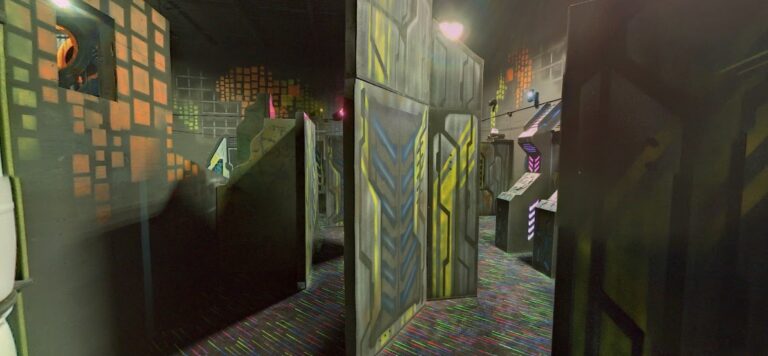
Urban Air in Orange is far from a simple trampoline park. Under one roof, visitors will find over twenty different attractions that range from high-flying adventures to competitive games. The park features indoor go-kart tracks, a Sky Rider indoor zip line, a multi-level ropes course, climbing walls of varying difficulty, and a dedicated Warrior Course inspired by ninja obstacle competitions. For those who enjoy tactical play, there is a laser tag arena where groups can gear up and face off in a glow-in-the-dark battle.
The trampoline areas are equally impressive, with the APEX trampolines that extend to the walls, a ProZone Performance Trampoline section for acrobats and daredevils, a Slam Dunk Zone for basketball fans, and a Runway tumble track. Younger visitors (ages 7 and under) have their own dedicated Kid’s Area, ensuring safe and age-appropriate fun. Other notable attractions include the Spin Zone Bumper Cars, a Battle Beam (balance beam with foam swords), a Drop Zone leap of faith onto an airbag, a Trapeze, and a Tubes Playground that doubles as an obstacle course.
 Indoors
Xperiment Virtual Reality is located in the Stop & Shop Plaza at 89 Washington Avenue in North Haven, Connecticut.
The venue offers a broad range of immersive virtual reality experiences, including room-scale VR with over 80 games, a wireless Free-Roam arena for 2–4 players, VR escape rooms, and racing simulators. Guests can choose from action shooters, family-friendly adventures, sports games, and educational content. The facility is well-suited for birthday parties, corporate team building, school field trips, and private events, with party packages that include VR time, a private party room, pizza, and drinks.
In addition to on-site gaming, Xperiment VR provides a Mobile VR service that brings the experience to schools, camps, and community events. The venue features a lounge area with live gameplay displays, a private party room for celebrations, and a staff known for being friendly and helpful with first-time users. Hygiene protocols include sanitizing all equipment between uses, and the space is ADA compliant with seated options available.
IndoorsThe Cave is located in the Stony Hill area of Bethel, Connecticut.
The venue is a three-level indoor glow-in-the-dark entertainment center. Its main attractions include a two-level laser tag arena (3,000 sq. ft., up to 24 players, 30+ game modes), 18 holes of glow mini-golf, a high ropes course suspended above the golf course, bumper cars, six lanes of mini-bowling, and four virtual reality rides (Starship Adventure, Infinite Battle, 360 Coaster, VR Racing). Individual attraction prices range from $6 to $14, with combo passes available for $45–$65 on weekends.
Additional offerings include a six-lane axe throwing lounge (30- and 45-minute sessions from $25), a private karaoke recording studio with a green screen ($10 per person for 20 minutes), and two floors of ticketless arcade games. The venue specializes in birthday parties (starting at $450 for up to 12 guests), corporate events, team-building, and adult parties. A lounge area is available on the lower level, and the venue reimburses delivery fees for food ordered from local restaurants. An in-house cafe and bar are planned for later in 2025.
Indoors
New Haven, Connecticut recently welcomed its first Virtual Reality (VR) Arena. The VR Arena offers an immersive experience where the player can become a fighter pilot, race car driver, or even an underwater explorer. Players can use a variety of VR equipment such as head-mounted displays, motion tracking technology, and interactive controllers to experience exhilarating and unique gaming scenarios.

A free‑roam virtual‑reality arena is a purpose‑built physical space that lets participants move unhindered while wearing a head‑mounted display (HMD). Unlike seated or treadmill‑based setups, the arena’s floor is typically covered with a tracking system—often a combination of infrared cameras, lidar sensors, or inside‑out tracking that maps a user’s position in real time. The result is a seamless blend of the digital and the tangible: users can walk, duck, jump, and interact with objects as if they were really there, while the software translates every movement into the virtual world.
The design of a free‑roam arena prioritises safety as much as immersion. Soft flooring, rounded corners, and strategically placed “virtual walls” that trigger haptic or visual cues when an imminent collision is detected are standard. Because the environment is bounded, developers can craft experiences that would be impossible in a conventional living‑room setup—large‑scale battles, cooperative puzzle rooms, and physics‑heavy simulations that require full‑body motion. In short, a free‑roam VR arena transforms a room into a playground where the only limit is the imagination of the experience creator.
The breadth of scenarios that thrive in a free‑roam setting is vast, reflecting the medium’s capacity to engage multiple senses simultaneously. Some of the most popular categories include:
Adventure Expeditions – Participants trek through digitally rendered jungles, ancient ruins, or alien planets, using handheld controllers as tools, weapons, or environmental probes. The ability to physically turn a corner or climb a virtual ladder adds authenticity that traditional screen‑based games cannot match.
Co‑op Escape Rooms – Teams solve riddles, manipulate virtual levers, and coordinate movements across a shared space. Because players can see each other’s avatars in real time, communication becomes natural, and the tension of a ticking clock feels palpably real.
Sports Simulations – From futuristic quidditch matches to realistic soccer drills, free‑roam arenas enable full‑body athleticism. Motion capture of swings, kicks, and jumps is translated directly into the game, providing both a workout and a competitive outlet.
Educational Field Trips – Students can walk through a recreated dinosaur ecosystem, explore the molecular structure of a virus, or navigate the interior of a human heart. The kinesthetic aspect of moving through these environments helps reinforce learning by linking visual information to physical action.
Narrative Cinematic Experiences – Story‑driven adventures place users inside a movie‑like world where they become the protagonist. The freedom to explore at one’s own pace encourages deep emotional engagement and personal agency within the plot.
These scenarios exploit the core advantage of free‑roam VR: the removal of physical constraints. By mapping a real‑world space onto a virtual canvas, designers can scale experiences far beyond the dimensions of the actual arena, creating the illusion of infinite space while ensuring participants remain safely within the defined boundaries.
The appeal of free‑roam VR spans a surprisingly diverse demographic, driven by the universal draw of embodied interaction.
Gamers and Esports Enthusiasts – Competitive players gravitate toward free‑roam arenas for the heightened skill ceiling. Precise footwork, spatial awareness, and rapid decision‑making become decisive factors, differentiating elite participants from casual players.
Families and Social Groups – Because the technology is intuitive—walk, reach, swing—families can jump straight into the action without a steep learning curve. Group experiences foster teamwork and create memorable shared moments, making the arenas popular destinations for weekend outings.
Educators and Researchers – Schools, museums, and universities employ free‑roam spaces as experimental labs. The ability to control variables such as environment, object physics, and participant movement makes the arena an ideal platform for studies in cognition, motor learning, and human‑computer interaction.
Corporate Teams – Companies use these venues for team‑building exercises, leadership development, and creativity workshops. Immersive scenarios that require collaboration under pressure translate into real‑world soft‑skill training.
Therapists and Healthcare Providers – Physical rehabilitation programs incorporate free‑roam VR to encourage patients to perform functional movements in a motivating, low‑risk setting. The immediate visual feedback and gamified objectives increase adherence to therapy regimens.
The convergence of entertainment, education, and professional development in a single medium explains why the user base continues to expand beyond early adopters to mainstream audiences.
Designing free‑roam experiences for children demands a careful balance between excitement and safety. Kid‑focused arenas typically employ several key adaptations:
Scaled Environments – Virtual worlds are adjusted to accommodate shorter stature and reduced stride length, ensuring that spatial cues remain accurate and navigation feels natural.
Simplified Controls – Handheld devices are often replaced with lightweight, ergonomic controllers that require minimal grip strength. Some experiences even rely solely on hand tracking, eliminating the need for any physical peripheral.
Age‑Appropriate Content – Narrative themes avoid intense horror or graphic violence, favouring whimsical adventures, puzzle hunts, and cooperative quests that promote problem‑solving and social interaction.
Enhanced Safety Features – Soft, padded walls, lower ceiling heights, and on‑board monitoring systems that alert staff when a child approaches the physical limits of the arena are standard. In addition, staff members equipped with motion‑capture markers can intervene instantly if a participant loses balance.
Parental Oversight Interfaces – Real‑time dashboards let guardians view a child’s location within the virtual space, monitor session duration, and set limits on exposure.
These considerations create an environment where children can explore, learn, and expend energy while parents feel confident about the level of supervision and the appropriateness of the content.
When it comes to celebrations, free‑roam VR offers a fresh alternative to traditional party venues. Organisers can tailor the experience to fit the occasion, leveraging the adaptability of the platform.
Birthday Parties – A themed adventure—such as a treasure hunt on a pirate island or a superhero training camp—turns the birthday child into the central hero. Group challenges encourage friendly competition, while customizable avatars let each guest express their personality.
Graduations – To mark a milestone, graduates can step into a futuristic city where each building represents a field of study or a personal achievement. Interactive installations allow guests to leave virtual messages, creating a digital memory wall that persists long after the celebration ends.
Corporate Parties – Companies looking to blend fun with brand reinforcement can commission bespoke scenarios that incorporate product prototypes, corporate values, or industry‑specific challenges. A collaborative build‑the‑future game, for example, can highlight innovation while reinforcing teamwork.
The logistical advantages are notable: the arena’s controlled environment eliminates weather concerns, the modular nature of VR content means the same physical space can host multiple distinct experiences in a single day, and the technology naturally captures footage that can be edited into highlight reels for post‑event marketing.
The scientific community and technology industry analysts converge on a few core observations regarding free‑roam VR’s trajectory.
First, embodiment—the sensation of owning a virtual body—is markedly stronger in free‑roam setups. Neuroimaging studies reveal heightened activation in sensorimotor cortices when participants physically walk compared with those who use joystick navigation. This suggests that free‑roam experiences can more effectively induce presence, a critical factor for applications ranging from training simulations to psychotherapy.
Second, spatial cognition benefits from the real‑world movement integrated into virtual tasks. Experiments measuring wayfinding performance show that participants who navigate a virtual maze by walking retain spatial maps more accurately than those who navigate via thumbsticks. The implication is that free‑roam VR could become a valuable tool for studying navigation disorders or for enhancing spatial learning in educational curricula.
Third, ergonomic research highlights both opportunities and challenges. While the natural movement reduces motion‑sickness compared with seated VR, prolonged standing and vigorous activity can introduce fatigue or strain. Experts recommend session designs that incorporate rest intervals, adjustable difficulty, and ergonomic controller placement to mitigate these risks.
From an industry standpoint, analysts point to the economies of scale emerging as hardware costs decline. Standalone HMDs with inside‑out tracking are becoming powerful enough to replace external camera rigs, simplifying arena setup and maintenance. Moreover, the rise of cloud‑based rendering services promises to offload computationally intensive graphics, allowing venues to run high‑fidelity experiences on modest local hardware.
Finally, the interdisciplinary potential of free‑roam VR is frequently cited. By uniting game designers, cognitive scientists, educators, and health professionals under a common platform, the arena becomes a crucible for innovation. Collaborative research projects are already exploring its use for remote surgical training, disaster response drills, and even social empathy exercises that place participants in the perspective of marginalized groups.
Taken together, these expert perspectives indicate that free‑roam VR is moving from a niche entertainment offering toward a versatile platform with far‑reaching implications across society.
Free‑roam virtual‑reality arenas represent a convergence of cutting‑edge tracking technology, immersive storytelling, and real‑world safety engineering. They enable a spectrum of scenarios—from pulse‑pounding adventures and collaborative puzzles to educational field trips and therapeutic exercises—while accommodating a remarkably broad audience that includes gamers, families, students, professionals, and children. Tailored experiences for special events such as birthdays, graduations, and corporate gatherings demonstrate the medium’s flexibility and its capacity to turn ordinary celebrations into unforgettable, interactive journeys.
Scientific research underscores the unique advantages of full‑body interaction, particularly in fostering presence, enhancing spatial cognition, and providing rich data for interdisciplinary study. Meanwhile, industry trends suggest that decreasing hardware costs and advances in cloud rendering will make free‑roam VR increasingly accessible to venues worldwide.
As the technology matures, the line between the physical arena and the virtual worlds it hosts will continue to blur, opening new possibilities for entertainment, education, health, and beyond. For anyone seeking a truly immersive experience where movement matters as much as imagination, the free‑roam VR arena stands poised as the next frontier of digital interaction.


 260 Bull Hill Ln, Orange, CT 06477, United States

