El Monte
 Log in
Log in
Log in

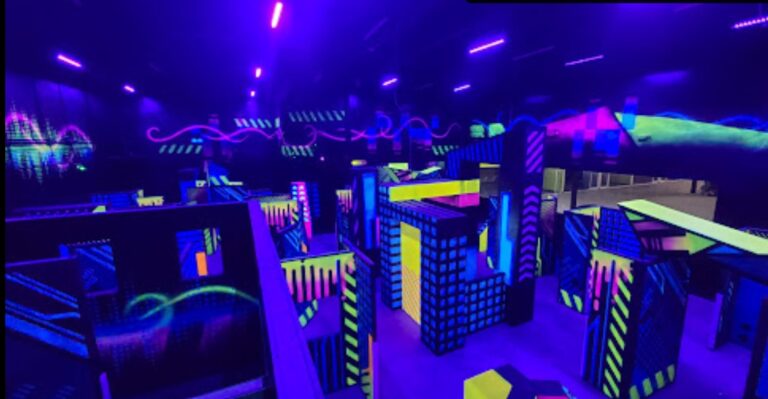
Laser Planet Plus is located in the East End of Waterbury, Connecticut, tucked away in the rear of the Sunbeam Plaza on East Main Street.
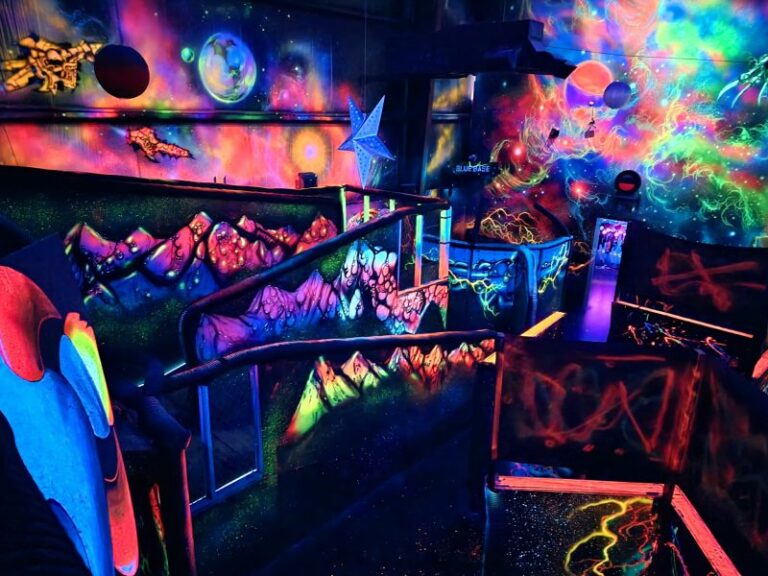
The venue is home to New England’s largest multi-level laser tag arena — a space-themed cosmic maze with fluorescent graffiti, neon lighting, and immersive sound effects. Players can engage in tactical laser tag battles with multiple levels, hiding spots, and sniper positions. Beyond laser tag, the facility offers UFO bumper cars that glide like flying discs, virtual reality games, and a classic arcade with prize redemption. Walk-in pricing is available for individuals, and the arena accommodates up to 25 players per game.
For group celebrations, Laser Planet Plus provides private party rooms with two party packages: a standard Laser Tag Party and a premium “Out of This World” package that includes bumper car rides, a t-shirt for the guest of honor, and goodie bags. The venue also offers private event rentals for corporate team-building, youth sports teams, scout groups, and school celebrations. Add-ons include pizza, arcade cards, activity tickets, and goodie bags. The atmosphere is casual and energetic, suitable for ages five and up.
 Indoors
Urban Air Adventure Park is located on Bank Street in Waterbury, Connecticut.
The park features a wide range of indoor attractions including trampoline zones, a ropes course, a zipline (Sky Rider), laser tag, bumper cars, climbing walls, a warrior obstacle course, a tubes playground, and a dedicated area for children under 7. Birthday party packages include a host, reserved space, all-day play, and setup/cleanup services. The park also accommodates school field trips, team-building events, and youth group outings.
The on-site Urban Café serves pizza, snacks, and drinks for refueling. Private rooms with HDTV are available for parties. Memberships are offered for frequent visitors, providing unlimited play and discounts on food and guest passes. The staff handles party coordination and safety briefings, and an online waiver system streamlines check-in.
Indoors
In recent years, Hartford, Connecticut has seen a surge in virtual reality (VR) experiences. New VR arenas have popped up throughout the city, allowing people to explore their favorite video games and worlds with a completely immersive experience. From family-friendly gaming rooms to thrilling encounters, these arenas are bringing people together in a whole new way.

A free‑roam virtual‑reality arena is a purpose‑built space where participants can move unencumbered while wearing a head‑mounted display (HMD) that tracks their position in real time. Unlike seated or tabletop VR experiences, the arena eliminates the need for cables, external controllers, or a confined play area. The floor is usually covered with a non‑slip material, and walls are lined with motion‑capture sensors, infrared cameras, or lidar arrays that continuously map the user’s location, orientation, and gestures.
The technology creates a seamless blend of the physical and the digital: a user might swing a virtual sword, climb a digital cliff, or dodge laser fire while actually walking, ducking, or leaping within a safe, bounded environment. Because the system knows exactly where each participant is, it can prevent collisions, adapt the virtual world to the size of the arena, and even synchronize multiple users in the same digital space. In essence, a free‑roam VR arena transforms a room into a three‑dimensional playground where the only limit is imagination.
The possibilities inside a free‑roam arena are as varied as the creative teams that design them. Some of the most popular scenarios include:
Adventure Quests – Players embark on narrative‑driven missions, solving puzzles and battling foes while exploring sprawling virtual landscapes that are mapped onto the physical floor. A medieval castle, an alien planet, or a haunted mansion can all be rendered around a single, modest‑sized arena.
Sports Simulations – From futuristic hover‑board races to realistic soccer drills, free‑roam VR lets athletes practice footwork, timing, and spatial awareness without the constraints of a traditional field. The system can record performance metrics, making it a valuable training tool as well as a recreational activity.
Co‑op Escape Rooms – Teams work together to decipher clues, manipulate virtual objects, and unlock doors. Because participants can physically move around each other, the tension of a real‑world escape room is amplified by the immersive visual and auditory cues of VR.
Creative Studios – Artists and designers can sculpt three‑dimensional models, paint on virtual canvases, or compose music by interacting with digital instruments placed throughout the arena. The tactile feedback of walking to a “canvas” or “instrument” adds a kinesthetic dimension absent from desktop‑based tools.
Educational Expeditions – History buffs can walk through a reconstruction of ancient Rome, biology students can explore a giant cell from the inside, and space enthusiasts can navigate a realistic simulation of the International Space Station. The ability to move physically through these environments helps cement concepts that are otherwise abstract.
Each scenario leverages the core advantage of free‑roam VR: the freedom to physically act out the actions that the virtual world demands, creating a level of embodiment that stationary VR cannot match.
The user base for free‑roam VR is surprisingly diverse, reflecting the platform’s adaptability.
Gamers and Esports Enthusiasts – Hardcore players who seek a step beyond couch‑based gaming gravitate toward free‑roam arenas for the heightened immersion and competitive possibilities. Tournaments are beginning to feature free‑roam formats, where teams compete in large‑scale, physically active matches.
Fitness Buffs – The kinetic nature of free‑roam VR makes it a natural fit for those looking to combine exercise with entertainment. Studios market “VR cardio” or “VR HIIT” sessions that track calories burned, heart rate, and movement patterns, appealing to people who find traditional workouts monotonous.
Families and Casual Visitors – Many entertainment centers incorporate free‑roam experiences as an “alternative attraction,” drawing families who want a novel activity that both children and adults can enjoy together.
Corporate Teams – Companies use the arenas for team‑building exercises, leadership simulations, and problem‑solving workshops. The physical collaboration required in many free‑roam games encourages communication, trust, and quick decision‑making.
Researchers and Students – Academic institutions rent arenas for studies on spatial cognition, human‑computer interaction, and motion sickness. The controlled yet immersive environment enables rigorous data collection while preserving ecological validity.
Overall, the appeal lies in the blend of physical activity, social interaction, and immersive storytelling, which resonates with a broad spectrum of users.
Designing free‑roam experiences for children involves balancing excitement with safety. Operators typically implement the following measures:
Age‑Appropriate Content – Scenarios avoid graphic violence or horror themes, focusing instead on colorful adventures, animal interactions, or educational quests. Difficulty levels can be adjusted so younger players are not overwhelmed by complex puzzles.
Safety Protocols – The arena floor is padded, and the perimeter is clearly marked with low‑height barriers or visual cues visible inside the headset. Staff monitor participants, intervene when necessary, and enforce a maximum number of players per session to prevent overcrowding.
Physical Size Limits – For younger children, the virtual space is often scaled down to match their shorter stride length and reduced reach, ensuring that the digital world aligns with their real‑world movements.
Parental Controls – Operators may provide a “parent mode” where adults can see a live feed of the arena, pause the session, or adjust volume and visual settings.
When these considerations are met, free‑roam VR becomes a powerful educational tool. For instance, a “Dinosaur Dig” scenario can teach paleontology basics while kids physically crouch, reach, and move around a simulated excavation site. The embodied learning experience has been shown to improve retention compared with passive video watching.
The versatility of free‑roam arenas makes them attractive venues for a wide range of celebrations and gatherings.
Parents increasingly book VR arenas for milestone birthdays because the experience feels futuristic and can be customized. Party packages often include a dedicated host who guides the group through a themed adventure—such as a treasure hunt on a pirate island—ensuring that every child gets a turn in the spotlight. The physical nature of the activity also encourages social interaction, reducing the reliance on screens that dominate traditional parties.
High‑school and college graduates are looking for memorable ways to mark their transition. A free‑roam “Future City” scenario, where participants collaboratively build a digital metropolis while physically moving across the arena, symbolizes the collaborative effort required to construct a new life chapter. Photographic capture points within the arena allow graduates to pose with virtual elements—a trophy, a diploma, a fireworks display—creating unique mementos.
Companies leverage free‑roam VR to break down hierarchical barriers. In a corporate setting, the emphasis shifts from competition to cooperation. Scenarios such as “Space Station Repair” or “Rescue Mission” require participants to delegate roles, communicate clearly, and synchronize movements, mirroring workplace dynamics. Additionally, the data collected during sessions—time to complete tasks, error rates, communication patterns—can be anonymized and analyzed to provide insights into team performance.
The flexibility of the arena also means that organizers can blend VR with physical decorations, catering, and music, creating a hybrid environment that satisfies both the desire for cutting‑edge entertainment and the comfort of familiar party elements.
The scientific community has taken notice of free‑roam VR for several reasons. Researchers in neuroscience and psychology examine how full‑body immersion influences presence, memory formation, and emotional response. Early studies suggest that the proprioceptive feedback obtained by physically walking and gesturing enhances the feeling of “being there,” leading to stronger episodic memory encoding compared with seated VR.
From an engineering perspective, experts highlight the challenges of scaling the technology. High‑precision tracking across large spaces demands robust sensor networks and sophisticated algorithms to fuse data from cameras, inertial measurement units (IMUs), and sometimes ultrasound beacons. Latency— the delay between a user’s movement and the visual update—must be kept under 20 ms to avoid motion sickness, a threshold that pushes the limits of current wireless streaming solutions.
Industry analysts project rapid growth for the free‑roam market. According to market forecasts, revenue from location‑based VR experiences is expected to double within five years, driven largely by the emergence of mixed‑reality hybrids that combine virtual overlays with physical props. The convergence of 5G, edge computing, and lightweight HMDs is anticipated to reduce hardware costs, making free‑roam installations more accessible to smaller entertainment venues and educational institutions.
Ethicists also weigh in, cautioning that the immersive power of free‑roam could be leveraged for persuasive marketing or behavioral manipulation. They advocate for transparent consent mechanisms and age‑appropriate content guidelines, especially when the technology is used in settings frequented by children.
Overall, the consensus among scientists and industry leaders is that free‑roam VR represents a pivotal step toward truly embodied digital experiences. While technical hurdles remain, the trajectory points toward wider adoption, richer content ecosystems, and deeper integration into everyday entertainment, education, and professional development.
Free‑roam VR arenas have evolved from niche attractions into multifaceted platforms that cater to gamers, fitness enthusiasts, families, corporations, and researchers alike. By granting users the freedom to walk, run, and interact physically within a digitally constructed world, these arenas unlock a level of immersion that stationary setups cannot achieve. Whether it is a child on a dinosaur expedition, a team of engineers repairing a virtual spacecraft, or a birthday group on a pirate treasure hunt, the blend of movement, social interaction, and compelling storytelling defines the unique appeal of free‑roam VR. As technology continues to advance and the cost barrier lowers, the arena is poised to become a staple of modern leisure and learning, reshaping how people experience virtual worlds.


 2457 E Main St, Waterbury, CT 06705