
 El Monte
 Log in
Log in
Log in

Chambers Escape Games Indoor Center is located in Honolulu, HI.
Chambers Escape Games Indoor Center can be found in Honolulu, HI. This immersive venue offers exciting escape room experiences for groups who are looking for a fun and challenging activity. With a variety of themed rooms to choose from, visitors can test their problem-solving skills and teamwork as they work to solve puzzles and escape before time runs out. Chambers Escape Games provides a unique and engaging outing for friends, families, and team-building events in Honolulu.
 Indoors
Virtual reality (VR) is a rapidly growing technology that is being embraced by the world of gaming and entertainment. The city of Honolulu, HI is quickly becoming a hotspot for these immersive environments. VR Arenas in Honolulu are popping up in various locations across the city, offering an exciting and interactive way to experience the world of virtual reality.
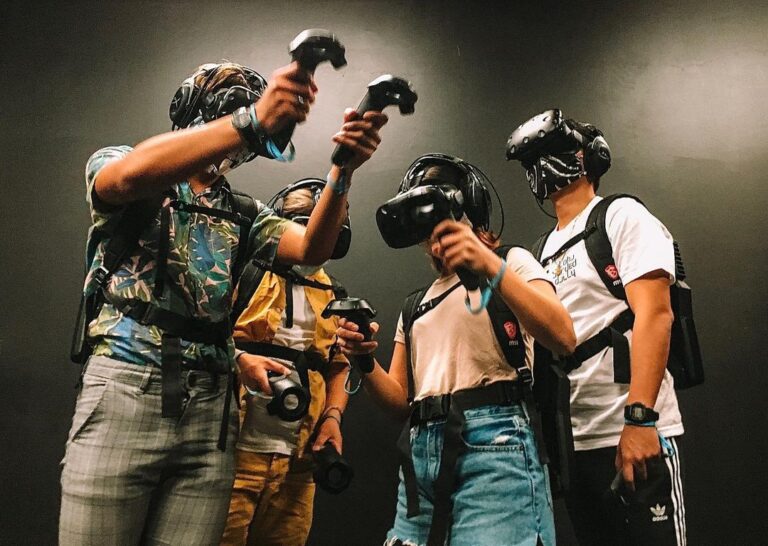
A free‑roam virtual‑reality (VR) arena is a purpose‑built physical space that lets users move unhindered while immersed in a digital world. Unlike seated or tabletop setups, the arena is equipped with a network of external sensors, motion‑capture cameras, and sometimes tether‑free head‑mounted displays (HMDs) that track a participant’s exact position, orientation, and gestures in real time. The result is a seamless blend of the real and the virtual: a user can walk, duck, sidestep, or even climb without fearing collision because the arena’s safety system—soft padding, ceiling‑mounted barriers, and automatic collision alerts—keeps the physical environment under control.
The core technology stack typically comprises:
Together these components create an immersive playground where the boundaries of the digital world are only limited by imagination, not by the size of a living room or the length of a cable.
The versatility of free‑roam VR lends itself to an expanding catalogue of scenarios, each designed to exploit unrestricted movement. Some of the most popular categories include:
Players become heroes navigating sprawling fantasy realms—scaling castle walls, sprinting through enchanted forests, and dueling monsters in full‑body combat. The ability to physically dodge attacks adds a tactile layer of excitement that traditional screen‑based games cannot replicate.
From virtual basketball courts to futuristic hover‑board tracks, free‑roam arenas reproduce the kinetic demands of real sport. Participants can practice shooting form, refine footwork, or simply enjoy a high‑octane race without the logistical constraints of a physical field.
Co‑operative challenges require groups to manipulate oversized virtual objects, solve spatial riddles, or coordinate synchronized actions. The physical proximity encourages natural communication and builds camaraderie.
Students can explore a reconstructed ancient city, walk inside a human heart, or conduct a chemistry experiment in a zero‑gravity lab. The kinetic involvement reinforces learning by converting abstract concepts into embodied experiences.
Interactive dramas let participants inhabit a character’s perspective, making choices that alter the plot’s direction. The freedom to physically walk through story scenes deepens emotional engagement and makes each session feel uniquely personal.
These scenarios illustrate how free‑roam VR transcends entertainment, merging physical activity with digital storytelling to create experiences that feel both thrilling and meaningful.
The demographic profile of free‑roam VR users is surprisingly broad, reflecting the technology’s adaptability across age groups, skill levels, and interests.
Overall, the arena’s appeal lies in its capacity to transform passive spectators into active participants, a shift that resonates with anyone looking for a more embodied form of entertainment or learning.
Designing a child‑friendly free‑roam VR experience requires a balance between safety, accessibility, and imaginative content. Operators typically adopt several strategies:
Parents appreciate these tailored environments because they combine excitement with peace of mind. Moreover, the physical activity inherent in free‑roam VR helps combat sedentary screen time, offering a healthier alternative to traditional video games.
When it comes to celebrations and corporate gatherings, free‑roam VR functions as both a centerpiece attraction and a versatile venue enhancer.
A birthday celebration can be transformed into an unforgettable adventure by selecting a themed scenario—pirate treasure hunts, superhero training camps, or interstellar rescue missions. Birthday children often receive a custom avatar, and the session can be timed to fit the party schedule, with a “photo‑capture” moment at the end where participants’ in‑game poses are printed as souvenirs.
Graduation ceremonies benefit from the arena’s capacity to host large groups while offering individualized experiences. Schools may organize a “Future‑Career Quest,” where graduates explore simulated workplaces—labs, studios, or field sites—mirroring potential career paths. The immersive format creates a shared memory that distinguishes the rite of passage from conventional cap‑and‑gown events.
For corporate events, free‑roam VR serves multiple purposes:
By integrating free‑roam VR into these occasions, organizers inject a futuristic, high‑energy element that elevates the overall guest experience and leaves a lasting impression.
The academic and professional communities are increasingly attentive to the implications of free‑roam VR, both as a research tool and as a catalyst for emerging markets.
Human‑Computer Interaction (HCI) Researchers note that unrestricted physical movement bridges the gap between digital input and proprioceptive feedback, yielding richer data on how users perceive virtual environments. Studies show that presence—the feeling of “being there”—is significantly heightened in free‑roam setups compared to seated experiences, which can improve the validity of behavioral experiments.
Neuroscientists are exploring the technology’s potential for cognitive rehabilitation. The immersive, multi‑sensory nature of free‑roam VR stimulates neural pathways associated with spatial memory and motor planning, offering a controlled yet dynamic platform for patients recovering from stroke or traumatic brain injury.
Ergonomics Specialists highlight the necessity of designing interactions that avoid overexertion. While the physicality of the arena promotes active play, prolonged sessions can lead to fatigue. Experts recommend session lengths of 10‑15 minutes interspersed with rest periods, and advocate for adaptive difficulty scaling based on real‑time biometric monitoring.
Industry Analysts see free‑roam VR as a growth engine for the experiential economy. Market forecasts predict a compound annual growth rate exceeding 30 % for location‑based VR venues over the next five years, driven by demand for novel entertainment, corporate training, and educational experiences. The technology’s modular nature allows operators to repurpose arenas for different use cases, maximizing return on investment.
Ethicists caution that immersive environments can blur reality boundaries, especially for younger users. They stress the importance of transparent consent processes, age‑appropriate content filters, and post‑session debriefings to help participants re‑orient to the physical world.
Overall, the consensus among scientists and experts is that free‑roam VR offers a powerful, multidimensional platform that can enhance learning, health, and social interaction—provided that design, safety, and ethical considerations remain at the forefront of development.
Free‑roam VR arenas embody a convergence of cutting‑edge tracking technology, immersive storytelling, and physical interaction. By freeing users from the constraints of chairs and cables, they unlock a spectrum of scenarios—from high‑octane adventure games and sports simulations to educational expeditions and corporate workshops. The audience is equally diverse, spanning casual gamers, fitness buffs, students, therapists, and celebrants.
For children, specially tailored experiences provide safe, engaging pathways to exploration and learning. For parties and graduations, the arena becomes a dynamic stage that transforms ordinary gatherings into unforgettable journeys. Meanwhile, scientists and industry leaders recognize free‑roam VR as a fertile ground for research, therapeutic innovation, and commercial expansion—while also emphasizing the need for responsible design.
As the technology continues to mature, the line between the virtual and the tangible will grow ever thinner, inviting anyone who steps into an arena to become an active participant in worlds limited only by imagination. The next evolution of entertainment, education, and collaboration may well be measured in steps taken, doors opened, and horizons expanded—one freely‑roaming stride at a time.


 550 Halekauwila St Unit #201, Honolulu, HI 96813, United States