
 El Monte
 Log in
Log in
Log in

Sorry. We don’t know any vr locations in this city yet
Virtual reality (VR) offers a totally immersive experience, allowing you to explore and interact with imaginary worlds. While the technology has been around for years, it has recently become much more accessible, and is now finding its way into the gaming industry.
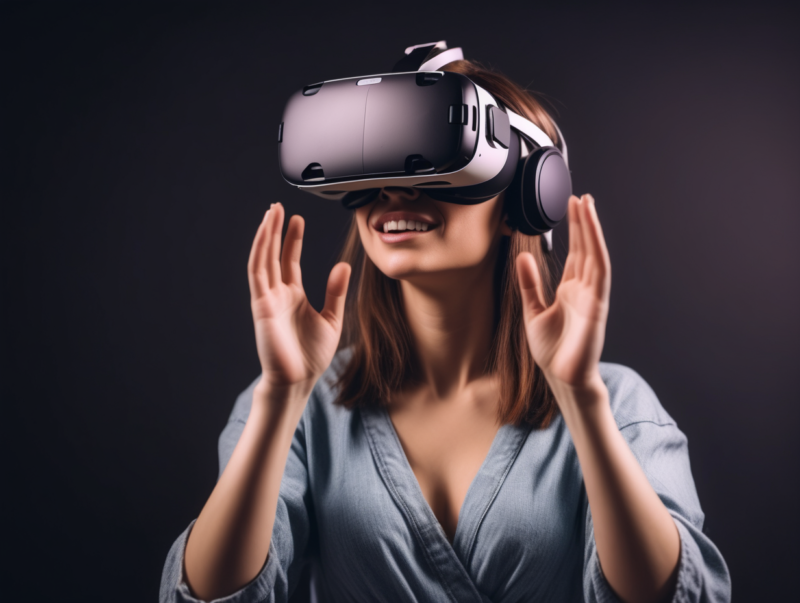
Unlike the cramped, headset‑only experiences that most people associate with virtual reality, a free‑roam VR arena is a purpose‑built space where participants can move unhindered while the digital world follows them. The arena is fitted with an array of external sensors—often a combination of infrared cameras, lidar scanners, or ultra‑wide‑angle depth cameras—strategically positioned around the perimeter. These devices track every participant’s headset, handheld controllers, and sometimes even full‑body motion suits in real time, translating physical movement into a seamless virtual environment.
The hallmark of a free‑roam arena is its “six‑degrees‑of‑freedom” (6‑DoF) capability at a scale that rivals a miniature theme park. Users can walk, duck, jump, and even climb a ladder while remaining fully immersed, because the virtual scene updates instantaneously to reflect their location and orientation. The physical safety net is provided by soft padding, padded walls, and clearly marked boundaries that are also rendered virtually, preventing collisions with real‑world obstacles. In short, a free‑roam arena transforms a room into a portal where the boundaries of the physical and digital blur, allowing a level of bodily interaction that stationary VR setups cannot match.
Free‑roam technology lends itself to a surprisingly diverse range of scenarios, each tailored to exploit the freedom of movement the arena offers.
Adventure Quests – Participants become explorers navigating ancient ruins, alien planets, or mythic forests. The arena’s size lets designers place towering structures, hidden chambers, and dynamic puzzles that require actual walking, climbing, or ducking to solve.
Sports Simulations – From virtual soccer fields to futuristic obstacle courses, athletes can hone real‑world skills in a safe, repeatable environment. Motion capture data can be fed back to coaches for performance analysis, turning the arena into a high‑tech training lab.
Collaborative Storytelling – Small groups can co‑author a narrative, each assuming a role—wizard, detective, engineer—while physically moving through a shared storyline. The arena’s spatial audio and haptic feedback make the story feel alive, encouraging improvisation and teamwork.
Educational Field Trips – Students can “walk” through a reconstructed dinosaur habitat, explore the anatomy of a human heart at a giant scale, or travel to the International Space Station without leaving the classroom. The tactile element—reaching out to touch a virtual object—strengthens retention compared with 2‑D video lessons.
Corporate Simulations – Safety drills, emergency response training, or product design reviews can be enacted in a risk‑free setting. Engineers can walk around a virtual prototype, interact with moving parts, and instantly assess ergonomics.
Each scenario leverages the arena’s capacity for large‑scale locomotion, turning the simple act of walking into a powerful narrative or learning tool.
The audience for free‑roam experiences is as varied as the scenarios themselves.
Gaming Enthusiasts – Hardcore gamers, accustomed to fast‑paced, high‑definition titles, gravitate toward the immersive, physically demanding adventures that free‑roam arenas provide. The novelty of moving a full body through a virtual battlefield attracts both seasoned players and newcomers seeking a “real‑life” gaming experience.
Families and Children – For families, the arena offers a safe, supervised playground where kids can expend energy while engaging their imagination. Parents appreciate the controlled environment; the physical boundaries and padded surfaces eliminate many of the hazards associated with traditional playgrounds.
Educators and Students – Schools and universities use free‑roam arenas as extensions of the lab. Science teachers can demonstrate concepts like electromagnetism or planetary motion in ways that static textbooks cannot, while art students can sculpt massive 3‑D installations that they walk around and view from every angle.
Corporate Teams – Team‑building facilitators book arenas for problem‑solving challenges that require coordination, communication, and trust. The physicality of the experience forces participants out of their comfort zones, leading to more memorable lessons in collaboration.
Researchers and Developers – Scientists studying human perception, ergonomics, or spatial cognition frequently use free‑roam arenas to collect high‑resolution motion data. Game developers and hardware manufacturers also use the space for testing new interaction paradigms, from haptic gloves to full‑body suit feedback.
The common denominator across all these groups is a desire for an experience that blends physical activity with digital storytelling—a hybrid that the free‑roam arena uniquely delivers.
When it comes to children, the appeal of free‑roam VR goes beyond sheer entertainment. The embodied interaction encourages kinesthetic learning, a style in which children grasp concepts best when they can move and manipulate objects physically. In a free‑roam setting, a child can explore a virtual coral reef, reach out to “touch” a fish, and hear a gentle chime that confirms the interaction. This multisensory feedback reinforces curiosity and builds a bridge between abstract ideas and concrete understanding.
Safety is paramount. Most kids‑focused arenas enforce strict age limits, require adult supervision, and provide lightweight headsets designed for smaller heads. The physical padding and clear visual boundaries mitigate the risk of accidental collisions, while session lengths are typically limited to prevent fatigue. Parents also appreciate the social dimension: a group of friends can collaborate on a treasure‑hunt adventure, fostering teamwork and communication skills that translate to the real world.
Because the hardware is robust and the environment is controlled, free‑roam VR can be an inclusive platform for children with diverse abilities. Adaptive controllers, wheelchair‑compatible pathways, and customizable visual settings make it possible for kids with mobility or sensory challenges to participate alongside their peers, turning the arena into a truly universal play space.
The versatility of a free‑roam arena makes it an attractive venue for celebrations that want to stand out from the usual cake‑and‑balloon routine.
Birthday Parties – Imagine a child’s six‑year‑old birthday where the guests are invited to become “space cadets” on a mission to rescue a stranded alien. The arena can be themed on the fly, swapping a medieval castle for a neon‑lit cyber‑city within minutes. Party packages often include a dedicated game master, catering options, and photo‑capture stations that overlay avatars onto the live footage, giving families a digital souvenir.
Graduation Events – For high school seniors or university graduates, a free‑roam celebration can symbolize the transition from structured learning to boundless possibility. A graduation theme might involve navigating a virtual maze of future careers, each corridor representing a different industry. Participants walk through their chosen path, collect “skill tokens,” and emerge with a personalized digital badge that can be shared on social media. The physical act of moving through the arena mirrors the journey of stepping into adulthood.
Corporate Parties and Team‑Building – Companies looking to reward employees or foster a culture of innovation can rent an arena for a night of immersive experiences. A corporate party may blend entertainment with subtle brand messaging: a virtual showroom where employees test new products, or a gamified “innovation sprint” where teams compete to design the most efficient virtual factory within a set timeframe. The high‑energy environment encourages networking, while the data collected on teamwork, decision‑making speed, and problem‑solving can be anonymized and analyzed for HR insights.
The key to success for any of these events is the arena’s ability to be customized on demand. Content developers can upload new worlds, tweak difficulty levels, and integrate branding elements in days rather than months, making the venue adaptable to any occasion.
From a research perspective, free‑roam VR is heralded as a breakthrough in embodied cognition studies. The technology provides an unprecedented level of spatial fidelity while maintaining the flexibility of a virtual environment. Researchers point out that traditional seated VR limits natural locomotion cues, which can affect balance, proprioception, and even memory formation. By allowing participants to walk freely, the arena restores vestibular feedback, resulting in more ecologically valid data.
In the field of ergonomics, engineers use free‑roam arenas to prototype workspaces before any physical construction begins. A factory floor layout can be mirrored virtually; workers can walk through the simulated environment, test reach distances, and adjust machinery placement in real time. The iterative process cuts down on costly redesigns and reduces the time required to bring a product from concept to market.
Healthcare professionals also see promise. Physical therapists are experimenting with therapeutic “games” that motivate patients to perform rehabilitation exercises in a fun, immersive context. The arena’s sensors capture precise joint angles and movement patterns, allowing clinicians to monitor progress quantitatively while patients remain engaged.
Industry analysts note that the commercial viability of free‑roam VR hinges on three trends: decreasing cost of high‑resolution tracking hardware, the rise of content‑as‑a‑service platforms, and growing consumer appetite for experiential entertainment. As sensor prices fall and software development kits become more accessible, smaller operators can launch pop‑up arenas in malls or festivals, expanding the market beyond dedicated flagship locations.
Critics, however, caution against over‑promising. They argue that the novelty may wear off if content pipelines cannot keep pace with the rapid turnover of themes demanded by event planners and educators. Moreover, the physical space requirements limit scalability in densely populated urban areas where real estate is premium. To address these concerns, experts advocate for hybrid models—combining free‑roam sections with stationary VR pods—to maximize utilization of limited floor plans.
Looking ahead, the trajectory of free‑roam VR points toward tighter integration with emerging technologies. Advances in lightweight, high‑fidelity headsets will reduce user fatigue, allowing longer sessions without compromising immersion. Haptic suits that deliver localized pressure, temperature, and even texture sensations will deepen the sense of presence, turning a simple virtual wall into a feeling of resistance or softness.
Artificial intelligence will play a dual role: on the one hand, AI‑driven procedural generation will enable venues to create endlessly varied worlds on the fly, keeping repeat visitors engaged. On the other hand, machine‑learning models will analyze player motion data to adapt difficulty levels in real time, ensuring each participant experiences a personalized challenge that matches their skill set.
Finally, the convergence of free‑roam VR with the metaverse concept could redefine social interaction. Shared, persistent virtual spaces that map onto physical arenas would let people from different locations join a single experience, each occupying a different physical space yet seeing each other’s avatars in a unified world. Such a hybrid reality would blur the line between remote collaboration and co‑located play, unlocking new possibilities for global education, multinational corporate training, and cross‑border entertainment.
A free‑roam VR arena is more than a high‑tech playground; it is a versatile platform where motion, perception, and narrative intertwine. Its capacity to accommodate diverse scenarios—from epic quests and sports simulations to educational expeditions and corporate challenges—makes it a compelling venue for a wide spectrum of users. Children benefit from kinesthetic learning in a safe, inclusive setting, while adults find fresh avenues for celebration, team building, and professional development. Scientists value the arena as a laboratory for studying embodied cognition, ergonomics, and rehabilitation, and industry experts see it as a growth engine powered by falling hardware costs and rising demand for immersive experiences.
As technology continues to shrink the gap between the physical and the virtual, free‑roam VR arenas will likely become a familiar backdrop in urban leisure districts, university campuses, and corporate campuses alike. Whether they host a birthday quest, a graduate’s rite of passage, or a breakthrough research study, these spaces demonstrate that the future of virtual reality is not confined to a chair—it is a room where imagination can finally run free.


