
 El Monte
 Log in
Log in
Log in

VR Arcade USA is located in the Garden of the Gods Plaza shopping center in Colorado Springs, CO, behind Jimmy John’s.
The club offers a free-roam virtual reality experience where players walk, dodge, and explore digital worlds using Quest 3 headsets and Katwalk C2 treadmills. The game library includes VR escape rooms (House of Fear, Mission Sigma, Sanctum, and more), VR laser tag, boxing, racing sims, mini-golf, bowling, and hundreds of other titles. Guests can choose between the Featured Experience (a rotating cinematic group adventure), Free Play (full library access), or combine both for The Ultimate Experience. Every admission includes an appetizer and beverage.
The venue is built for birthday parties, corporate team-building events, and group celebrations. Spectators are welcome with their own admission and can watch the action on screen. The staff is known for being friendly and helpful with first-timers and large groups alike. A lounge area allows guests to eat, relax, and socialize before and after gameplay. The club operates by reservation only and is suitable for ages 6 and up.
 Indoors
Level Up Virtual Reality is located in Colorado Springs, Colorado, just off Garden of the Gods Road.
The club specializes in free-roam VR gaming where players physically move through a dedicated arena for cooperative shooters, competitive battles, and VR laser tag, plus a separate zone with 12 virtual reality escape rooms, racing simulators, and a Kat VR treadmill. Up to eight players can play together in the free-roam space, and the entire arcade with 14 headsets can be booked privately for groups.
Beyond the games, the venue offers a lounge area, optional food and beverage packages for parties, mobile VR services that bring equipment to your location, military and group discounts, and free on-site parking. It is family-owned and suited for birthdays, corporate team building, bachelor parties, and youth group outings. Walk-ins are welcome on weekends, and appointments are available throughout the week.
Indoors
Virtual reality, or VR, is quickly becoming one of the most popular forms of entertainment in the world. In Colorado Springs, CO, citizens can experience this cutting-edge technology in VR arenas. These high-tech arenas offer a variety of exciting and immersive VR experiences for all ages.
VR arenas are popping up all over the United States, and Colorado Springs is no exception. At these arenas, participants can enjoy virtual reality walking, shooting, and racing games in a completely immersive environment that encourages physical activity and social interaction. You don’t just watch a show here, you are part of the show! Plus, you can challenge yourself and your friends to compete in tournaments or try out free-play games.
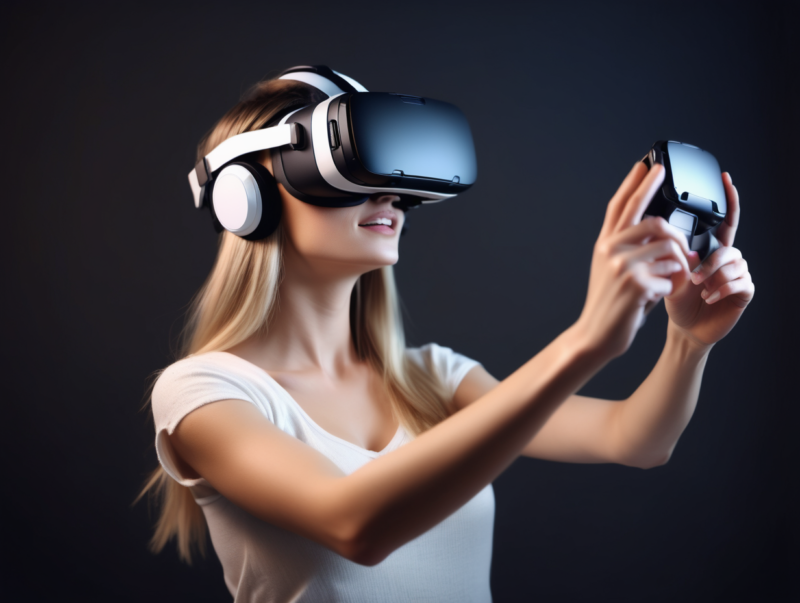
A free‑roam virtual‑reality (VR) arena is a purpose‑built physical space where users can move unrestricted while wearing a headset that tracks their position in three dimensions. Unlike seated or standing “tethered” experiences that confine the player to a limited play area, a free‑roam arena blends the freedom of real‑world locomotion with the immersive storytelling of VR. The technology stack typically comprises:
Because the arena can be scaled from a modest 400‑square‑foot room to a multi‑room warehouse, developers can design experiences that range from intimate puzzle rooms to sprawling, multi‑stage adventures. The result is a hybrid playground where the physical body is the controller, and the virtual world reacts instantly to every stride.
The versatility of a free‑roam arena opens the door to a spectrum of scenarios that would be impossible—or at least highly impractical—in a conventional living‑room setup.
Story‑driven games place participants at the centre of a plot, letting them explore haunted mansions, alien outposts, or fantasy kingdoms. The physical layout of the arena mirrors the virtual geography, so a narrow hallway in the game is an actual corridor that the player must navigate. This tactile alignment deepens immersion, turning each gasp and footstep into a narrative beat.
From futuristic sword duels to zero‑gravity basketball, free‑roam arenas support fast‑paced, multiplayer competition. Because every player is tracked independently, the system can enforce team boundaries, instant respawns, and real‑time score overlays that appear on a shared screen for spectators.
Industrial, medical, and emergency‑response organisations use free‑roam VR to rehearse high‑risk procedures. A fire‑fighting drill might simulate smoke, heat, and collapsing structures, while trainees physically move around the arena, practising evacuation routes and equipment handling under realistic stressors.
Some venues offer “sandbox” modes where users can sculpt virtual objects, paint in three dimensions, or build collaborative structures. The physical freedom to walk around a creation from any angle encourages a more intuitive sense of scale and proportion.
History classes can step onto a reconstructed Roman forum, biology lessons can explore a giant, magnified cell, and geography students can virtually hike a volcanic ridge—all while standing in a safe, controlled environment.
These scenarios illustrate why free‑roam VR has quickly become a go‑to platform for experiences that demand both mental engagement and physical movement.
The user base for free‑roam VR is remarkably broad, reflecting the medium’s capacity to cater to disparate interests and age groups.
People who enjoy arcade‑style entertainment often visit free‑roam venues for a quick burst of adrenaline. The novelty of moving freely while battling virtual foes draws crowds who might otherwise shy away from traditional headset setups because of motion sickness or space constraints at home.
Parents looking for a shared activity that involves the whole family find free‑roam arenas appealing. The environments are designed with safety zones and adjustable difficulty levels, making it easy for grandparents, parents, and children to play together without the need for separate equipment.
Team‑building exercises leverage the collaborative nature of free‑roam VR. Companies book sessions for problem‑solving challenges, escape‑room style missions, or simulated project management scenarios that require communication, leadership, and trust.
Schools incorporate free‑roam VR into curricula to bring abstract concepts to life. The tactile interaction helps students retain information better than textbook diagrams alone.
Pilots, surgeons, firefighters, and military personnel use free‑roam arenas for high‑fidelity simulation. The capability to replicate dangerous or expensive environments in a safe setting accelerates skill acquisition while reducing risk.
Overall, the demographic mix underscores that free‑roam VR is not a niche hobby; it is a versatile platform that meets the recreational, educational, and professional needs of a wide audience.
When the audience is children, developers and venue operators must prioritize two key factors: safety and age‑appropriate content.
All arenas enforce strict height‑based barriers, floor padding, and invisible “no‑go” zones that trigger an automatic pause if a child approaches a wall too quickly. Staff are trained to monitor each session, ensuring that helmets or soft‑headgear are worn when necessary.
Kid‑focused experiences tend to be bright, whimsical, and guided. Popular themes include:
The underlying philosophy is to harness the kinetic energy of children—who love to run, jump, and explore—while delivering educational or narrative value without overwhelming them with complex mechanics.
Free‑roam VR has become a sought‑after attraction for a range of celebratory occasions. Its ability to transform a plain hall into an immersive wonderland makes it a compelling addition to parties and ceremonies.
A birthday celebration can be turned into a “mission impossible” quest where the birthday child leads a squad of friends through a series of escalating challenges. Customizable avatars, personalized victory screens, and souvenir video clips of the event give the party a memorable, shareable dimension.
Universities and high schools use free‑roam VR to stage symbolic journeys—such as crossing a virtual bridge from student life to professional horizons. Graduates can walk together in a shared virtual landscape that reflects their field of study, turning a conventional ceremony into an experiential milestone.
Companies often integrate brand messaging directly into the VR narrative. A tech firm unveiling a new gadget might create a scenario where participants test the device’s capabilities in a futuristic setting, blending entertainment with product education. Corporate parties also benefit from the team‑building aspect: collaborative puzzles encourage employees to interact beyond the usual office environment.
Because the experience can be tailored to any theme, the ROI for event planners lies not only in the novelty factor but also in the built‑in promotional content—videos captured during the session can be repurposed for social media, internal communications, or marketing collateral.
The academic and professional communities have taken a keen interest in free‑roam VR, recognizing its potential to advance research, training, and human‑computer interaction.
Neuroscientists study how unrestricted movement influences presence and memory retention. Early findings suggest that free‑roam experiences generate higher levels of spatial awareness and lower incidences of motion‑induced nausea compared with stationary VR, because the vestibular system receives congruent proprioceptive feedback.
Industrial ergonomists evaluate how free‑roam setups can be optimized for safety and comfort. Recommendations include adjustable tracking heights to accommodate users of varying stature, and dynamic lighting that mimics real‑world conditions without causing visual strain.
A series of controlled experiments in medical schools demonstrated that residents who rehearsed surgical procedures in a free‑roam VR lab performed better in the operating room, measured by reduced error rates and shorter procedure times. The authors attribute this to the embodied practice—trainees physically manipulate instruments in a space that mirrors the actual OR layout.
Industry analysts forecast a compound annual growth rate of roughly 28 % for the free‑roam segment over the next five years. Drivers include the decreasing cost of high‑resolution wireless headsets, the rollout of 5G networks that enable low‑latency streaming, and rising consumer demand for experiential entertainment that blends physical activity with digital storytelling.
Experts also caution about data privacy, as free‑roam systems capture detailed motion profiles and biometric cues. Transparent consent mechanisms and secure storage protocols are recommended to protect users, especially minors, from inadvertent data exploitation.
Collectively, these perspectives highlight that free‑roam VR is not merely a novelty but a rapidly maturing technology poised to impact multiple sectors.
Free‑roam VR arenas represent a convergence of physical freedom and digital immersion that reshapes how people play, learn, and work. From narrative adventures that make every hallway a story element, to training simulations that bring hazardous scenarios into a safe space, the technology offers a versatile canvas for creators and users alike. Its broad appeal spans casual gamers, families, corporate teams, educators, and professionals, with specialized adaptations for children and celebratory events.
Scientific inquiry validates the medium’s benefits for cognition, safety, and skill acquisition, while industry forecasts point to robust growth. As wireless headsets become more affordable and tracking systems more precise, free‑roam VR is set to move from niche entertainment hubs into mainstream venues—universities, hospitals, corporate campuses, and community centres.
The era of “standing still while traveling far” is giving way to “moving freely while exploring worlds beyond.” In the years ahead, free‑roam VR arenas will likely become as commonplace as gyms or movie theatres, inviting anyone who steps inside to walk, run, and discover new possibilities in the limitless landscape of virtual reality.


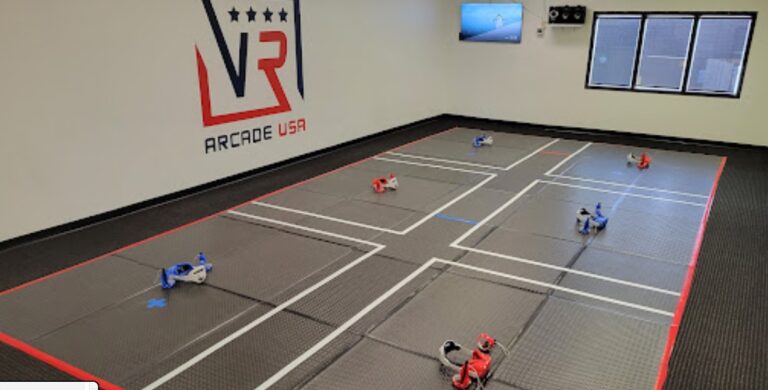
 1025 Garden of the Gods Rd suite d, Colorado Springs, CO 80907, United States
