El Monte
 Log in
Log in
Log in

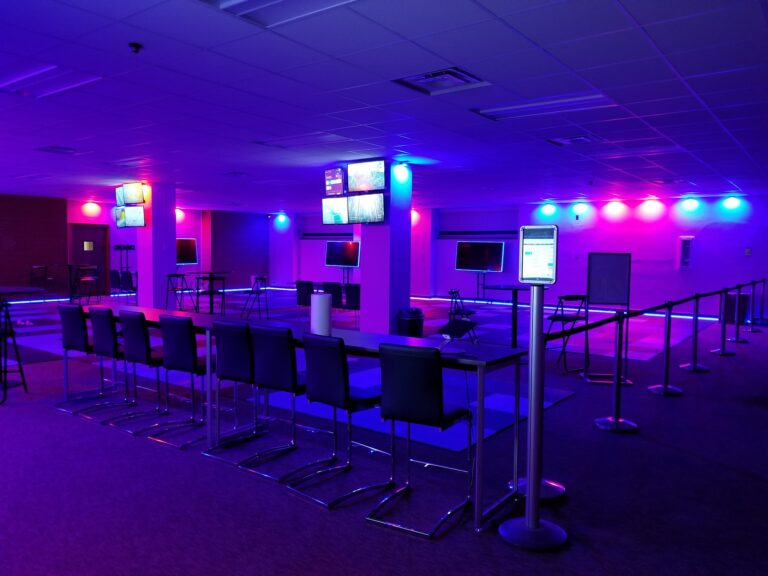
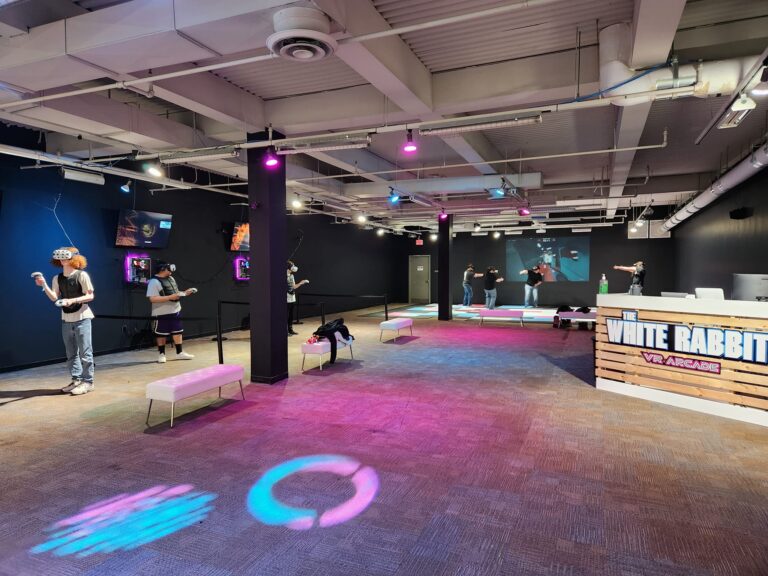
The White Rabbit Virtual Reality Indoor Arcade is located in Des Moines, IA.
The White Rabbit Virtual Reality Arcade is located in Des Moines, IA and provides a unique experience for gamers and technology enthusiasts alike. Visitors can step into a virtual world with the help of state-of-the-art equipment and immersive headsets to engage in thrilling gameplay. The facility offers various games and experiences, such as shooting games, racing games, and escape rooms. With affordable prices and friendly staff, the White Rabbit Virtual Reality Arcade is a must-visit destination for those seeking a thrilling gaming experience.
 Indoors
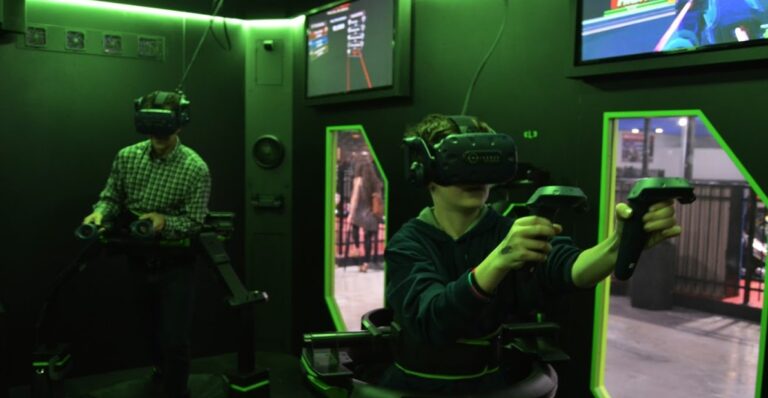
RezBlue VR Indoor Arena is located in Des Moines, IA.
RezBlue VR Arena is a cutting-edge virtual reality gaming hub located in Des Moines, Iowa. Offering a wide range of exciting VR experiences, including multiplayer games and individual challenges, this arena is the perfect spot for both casual and avid gamers alike. With state-of-the-art equipment, immersive sound, and a friendly environment, RezBlue VR Arena delivers an unparalleled interactive gaming experience for players of all ages and skill levels. Whether you’re looking for a fun activity with friends or a unique solo adventure, RezBlue VR Arena is the ultimate destination for virtual reality gaming in Des Moines.
IndoorsOmniverse Virtual Reality Indoor Arena is located in Des Moines, IA.
Omniverse Virtual Reality is an innovative entertainment company located in Des Moines, IA, that provides guests with an immersive virtual reality experience like no other. With a wide range of virtual reality games and experiences, visitors can choose from adrenaline-pumping adventures to relaxing virtual retreats, all while being transported to another realm. The company also offers private and corporate events, making it the perfect destination for team building activities, parties, and other group gatherings. Omniverse Virtual Reality is the ultimate destination for anyone looking to experience the exciting world of virtual reality.
Indoors
A free‑roam virtual‑reality arena is a purpose‑built space where users can move unhindered while wearing a head‑mounted display (HMD) and, in many cases, wireless tracking equipment. Unlike seated or room‑scale setups that limit motion to a few meters, a free‑roam arena spans tens of meters, often covering an entire warehouse, gymnasium, or specially constructed hall. The environment is fitted with an array of infrared cameras, lidar sensors, or ultra‑wide‑band (UWB) beacons that continuously locate each headset and any handheld controllers with sub‑centimetre accuracy.
The core idea is simple: give participants the freedom to walk, run, jump, and physically interact with virtual objects as if they were really there. The digital world is rendered in real time on the headset, while the physical floor is cleared of obstacles, sometimes padded, and often equipped with “haptic walls” or floor projections that guide movement. Because the system tracks the player’s position in three‑dimensional space, designers can create sprawling landscapes, obstacle courses, or narrative adventures that would be impossible in a traditional gaming room.
The versatility of a free‑roam arena opens the door to a wide range of scenarios, each exploiting the unique blend of physical motion and immersive graphics.
| Scenario Type | Typical Experience | Key Design Elements |
|---|---|---|
| Adventure Quests | Players embark on a treasure‑hunt, solving puzzles scattered across a virtual ancient temple. | Branching pathways, interactive props, timed challenges. |
| Sports Simulations | A virtual soccer field or basketball court where players actually run, dribble, and shoot. | Accurate physics, real‑world sized equipment, multi‑player sync. |
| Escape Rooms | Teams must locate clues, manipulate virtual locks, and collaborate to “break out” before time expires. | Narrative tension, hidden triggers, progressive difficulty. |
| Training Simulations | Firefighters practice navigating a burning building; surgeons rehearse a complex operation. | Realistic hazard cues, haptic feedback, performance analytics. |
| Creative Playgrounds | Children paint giant 3D murals with virtual brushes that leave glowing trails on the floor. | Open‑ended tools, low‑stress pacing, vibrant colour palettes. |
| Live Performances | Audiences don headsets and become part of a concert’s visual narrative, moving through dynamic light shows. | Synchronised audio‑visual cues, crowd‑scale tracking, spectacle lighting. |
Designers blend these concepts, often layering narrative storytelling on top of a sports‑style challenge, to keep participants engaged from the first step to the final victory. Because the arena captures each participant’s exact location, developers can program the virtual world to react uniquely to every individual—opening doors only for one player, or spawning a virtual companion that follows a specific person’s path.
Free‑roam VR has quickly become a cross‑generational pastime. The following groups dominate the user base:
Casual Gamers and Families – Parents seeking a fresh, active alternative to screen‑bound gaming often bring their children to arenas for a “digital playground” that burns calories while delivering excitement.
Esports Enthusiasts – Competitive teams now train in free‑roam arenas for titles that require full‑body movement, such as “VR Combat League” or “Hyperdash”. The physical element adds a new strategic layer, prompting coaches to develop stamina‑based tactics.
Corporate Teams – Companies book sessions for team‑building exercises, leveraging the collaborative problem‑solving that escape‑room‑style scenarios foster. The shared physical experience builds trust in a way that traditional video calls cannot.
Educational Institutions – Schools and universities incorporate free‑roam VR into curricula ranging from physics (visualising forces in a virtual lab) to history (walking through a recreated ancient city).
Therapeutic Practitioners – Physical therapists use the arenas for rehabilitation, allowing patients to perform guided movements in a low‑risk, highly motivating virtual environment.
Researchers and Scientists – The precise motion tracking and immersive fidelity make the arena a valuable tool for studying human perception, spatial awareness, and even neuro‑cognitive responses to virtual stimuli.
The common denominator across these demographics is the desire for embodied interaction—an experience that feels real because the body actually moves through space while the mind is transported elsewhere.
When it comes to younger audiences, free‑roam arenas offer a blend of safety, imagination, and physical activity that resonates with both parents and children.
Safety‑First Design – Floors are padded, walls are soft, and the tracking system can instantly stop a game if a player approaches a boundary. Some venues add “safety halos”—virtual visual cues projected onto the floor that turn red as a child nears the edge of the play area.
Age‑Appropriate Content – Game worlds are curated to avoid intense horror or excessive violence. Popular themes include dinosaur expeditions, underwater treasure hunts, and magical forest quests. The narratives are short (10‑15 minutes) to match typical attention spans.
Learning Integration – Simple math puzzles appear as magical runes that must be solved to unlock a gate; spelling challenges appear as glowing letters that need to be arranged correctly. This covert educational layer helps parents justify the cost as an investment in learning.
Social Play – Sessions often accommodate groups of 4‑6 children, encouraging teamwork. Because the arena tracks each player individually, it can display personalized avatars and assign unique roles (e.g., “leader”, “engineer”, “scout”), fostering cooperation without the need for verbal coordination.
Physical Benefits – Studies from community health programs indicate that a 30‑minute free‑roam session can burn as many calories as a light jog, while also improving balance and coordination. For children who spend most of their day seated, these sessions serve as a vital outlet for kinetic energy.
Overall, free‑roam VR provides a controlled yet expansive playground where kids can explore, learn, and stay active—all under the watchful eye of trained staff.
The adaptability of a free‑roam arena makes it an attractive venue for milestone celebrations and corporate gatherings alike.
Parents can customize a birthday adventure to match the child’s interests. A typical package includes a 45‑minute themed quest, a brief tutorial, and a post‑game photo booth where participants capture their avatar poses. The arena staff can also incorporate a “cake countdown”—a virtual timer that ends the game with a fireworks display and a real cake delivery.
Some universities are experimenting with VR graduations that let graduates “walk” across a virtual campus, collect digital diplomas, and pose for a holographic group photo. The experience is broadcast live to families who watch via streamed headsets, creating a shared sense of presence despite geographic distance.
Companies use free‑roam sessions to break the monotony of boardrooms. A popular format is the “Mission Impossible” scenario: small teams must infiltrate a virtual facility, avoid laser grids, and retrieve a data core—all while communicating through headsets. The physical exertion combined with problem‑solving provides measurable improvements in morale, as post‑event surveys consistently report higher satisfaction scores compared to traditional cocktail receptions.
Furthermore, data analytics built into the arena software can generate performance dashboards—showing how many puzzles each team solved, average completion times, and levels of collaboration. These metrics become valuable conversation starters during debriefings, turning a fun activity into actionable insight for managers.
The scientific community treats free‑roam VR as more than a novelty; it is a research platform with rigorously quantifiable data.
Neuroscience – Researchers at leading neuro‑imaging labs use the arena to study spatial navigation in a controlled yet highly realistic setting. By synchronising headset data with EEG or fNIRS recordings, they can map brain activity associated with way‑finding, decision‑making, and embodiment.
Human‑Factors Engineering – Industry experts assess how people interact with virtual objects that have no physical mass. Findings have informed the design of haptic gloves and exoskeletons that simulate resistance, advancing the fidelity of virtual manipulation.
Psychology – Studies on presence and flow state leverage the arena’s ability to eliminate external distractions. Participants often report higher immersion scores than in seated VR, which translates into stronger emotional responses—information valuable for therapeutic and entertainment applications alike.
Robotics and AI – The arena’s tracking infrastructure provides a high‑resolution map of human motion that can be fed into machine‑learning models. These models teach autonomous agents (e.g., virtual NPCs) to predict human movement patterns, improving crowd simulation and safety protocols for real‑world environments such as warehouses or disaster zones.
Public Health – Epidemiologists have examined how free‑roam VR can encourage physical activity in sedentary populations. Early trials suggest a modest but statistically significant increase in weekly moderate‑to‑vigorous activity when participants engage in weekly sessions.
Overall, experts converge on a shared sentiment: free‑roam VR bridges the gap between the virtual and the physical, delivering a research‑grade platform that maintains ecological validity while preserving experimental control.
Free‑roam VR arenas have evolved from experimental labs into commercial destinations that welcome families, gamers, corporations, and scientists alike. Their defining feature—unrestricted physical movement inside a meticulously tracked virtual world—opens a spectrum of scenarios ranging from whimsical adventures for children to high‑stakes corporate challenges and rigorous scientific experiments.
The technology’s safety‑first design, adaptable content, and ability to generate actionable data have cemented its place in modern entertainment and research ecosystems. As sensor accuracy improves, haptic feedback becomes richer, and AI‑driven narrative engines mature, the next wave of free‑roam experiences will likely blur the line between reality and simulation even further.
For anyone seeking an activity that sparks imagination, encourages physical exertion, or provides a novel data collection environment, the free‑roam VR arena stands ready—offering a space where the only limit is the depth of one’s own curiosity.


 3800 Merle Hay Rd, Des Moines, IA 50310, United States