
 El Monte
 Log in
Log in
Log in

Dragon’s Lair Family Adventure Center is located in southwest Cedar Rapids, Iowa. The centerpiece is a 5,000-square-foot tactical laser tag arena using high-end Laserwar equipment, featuring over 15 different mission-based game modes like Domination, Capture the Flag, and unique in-house creations like Medic-Medic. Beyond laser tag, the venue offers four physical escape rooms, eight virtual reality escape experiences, professional Dungeons & Dragons sessions, Nerf Warz, and a weekly Family Game Night with over 120 board games.
The facility includes two private party rooms with video games and fridge space, making it a great fit for birthday parties and corporate team-building events. The venue also offers a variety of additional options including gift vouchers and pre-paid specials, with a focus on creating memorable group experiences for all ages.
 Indoors
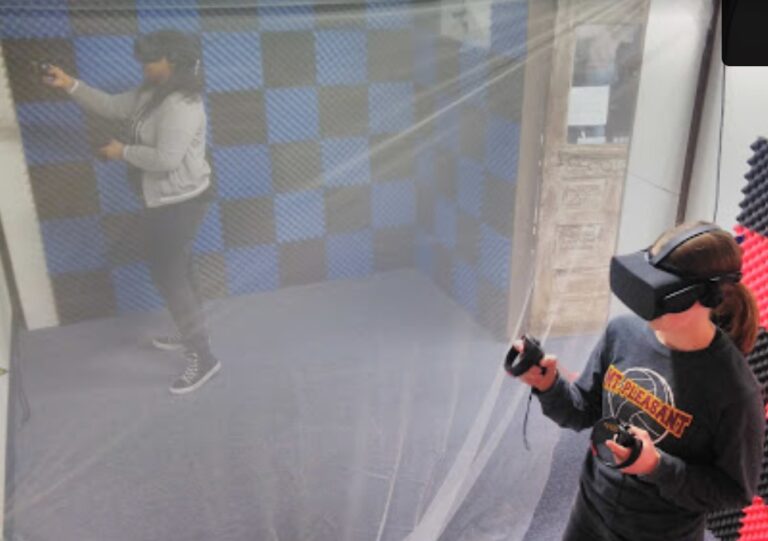
A free‑roam virtual‑reality arena is a purpose‑built physical space where participants can move unhindered while wearing a head‑mounted display (HMD) that tracks their position in real time. Unlike tabletop or seated VR experiences, the arena removes the constraints of a static play area and replaces them with a large, often open‑plan environment—typically 1,000 to 3,000 sq ft—lined with safety padding, motion‑capture sensors, and sometimes a grid of wireless charging stations for the headsets. The technology behind free‑roam VR blends optical tracking, inertial measurement units (IMUs), and sometimes lidar to create a seamless mapping of a participant’s movements to a digital world. In practice, a player can sprint, jump, duck, or even climb (within safe limits) while the virtual environment updates instantly, delivering a level of immersion that feels almost indistinguishable from reality.
The core appeal lies in the removal of the “play‑area bubble” that most consumer VR systems enforce. In a free‑roam arena, the only limits are the physical walls of the facility and the safety protocols established by staff. This freedom enables game designers to craft scenarios that rely on full‑body interaction, spatial puzzles, and kinetic storytelling—features that would be impossible in a living‑room setup.
Because the arena can accommodate unrestricted motion, developers have explored a diverse set of scenarios that exploit the three‑dimensional space:
| Scenario Type | Typical Gameplay Mechanics | Why It Works in Free‑Roam |
|---|---|---|
| Adventure Quest | Players follow a narrative, solving physical puzzles, climbing platforms, and engaging in melee combat with virtual foes. | The need to physically navigate terrain makes the experience feel like a live‑action role‑play. |
| Sci‑Fi Shooter | Fast‑paced gunplay with cover‑based tactics, requiring players to duck behind virtual walls and sprint across open fields. | Real‑world sprinting and dodging give a visceral intensity unmatched by seated shooters. |
| Co‑Op Escape Room | Teams collaborate to unlock doors, manipulate gigantic levers, and decode holographic clues spread across the arena. | The shared physical space encourages natural communication and teamwork. |
| Sports Simulation | Replicas of basketball, soccer, or futuristic hover‑ball where players use body gestures to pass, shoot, or block. | Full‑body motion translates directly into realistic athletic performance. |
| Educational Exploration | Immersive tours of historical sites, planetary surfaces, or microscopic environments where participants walk, point, and interact. | Walking through a reconstructed ancient city or a coral reef gives a kinesthetic learning dimension. |
Each scenario leverages the arena’s capacity for multi‑directional movement, spatial audio, and haptic feedback. Designers can populate the space with virtual objects that respond to touch, allowing players to feel the resistance of a virtual door or the impact of a virtual projectile. The result is an experience that feels less like “playing a game” and more like “living inside a story.”
Free‑roam VR appeals to a surprisingly broad demographic. Early adopters were predominantly tech‑savvy gamers seeking an upgrade from couch‑bound experiences, but the market has expanded to include:
Demographic data from several major venues show a fairly even split between teenagers (15‑19), young adults (20‑34), and older adults (35‑50). The common denominator is a desire for an experience that combines physical movement with cutting‑edge technology—a blend that traditional gaming, cinema, or sports alone cannot provide.
Children are a natural fit for free‑roam VR because the format encourages active play and imaginative exploration. Operators typically design kid‑friendly sessions with the following considerations:
Beyond pure entertainment, these experiences can reinforce educational goals. For example, a “Space Station Repair” mission teaches basic physics concepts as kids manipulate virtual tools to fix malfunctioning modules. The kinetic component helps develop gross motor skills, while the narrative fosters problem‑solving and teamwork.
When it comes to celebrations, free‑roam VR offers a fresh alternative to the usual cake‑and‑balloons routine. The versatility of the arena enables organizers to tailor the experience to the occasion:
A birthday session can be built around a themed adventure—pirates searching for treasure, wizards mastering spells, or racers navigating a neon‑lit circuit. Packages often include a dedicated party host, custom avatars with the celebrant’s name, and a post‑game photo montage that captures the highlights. Because the arena supports multiple participants simultaneously, friends can compete or cooperate, turning the party into a lively, shared story.
Graduation ceremonies benefit from the symbolic “crossing of thresholds.” An arena can simulate a campus tour where graduates walk through iconic virtual landmarks, receive digital diplomas, and partake in a final celebratory fireworks display that syncs with the real‑world lighting. The immersive element adds an unforgettable layer to an already momentous milestone.
Corporate celebrations—whether marking a fiscal quarter, a product launch, or an employee milestone—can leverage free‑roam VR for both entertainment and brand reinforcement. Custom scenarios can embed a company’s logo, product features, or corporate values within the gameplay. For example, a tech firm might design a “Data‑Center Defense” mission where teams protect virtual servers from cyber‑attacks, subtly echoing the company’s core business. After the event, analytics on team performance can be shared as a light‑hearted debrief, reinforcing camaraderie while showcasing the company’s innovative spirit.
In all cases, the arena’s flexibility allows the host to adjust difficulty levels, session duration, and narrative focus, ensuring that guests of varying ages and skill levels can participate comfortably.
The scientific community has taken a keen interest in free‑roam VR because it bridges the gap between laboratory‑controlled simulations and real‑world interaction. Researchers in fields ranging from neuroscience to human factors engineering point to several key advantages:
Industry analysts note that the hardware costs for a full‑scale arena—ranging from $250,000 to $500,000—remain a barrier for widespread adoption. However, economies of scale, modular arena designs, and the emergence of lighter, longer‑battery‑life headsets are expected to drive prices down over the next five years. Moreover, the expanding ecosystem of content creators, who are now able to publish free‑roam experiences through platforms such as Unity’s XR Toolkit, promises a richer library of scenarios that will attract new user segments.
In a recent conference panel, a consortium of university researchers and commercial VR studios emphasized the need for standardized safety protocols and data‑privacy frameworks. As the technology matures, regulations will likely require venues to log session data, ensure proper sanitization, and provide opt‑out options for biometric tracking. These measures aim to protect participants while preserving the scientific value of the data collected.
Free‑roam VR arenas have evolved from niche attractions into multi‑purpose venues that blend entertainment, education, and research. Their core strength—unrestricted physical movement within a digitally rendered world—opens doors to experiences that were once the domain of imagination alone. As hardware becomes lighter, tracking more precise, and content pipelines more robust, the line between virtual and physical play will continue to blur.
For families seeking a day of active fun, for organizations wanting to spark creativity and teamwork, and for scientists eager to explore the frontiers of embodied cognition, free‑roam VR offers a compelling solution. The technology is still relatively young, but the momentum is undeniable: every new arena, every fresh scenario, and every research study adds a layer to the growing narrative that virtual reality is not just something you watch—it’s something you live.



 5515 4th St Ct SW ste A, Cedar Rapids, IA 52404, United States